




Given, \[D\] is the midpoint of side \[BC\] of a \[\vartriangle ABC\] . \[AD\] is bisected at the point \[E\] and \[BE\] produces cuts \[AC\] at the point \[X\] . Prove that \[BE:EX = 3:1\] .
Answer
 Verified
557.4k+ views
Hint: To find the ratio \[BE:EX\] we will first construct \[DY\] parallel to \[BX\]. Then using the concept of similar triangles, we will prove the similarity of \[\vartriangle AEX\] and \[\vartriangle ADY\] and then similarity of \[\vartriangle BCX\] and \[\vartriangle DCY\]. Using the properties of similar triangles, we will find the ratio of different sides required and then using this we will find the ratio of \[BE:EX\].
Complete answer:
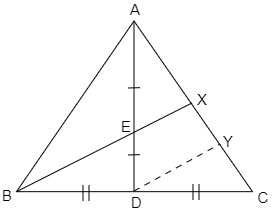
In \[\vartriangle AEX\] and \[\vartriangle ADY\], we have
\[\angle EAX = \angle DAY\] (Common)
\[\angle AXE = \angle AYD\] (By Corresponding angles)
Therefore, by angle-angle (\[AA\]) similarity
\[\vartriangle AEX \sim \vartriangle ADY\]
As when two triangles are similar, their corresponding sides are proportional.
From this we get in \[\vartriangle AEX\] and \[\vartriangle ADY\],
\[ \Rightarrow \dfrac{{EX}}{{DY}} = \dfrac{{AX}}{{AY}} = \dfrac{{AE}}{{AD}} - - - (1)\]
Since \[E\] is the midpoint of \[AD\], we can write
\[ \Rightarrow AE = ED\]
Now, as given
\[ \Rightarrow AD = AE + ED\]
Therefore, we can write
\[ \Rightarrow AD = AE + AE\]
On adding, we get
\[ \Rightarrow AD = 2AE\]
On rearranging,
\[ \Rightarrow \dfrac{{AE}}{{AD}} = \dfrac{1}{2} - - - (2)\]
Putting \[(2)\] in \[(1)\], we get
\[ \Rightarrow \dfrac{{EX}}{{DY}} = \dfrac{{AX}}{{AY}} = \dfrac{1}{2}\]
\[ \Rightarrow \dfrac{{EX}}{{DY}} = \dfrac{1}{2} - - - (3)\]
Now, in \[\vartriangle BCX\] and \[\vartriangle DCY\], we have
\[\angle BCX = \angle DCY\](Common)
\[\angle BXC = \angle DYC\] (By Corresponding angles)
Therefore, by angle-angle (\[AA\]) similarity
\[\vartriangle BCX \sim \vartriangle DCY\]
As when two triangles are similar, their corresponding sides are proportional.
From this we get in \[\vartriangle BCX\] and \[\vartriangle DCY\],
\[ \Rightarrow \dfrac{{BX}}{{DY}} = \dfrac{{CX}}{{CY}} = \dfrac{{BC}}{{DC}} - - - (4)\]
Since \[D\] is the midpoint of \[BC\]
\[ \Rightarrow BD = DC\]
Now, as given
\[ \Rightarrow BC = BD + DC\]
Therefore, we can write
\[ \Rightarrow BC = DC + DC\]
Adding right hand side, we get
\[ \Rightarrow BC = 2DC\]
On rearranging,
\[ \Rightarrow \dfrac{{BC}}{{DC}} = 2 - - - (5)\]
Putting \[(5)\] in \[(4)\], we get
\[ \Rightarrow \dfrac{{BX}}{{DY}} = \dfrac{{CX}}{{CY}} = 2\]
\[ \Rightarrow \dfrac{{BX}}{{DY}} = \dfrac{2}{1} - - - (6)\]
Dividing \[(6)\] by \[(3)\], we get
\[ \Rightarrow \dfrac{{\left( {\dfrac{{BX}}{{DY}}} \right)}}{{\left( {\dfrac{{EX}}{{DY}}} \right)}} = \dfrac{{\left( {\dfrac{2}{1}} \right)}}{{\left( {\dfrac{1}{2}} \right)}}\]
On solving,
\[ \Rightarrow \dfrac{{BX}}{{EX}} = \dfrac{4}{1}\]
On simplification,
\[ \Rightarrow BX = 4EX\]
As \[BX = BE + EX\], we can write the above equation as
\[ \Rightarrow BE + EX = 4EX\]
Taking \[EX\] from L.H.S. to R.H.S.
\[ \Rightarrow BE = 4EX - EX\]
\[ \Rightarrow BE = 3EX\]
On rearranging,
\[ \Rightarrow \dfrac{{BE}}{{EX}} = \dfrac{3}{1}\]
Hence, proved that \[BE:EX = 3:1\].
Note:
We have to find the ratio of \[BE:EX\], we are not interested in the exact value of \[BE\] and \[EX\]. Here we used the concept of similarity because it gives relation between ratios of different sides. As when two triangles are similar, their corresponding sides are proportional.
Complete answer:
In \[\vartriangle AEX\] and \[\vartriangle ADY\], we have
\[\angle EAX = \angle DAY\] (Common)
\[\angle AXE = \angle AYD\] (By Corresponding angles)
Therefore, by angle-angle (\[AA\]) similarity
\[\vartriangle AEX \sim \vartriangle ADY\]
As when two triangles are similar, their corresponding sides are proportional.
From this we get in \[\vartriangle AEX\] and \[\vartriangle ADY\],
\[ \Rightarrow \dfrac{{EX}}{{DY}} = \dfrac{{AX}}{{AY}} = \dfrac{{AE}}{{AD}} - - - (1)\]
Since \[E\] is the midpoint of \[AD\], we can write
\[ \Rightarrow AE = ED\]
Now, as given
\[ \Rightarrow AD = AE + ED\]
Therefore, we can write
\[ \Rightarrow AD = AE + AE\]
On adding, we get
\[ \Rightarrow AD = 2AE\]
On rearranging,
\[ \Rightarrow \dfrac{{AE}}{{AD}} = \dfrac{1}{2} - - - (2)\]
Putting \[(2)\] in \[(1)\], we get
\[ \Rightarrow \dfrac{{EX}}{{DY}} = \dfrac{{AX}}{{AY}} = \dfrac{1}{2}\]
\[ \Rightarrow \dfrac{{EX}}{{DY}} = \dfrac{1}{2} - - - (3)\]
Now, in \[\vartriangle BCX\] and \[\vartriangle DCY\], we have
\[\angle BCX = \angle DCY\](Common)
\[\angle BXC = \angle DYC\] (By Corresponding angles)
Therefore, by angle-angle (\[AA\]) similarity
\[\vartriangle BCX \sim \vartriangle DCY\]
As when two triangles are similar, their corresponding sides are proportional.
From this we get in \[\vartriangle BCX\] and \[\vartriangle DCY\],
\[ \Rightarrow \dfrac{{BX}}{{DY}} = \dfrac{{CX}}{{CY}} = \dfrac{{BC}}{{DC}} - - - (4)\]
Since \[D\] is the midpoint of \[BC\]
\[ \Rightarrow BD = DC\]
Now, as given
\[ \Rightarrow BC = BD + DC\]
Therefore, we can write
\[ \Rightarrow BC = DC + DC\]
Adding right hand side, we get
\[ \Rightarrow BC = 2DC\]
On rearranging,
\[ \Rightarrow \dfrac{{BC}}{{DC}} = 2 - - - (5)\]
Putting \[(5)\] in \[(4)\], we get
\[ \Rightarrow \dfrac{{BX}}{{DY}} = \dfrac{{CX}}{{CY}} = 2\]
\[ \Rightarrow \dfrac{{BX}}{{DY}} = \dfrac{2}{1} - - - (6)\]
Dividing \[(6)\] by \[(3)\], we get
\[ \Rightarrow \dfrac{{\left( {\dfrac{{BX}}{{DY}}} \right)}}{{\left( {\dfrac{{EX}}{{DY}}} \right)}} = \dfrac{{\left( {\dfrac{2}{1}} \right)}}{{\left( {\dfrac{1}{2}} \right)}}\]
On solving,
\[ \Rightarrow \dfrac{{BX}}{{EX}} = \dfrac{4}{1}\]
On simplification,
\[ \Rightarrow BX = 4EX\]
As \[BX = BE + EX\], we can write the above equation as
\[ \Rightarrow BE + EX = 4EX\]
Taking \[EX\] from L.H.S. to R.H.S.
\[ \Rightarrow BE = 4EX - EX\]
\[ \Rightarrow BE = 3EX\]
On rearranging,
\[ \Rightarrow \dfrac{{BE}}{{EX}} = \dfrac{3}{1}\]
Hence, proved that \[BE:EX = 3:1\].
Note:
We have to find the ratio of \[BE:EX\], we are not interested in the exact value of \[BE\] and \[EX\]. Here we used the concept of similarity because it gives relation between ratios of different sides. As when two triangles are similar, their corresponding sides are proportional.
Recently Updated Pages
Class 10 Question and Answer - Your Ultimate Solutions Guide

Master Class 12 Economics: Engaging Questions & Answers for Success
Master Class 12 Social Science: Engaging Questions & Answers for Success
Master Class 12 English: Engaging Questions & Answers for Success
Master Class 12 Maths: Engaging Questions & Answers for Success
Master Class 12 Physics: Engaging Questions & Answers for Success
Trending doubts
Explain the Treaty of Vienna of 1815 class 10 social science CBSE
The slogan Jai Hind was given by A Lal Bahadur Shastri class 10 social science CBSE
10 examples of evaporation in daily life with explanations
What is the full form of POSCO class 10 social science CBSE
Identify the feminine form of noun nephew a shenephew class 10 english CBSE
CSIR full form?