



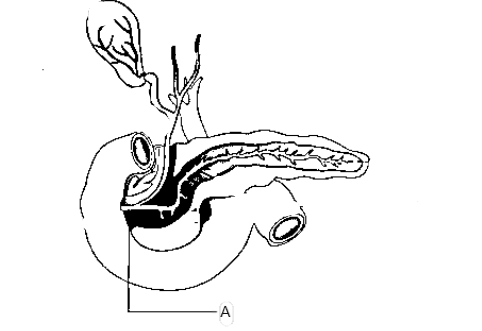
Given below is a diagrammatic representation of the duct systems of the Liver, gallbladder, and Pancreas. If the duct labelled a blocked which of the following will not occur in the body?
a. Secretion of bile juice from the liver.
b. Concentration of bile juice.
c. Formation synthesis of bile juice.
d. Digestion of carbohydrates, proteins, and fats.
Answer
 Verified
586.2k+ views
Hint: In the diagram given above hepato-pancreatic duct is the duct labeled as A. The pancreatic duct and the bile duct together open onto the duodenum as the common hepato-pancreatic duct. If there is a blockage of this duct then there is no supply of pancreatic and hepatic enzymes to the intestine.
Complete answer:
The digestive glands associated with the alimentary canal include the salivary gland, the liver, and the pancreas.
- Salivary glands are located outside the buccal cavity which secretes salivary juice.
- The liver is the largest gland of the body situated in the abdominal cavity. It secretes bile which is stored in the gallbladder. The duct of the gallbladder along with the hepatic duct from the liver forms the common bile duct. The pancreatic duct from the pancreas and the common bile duct together open onto the duodenum as the common hepato-pancreatic duct. This duct is guided by the sphincter called the sphincter of Oddi.
- The bile juice contains bile pigments and bile salts and its function is to emulsify the fats. The pancreatic juice (complete digestive juice) contains enzymes like trypsin, chymotrypsin, pancreatic amylase, pancreatic lipase, etc. It digests the protein proteases and peptones.
Hence, the correct answer is option (D).
Note: The various kinds of juices released from the different digestive glands act on the various substrates to give the end product. The action of bile juice on fat results in the emulsified fat as an end product. Similarly, the action of pancreatic juice on proteins gives amino acid as an end product.
Complete answer:
The digestive glands associated with the alimentary canal include the salivary gland, the liver, and the pancreas.
- Salivary glands are located outside the buccal cavity which secretes salivary juice.
- The liver is the largest gland of the body situated in the abdominal cavity. It secretes bile which is stored in the gallbladder. The duct of the gallbladder along with the hepatic duct from the liver forms the common bile duct. The pancreatic duct from the pancreas and the common bile duct together open onto the duodenum as the common hepato-pancreatic duct. This duct is guided by the sphincter called the sphincter of Oddi.
- The bile juice contains bile pigments and bile salts and its function is to emulsify the fats. The pancreatic juice (complete digestive juice) contains enzymes like trypsin, chymotrypsin, pancreatic amylase, pancreatic lipase, etc. It digests the protein proteases and peptones.
Hence, the correct answer is option (D).
Note: The various kinds of juices released from the different digestive glands act on the various substrates to give the end product. The action of bile juice on fat results in the emulsified fat as an end product. Similarly, the action of pancreatic juice on proteins gives amino acid as an end product.
Recently Updated Pages
Master Class 11 Business Studies: Engaging Questions & Answers for Success

Master Class 11 Computer Science: Engaging Questions & Answers for Success
Master Class 11 Economics: Engaging Questions & Answers for Success
Master Class 11 Social Science: Engaging Questions & Answers for Success
Master Class 11 English: Engaging Questions & Answers for Success
Master Class 11 Chemistry: Engaging Questions & Answers for Success
Trending doubts
Draw a diagram of nephron and explain its structur class 11 biology CBSE
Explain zero factorial class 11 maths CBSE
Chemical formula of Bleaching powder is A Ca2OCl2 B class 11 chemistry CBSE
Name the part of the brain responsible for the precision class 11 biology CBSE
The growth of tendril in pea plants is due to AEffect class 11 biology CBSE
One Metric ton is equal to kg A 10000 B 1000 C 100 class 11 physics CBSE