




Given above is a simplified model of phosphorus cycling in a terrestrial ecosystem with four blanks (A-D). Identify the blanks.
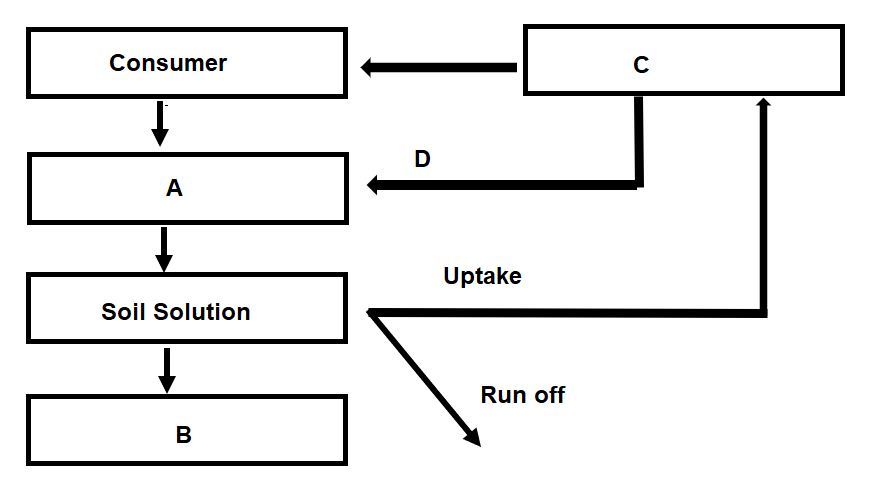
A) Rock minerals, B- Detritus, C- Litter falls, D- Producers
B) A- Litter, B- Producers, C- Rock minerals, D- Detritus
C) A- Detritus, B- Rock minerals, C- Producers, D- Litter fall
D) Producers, B- Litter fall, C- Rock minerals, D- Detritus
Answer
 Verified
559.2k+ views
Hint: The biogeochemical cycle that describes the transport of phosphorus through the lithosphere, hydrosphere, and biosphere is known as the phosphorus cycle. The atmosphere has no role in the transportation of phosphorus, unlike many other biogeochemical cycles, because phosphorus and phosphorus-based compounds are usually solids at the temperatures and pressures prevalent on Earth.
Complete answer:
Phosphorus cycle can be defined as the movement of the phosphorus through the lithosphere, biosphere and hydrosphere. The main steps are weathering, absorption by plants and animals and return to the environment by the process of decomposition.
According to the given question, the consumer produces Detritus which is leaf litter and other organic debris that has been mixed with soil to form humus (decomposition). Minerals make up the majority of rocks (weathering). Primary producers are creatures that produce biomass from inorganic substances in an ecosystem (autotrophs).
Litterfall is dead plant material that has fallen to the ground, such as leaves, bark, needles, and twigs. This detritus, or dead organic material, and the nutrients it contains are added to the soil's top layer, known as the litter layer.
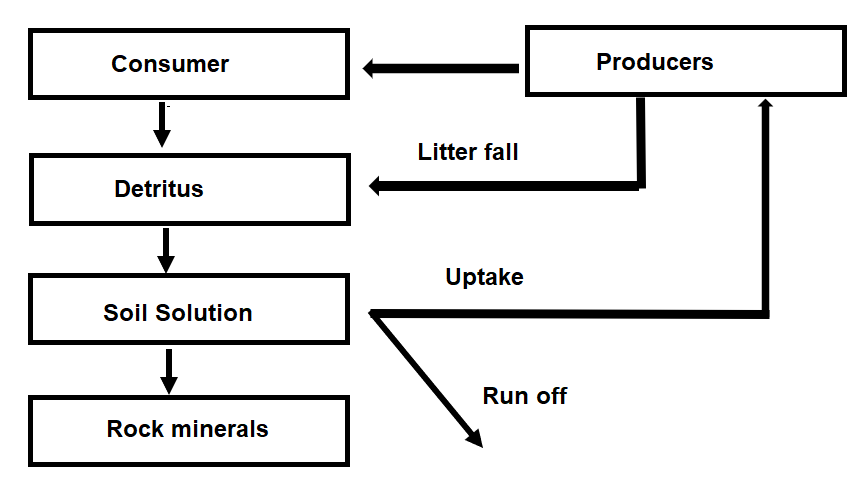
Therefore the correct answer is option ‘C’.
Note: The phosphorus is one of the important minerals which is needed for the growth and development of the living system. The DNA is made up of phosphate. The ATP or the main energy that can be utilised by the living system is made up of phosphate. So we can say the biological membrane, nucleic acids, and cellular energy transmission system all contain phosphorus.
Complete answer:
Phosphorus cycle can be defined as the movement of the phosphorus through the lithosphere, biosphere and hydrosphere. The main steps are weathering, absorption by plants and animals and return to the environment by the process of decomposition.
According to the given question, the consumer produces Detritus which is leaf litter and other organic debris that has been mixed with soil to form humus (decomposition). Minerals make up the majority of rocks (weathering). Primary producers are creatures that produce biomass from inorganic substances in an ecosystem (autotrophs).
Litterfall is dead plant material that has fallen to the ground, such as leaves, bark, needles, and twigs. This detritus, or dead organic material, and the nutrients it contains are added to the soil's top layer, known as the litter layer.
Therefore the correct answer is option ‘C’.
Note: The phosphorus is one of the important minerals which is needed for the growth and development of the living system. The DNA is made up of phosphate. The ATP or the main energy that can be utilised by the living system is made up of phosphate. So we can say the biological membrane, nucleic acids, and cellular energy transmission system all contain phosphorus.
Recently Updated Pages
Master Class 11 English: Engaging Questions & Answers for Success

Master Class 11 Biology: Engaging Questions & Answers for Success
Master Class 11 Social Science: Engaging Questions & Answers for Success
Master Class 11 Maths: Engaging Questions & Answers for Success
Master Class 11 Physics: Engaging Questions & Answers for Success
Master Class 11 Accountancy: Engaging Questions & Answers for Success
Trending doubts
Find the value of the expression given below sin 30circ class 11 maths CBSE
One Metric ton is equal to kg A 10000 B 1000 C 100 class 11 physics CBSE
10 examples of friction in our daily life
Draw a diagram of nephron and explain its structur class 11 biology CBSE
The teeth used for biting and cutting food are called class 11 biology CBSE
Proton was discovered by A Thomson B Rutherford C Chadwick class 11 chemistry CBSE