




Give these structure of the conduction system of the heart:
1. It is an Atrioventricular bundle
2. AV node
3. Bundle branches
4. Purkinje fibers
5. SA node
Choose the arrangement that lists the structure in an order of an action potential passes through them.
A. 2, 5, 3, 1, 4
B. 5, 2, 1, 3, 4
C. 2, 5, 1, 3, 4
D. 5, 2, 4, 1, 3
Answer
 Verified
596.4k+ views
Hint: The cardiac conduction system is a result of the specialized heart cells. These cells send signals to the other heart muscles causing contraction. The SA node, AV node, Purkinje fiber fibers, bundle branches, and the bundle of HIS are the main part of this system. The anatomical pacemaker initiates the action potential of the conduction system.
Complete answer:
The cardiac conduction system is the electrical conduction system that functions to control the heart rate. Electrical impulses generated through this process are conducted throughout the heart muscles. This process stimulates the contraction and pumping of blood by the heart.
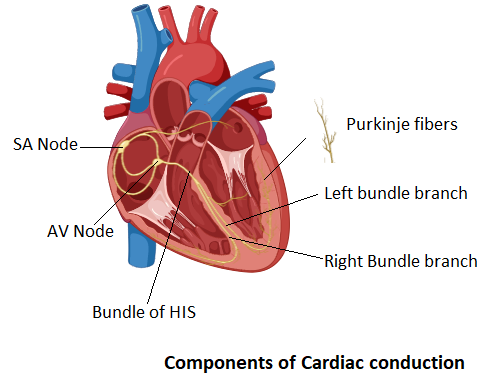
The conduction system of the heart begins with the SA nodes which are called the anatomical pacemakers of the heart. The signal from SA nodes travels to the AV nodes from where it goes to the bundle of HIS. Through the bundle of His, the signal further travels down the bundle branches and at last reaches Purkinje fibers. This process results in the contraction of ventricles. The signal can be recorded on a graph called an electrocardiogram as the signal creates an electrical current. The electrocardiogram analyzes the functioning of the cardiac system.
Hence, from the above discussion, we can conclude that the right order of action potential conduction is from SA node AV node Atrioventricular bundle or bundle of HIS bundle branches Purkinje fibers.
So, the correct answer is option B.
Note: Electrocardiogram assesses the heart rhythm and detects poor blood flow through the heart. A typical electrocardiogram represents five waves which are named P, Q, R, S, and T waves. The P waves belong to atrial activation and thus are of atrial origin. The Q, R, S, and T waves represent ventricular contraction and relaxation and thus are of ventricle origin.
Complete answer:
The cardiac conduction system is the electrical conduction system that functions to control the heart rate. Electrical impulses generated through this process are conducted throughout the heart muscles. This process stimulates the contraction and pumping of blood by the heart.
The conduction system of the heart begins with the SA nodes which are called the anatomical pacemakers of the heart. The signal from SA nodes travels to the AV nodes from where it goes to the bundle of HIS. Through the bundle of His, the signal further travels down the bundle branches and at last reaches Purkinje fibers. This process results in the contraction of ventricles. The signal can be recorded on a graph called an electrocardiogram as the signal creates an electrical current. The electrocardiogram analyzes the functioning of the cardiac system.
Hence, from the above discussion, we can conclude that the right order of action potential conduction is from SA node AV node Atrioventricular bundle or bundle of HIS bundle branches Purkinje fibers.
So, the correct answer is option B.
Note: Electrocardiogram assesses the heart rhythm and detects poor blood flow through the heart. A typical electrocardiogram represents five waves which are named P, Q, R, S, and T waves. The P waves belong to atrial activation and thus are of atrial origin. The Q, R, S, and T waves represent ventricular contraction and relaxation and thus are of ventricle origin.
Recently Updated Pages
Lysosomes are known as suicidal bags of cell why class 11 biology CBSE

Father s age is three times the sum of the ages of-class-11-maths-CBSE
Give a comparative account of the classes of kingdom class 11 biology CBSE
The ceiling of a long hall is 25m high What is the class 11 physics CBSE
Proton was discovered by A Thomson B Rutherford C Chadwick class 11 chemistry CBSE
Name the Largest and the Smallest Cell in the Human Body ?
Trending doubts
Difference Between Prokaryotic Cells and Eukaryotic Cells
Find the value of the expression given below sin 30circ class 11 maths CBSE
One Metric ton is equal to kg A 10000 B 1000 C 100 class 11 physics CBSE
Two of the body parts which do not appear in MRI are class 11 biology CBSE
10 examples of friction in our daily life
Draw a diagram of nephron and explain its structur class 11 biology CBSE