




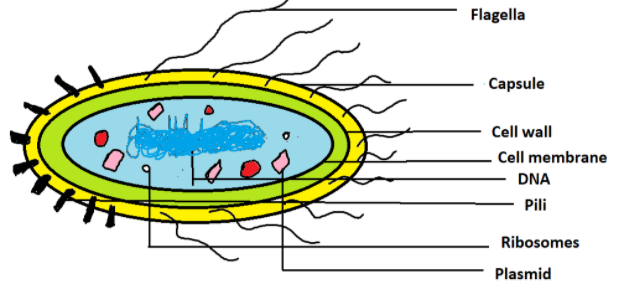
Give the symptoms of typhoid fever and draw a labelled diagram of its causal organism
Answer
 Verified
561.9k+ views
Hint: Fever is also referred to as high temperature, pyrexia, or hyperthermia. A body temperature that is higher than average is described as fever. Kids and adults may be affected by fever. A short-term rise in body temperature can help combat infection in your body. A severe fever, however, may be a symptom of a serious condition requiring immediate medical treatment.
Complete answer:
A bacterial infection that can lead to high fever, diarrhoea, and vomiting is typhoid. It can be fatal. It is caused by Salmonella typhi bacteria. The infection is also transmitted by contaminated food and drinking water, and in areas where hand washing is less frequent, it is more likely. Carriers who do not know they are carrying the bacteria may even pass it on.
An infection caused by the bacterium Salmonella typhimurium is typhoid (S. typhi). The bacterium lives in humans' bowels and bloodstream. It spreads between people by direct contact with an infected person's faeces. No animals bear this disease, but there is still human to human transmission.
The structure of Salmonella is given below.
Symptoms of typhoid fever:
Symptoms typically begin between 6 and 30 days after bacterial exposure. Fever and rash are the two main typhoid signs. Typhoid fever is especially severe, rising steadily to 104 degrees Fahrenheit, or 39 to 40 degrees Celsius, over many days. The rash is made up of rose-colored spots, especially on the neck and abdomen, that do not affect every patient. Weakness, stomach pain, constipation and headaches are other symptoms. Symptoms may rarely involve confusion, diarrhoea, and vomiting, but this is not necessarily severe. The bowel can become perforated in serious, untreated cases. This can lead to peritonitis, a tissue infection that lines the inside of the abdomen, which in 5 to 62 percent of cases has been reported as fatal.
Note: Antibiotics are the only safe cure for typhoid agents. Ciprofloxacin and ceftriaxone are the most commonly used. It is essential, apart from antibiotics, to rehydrate by drinking adequate water. In more serious cases, surgery may be needed where the bowel has been perforated.
Complete answer:
A bacterial infection that can lead to high fever, diarrhoea, and vomiting is typhoid. It can be fatal. It is caused by Salmonella typhi bacteria. The infection is also transmitted by contaminated food and drinking water, and in areas where hand washing is less frequent, it is more likely. Carriers who do not know they are carrying the bacteria may even pass it on.
An infection caused by the bacterium Salmonella typhimurium is typhoid (S. typhi). The bacterium lives in humans' bowels and bloodstream. It spreads between people by direct contact with an infected person's faeces. No animals bear this disease, but there is still human to human transmission.
The structure of Salmonella is given below.
Symptoms of typhoid fever:
Symptoms typically begin between 6 and 30 days after bacterial exposure. Fever and rash are the two main typhoid signs. Typhoid fever is especially severe, rising steadily to 104 degrees Fahrenheit, or 39 to 40 degrees Celsius, over many days. The rash is made up of rose-colored spots, especially on the neck and abdomen, that do not affect every patient. Weakness, stomach pain, constipation and headaches are other symptoms. Symptoms may rarely involve confusion, diarrhoea, and vomiting, but this is not necessarily severe. The bowel can become perforated in serious, untreated cases. This can lead to peritonitis, a tissue infection that lines the inside of the abdomen, which in 5 to 62 percent of cases has been reported as fatal.
Note: Antibiotics are the only safe cure for typhoid agents. Ciprofloxacin and ceftriaxone are the most commonly used. It is essential, apart from antibiotics, to rehydrate by drinking adequate water. In more serious cases, surgery may be needed where the bowel has been perforated.
Recently Updated Pages
Master Class 12 Economics: Engaging Questions & Answers for Success

Master Class 12 English: Engaging Questions & Answers for Success
Master Class 12 Social Science: Engaging Questions & Answers for Success
Master Class 12 Maths: Engaging Questions & Answers for Success
Master Class 12 Physics: Engaging Questions & Answers for Success
Master Class 9 General Knowledge: Engaging Questions & Answers for Success
Trending doubts
One Metric ton is equal to kg A 10000 B 1000 C 100 class 11 physics CBSE
Difference Between Prokaryotic Cells and Eukaryotic Cells
Find the value of the expression given below sin 30circ class 11 maths CBSE
Two of the body parts which do not appear in MRI are class 11 biology CBSE
1 ton equals to A 100 kg B 1000 kg C 10 kg D 10000 class 11 physics CBSE
Draw a diagram of nephron and explain its structur class 11 biology CBSE