




Give the nature of V-I graph for.
(i)ohmic
(ii)non-ohmic
circuit elements. Give an example of each.
Answer
 Verified
661.5k+ views
Hint: ohmic circuit elements are the elements which follow the ohm’s law and the non-ohmic are those circuit elements that don't follow the ohm’s law. Ohm’s law states that the electric current is proportional to voltage and inversely proportional to resistance.
Complete step-by-step answer:
(i). From the ohm’s law we have the relation between the current, resistance, and voltage through any electrical circuit, which is as follows,
According to ohm’s law,
$V = IR$
On looking at the above equation we find that this equation is of the $y = mx$ type equation which gives a straight line.
So, if we plot a graph between voltage, $V$ and current, $I$, we will get as follows,
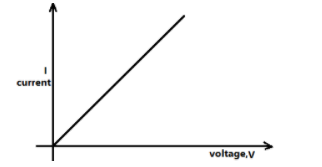
Hence the graph of the ohmic circuit elements will be straight-line passing through the origin.
Example for the ohmic circuit element- metallic conductors (such as silver, aluminium, copper, iron etc.).
(ii). For the non-ohmic circuit elements, as they will not follow the ohm’s law so they will not have the same equation as that of the ohmic circuit elements for plotting the graph. So, the graphs of the non-ohmic circuit elements will be other than the graphs of the ohmic circuit elements.
That means the graph of a non-ohmic circuit element will be a non-linear curve or the straight line which is not passing through the origin.
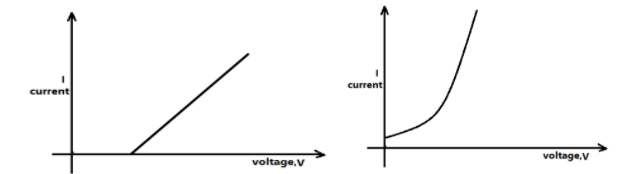
Example of the non-ohmic circuit element- Diodes and Transistors.
Note: When we are comparing the ohmic and non-ohmic resistors in a circuit or the ohmic and non-ohmic devices then we have to keep in mind that the distinction between them only can be done if the conditions of the resistors are constant. If conditions of the resistor are not constant then there is no point of comparing the ohmic and non-ohmic resistance.
Complete step-by-step answer:
(i). From the ohm’s law we have the relation between the current, resistance, and voltage through any electrical circuit, which is as follows,
According to ohm’s law,
$V = IR$
On looking at the above equation we find that this equation is of the $y = mx$ type equation which gives a straight line.
So, if we plot a graph between voltage, $V$ and current, $I$, we will get as follows,
Hence the graph of the ohmic circuit elements will be straight-line passing through the origin.
Example for the ohmic circuit element- metallic conductors (such as silver, aluminium, copper, iron etc.).
(ii). For the non-ohmic circuit elements, as they will not follow the ohm’s law so they will not have the same equation as that of the ohmic circuit elements for plotting the graph. So, the graphs of the non-ohmic circuit elements will be other than the graphs of the ohmic circuit elements.
That means the graph of a non-ohmic circuit element will be a non-linear curve or the straight line which is not passing through the origin.
Example of the non-ohmic circuit element- Diodes and Transistors.
Note: When we are comparing the ohmic and non-ohmic resistors in a circuit or the ohmic and non-ohmic devices then we have to keep in mind that the distinction between them only can be done if the conditions of the resistors are constant. If conditions of the resistor are not constant then there is no point of comparing the ohmic and non-ohmic resistance.
Recently Updated Pages
Which of the following graphs shows the variation of class 12 physics CBSE

Draw a labelled diagram of the human male reproductive class 12 biology CBSE
Describe the experiment to compare the emf of two cells class 12 physics CBSE
What is standard hydrogen electrode
What is conventional current and electric current class 12 physics CBSE
2Bromopentane is treated with an alcoholic KOH solution class 12 chemistry CBSE
Trending doubts
Draw a labelled sketch of the human eye class 12 physics CBSE
Which are the Top 10 Largest Countries of the World?
Differentiate between homogeneous and heterogeneous class 12 chemistry CBSE
Draw ray diagrams each showing i myopic eye and ii class 12 physics CBSE
Which is the correct genotypic ratio of mendel dihybrid class 12 biology CBSE
What is the Full Form of PVC, PET, HDPE, LDPE, PP and PS ?