




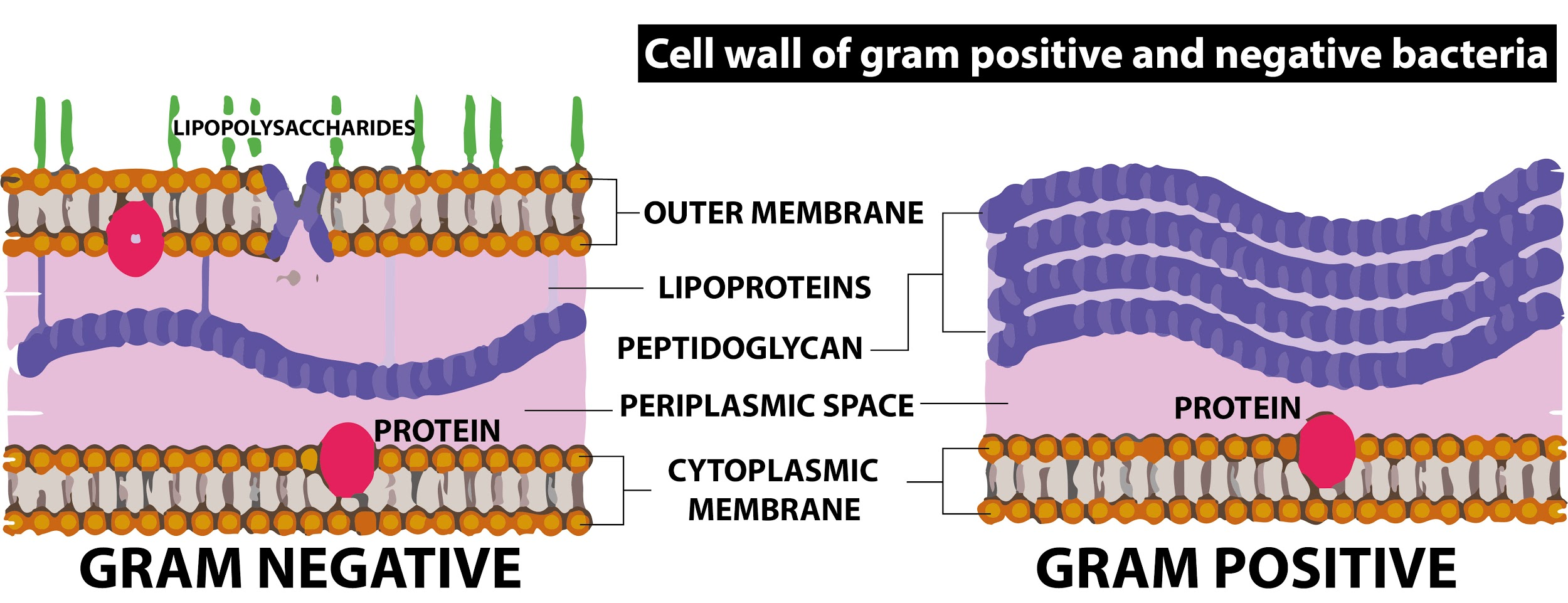
Give the difference between the cell walls of gram-positive and gram-negative bacteria.
Answer
 Verified
651.3k+ views
Hint: The name comes from the bacteriologist Hans Christian Gram, who invented the technique to classify bacteria into two broad groups -gram-positive and gram-negative based on the staining process.
Complete answer:
Note: In phylum Chlamydiae, bacteria appear to lack peptidoglycan, although their cell walls have a gram-negative structure. Bacteria belonging to the phylum Tenericutes lack a cell wall altogether, which makes them susceptible to osmotic changes.
Complete answer:
| Gram-positive bacteria | Gram-negative bacteria |
| The cell wall is single-layered and smooth | The cell wall is a double-layered structure and wavy in appearance |
| The thickness of the cell wall is about 20 to 80 nanometres | The thickness of the cell wall is 8 to 10 nanometres |
| The presence of the peptidoglycan layer which is multi-layered can be seen | The peptidoglycan layer is present but only a single layer is seen. |
| The presence of teichoic acids is seen | Teichoic acid is absent |
| Porins are absent on the membrane | Porins are present on the outer membrane |
| The lipid content of the wall is low | The lipid content of the wall is about 20 to 30%. |
| Lipopolysaccharide is absent | Lipopolysaccharide is present |
| Sulfur-containing amino acids are absent | Sulfur-containing amino acids are present in the cell wall. |
| The outer membrane is absent | The outer membrane is present |
| Rigid and less elastic | Less rigid and more elastic |
| Periplasmic space will be absent | Periplasmic space is present. |
| The bacteria falling under this category retain a crystal violet color even after they are washed with acetone or alcohol. And appear purple-colored when observed under a microscope | The type of bacteria falling under this category does not retain the stain even after they are washed with acetone or alcohol. They appear in pink colors when seen under the microscope |
| Examples- Streptococcus, Staphylococcus | Examples- Salmonella, Escherichia |
Note: In phylum Chlamydiae, bacteria appear to lack peptidoglycan, although their cell walls have a gram-negative structure. Bacteria belonging to the phylum Tenericutes lack a cell wall altogether, which makes them susceptible to osmotic changes.
Recently Updated Pages
Which will be the least stable resonating structure class 11 chemistry CBSE

How many 5 digit telephone numbers can be construc-class-11-maths-CBSE
How do you find the angle of the resultant vector class 11 physics CBSE
Draw labelled diagram of the following i Gram seed class 11 biology CBSE
1 Quintal is equal to a 110 kg b 10 kg c 100kg d 1000 class 11 physics CBSE
What is the need and importance of classification class 11 biology CBSE
Trending doubts
One Metric ton is equal to kg A 10000 B 1000 C 100 class 11 physics CBSE
Find the value of the expression given below sin 30circ class 11 maths CBSE
Draw a diagram of nephron and explain its structur class 11 biology CBSE
10 examples of friction in our daily life
Proton was discovered by A Thomson B Rutherford C Chadwick class 11 chemistry CBSE
The teeth used for biting and cutting food are called class 11 biology CBSE