




Give the biochemical composition of Plasma membrane. How are lipid molecules arranged in the membrane?
Answer
 Verified
543.9k+ views
Hint: Cell membrane is also known as plasma membrane. The plasma membrane is a bilayer of lipid composition. Lipid is nothing but fat. Lipid structures which separate the contents of cell compartments and the outer environment. It separates the cell matrix and the organelles. The plasma membrane, also known to be the cell surface membrane or plasmalemma. It is a phospholipid bilayer.
Complete Explanation:
A plasma membrane is said to be a semipermeable membrane because it allows certain molecules but not all to pass or enter into the cell. It regulates the movement of materials in and out of the cell and also facilitates the electrical signaling between them. It has major functions like it serves the purpose of passing nutrients and flow of ions into and out of the cells. It also conducts the external stimuli which shows signal transduction. It also interacts with other cells' boundaries and surfaces.
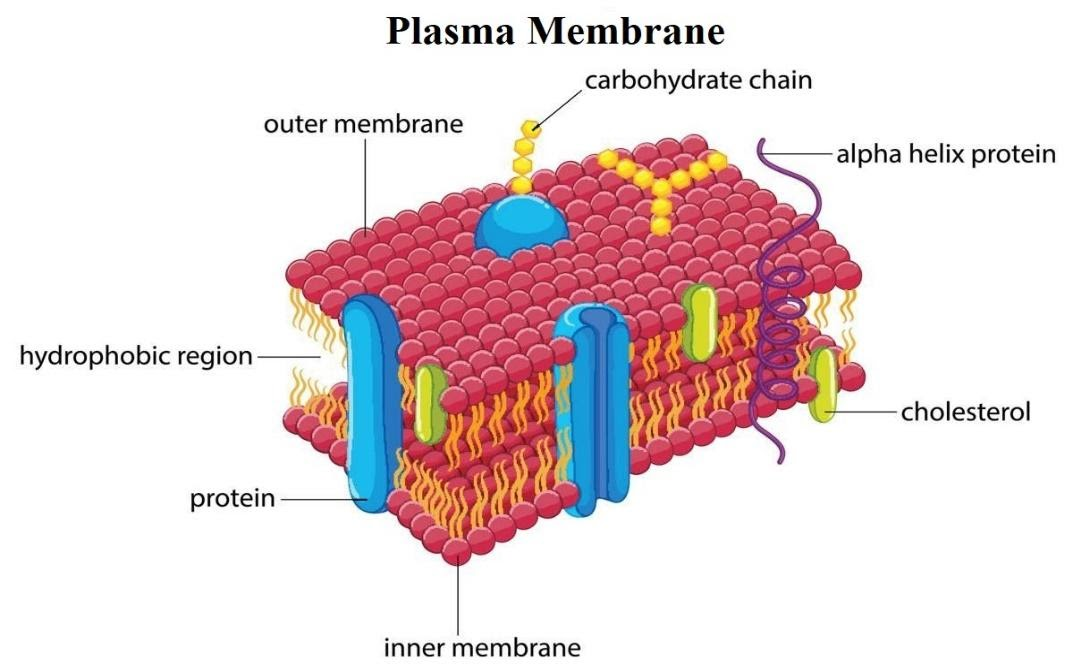
The biochemical composition of plasma membrane is that it consists of lipid bilayer which are embedded in a bed of proteins. They are approximately 5nm thick. Some membranes also carry carbohydrates, which differ from cell to cell.
The phospholipids contain a polar head group which is attached to two hydrophobic tails which are fatty acids in nature. The head faces towards the inner side which is aqueous in nature and the fatty acid is the tail interior of the bilayer.
Note:
Apart from phospholipid layer, plasma membranes had other different types of proteins such as- the embedded proteins they function as gated channels transports the movement of compounds across the membrane. They act as neurotransmitters. The peripheral membrane proteins do provide mechanical and structural support to the membrane. Third type of proteins are glycan anchor proteins. GPI is present in the neuronal membrane.
Complete Explanation:
A plasma membrane is said to be a semipermeable membrane because it allows certain molecules but not all to pass or enter into the cell. It regulates the movement of materials in and out of the cell and also facilitates the electrical signaling between them. It has major functions like it serves the purpose of passing nutrients and flow of ions into and out of the cells. It also conducts the external stimuli which shows signal transduction. It also interacts with other cells' boundaries and surfaces.
The biochemical composition of plasma membrane is that it consists of lipid bilayer which are embedded in a bed of proteins. They are approximately 5nm thick. Some membranes also carry carbohydrates, which differ from cell to cell.
The phospholipids contain a polar head group which is attached to two hydrophobic tails which are fatty acids in nature. The head faces towards the inner side which is aqueous in nature and the fatty acid is the tail interior of the bilayer.
Note:
Apart from phospholipid layer, plasma membranes had other different types of proteins such as- the embedded proteins they function as gated channels transports the movement of compounds across the membrane. They act as neurotransmitters. The peripheral membrane proteins do provide mechanical and structural support to the membrane. Third type of proteins are glycan anchor proteins. GPI is present in the neuronal membrane.
Recently Updated Pages
Master Class 12 Economics: Engaging Questions & Answers for Success

Master Class 12 English: Engaging Questions & Answers for Success
Master Class 12 Social Science: Engaging Questions & Answers for Success
Master Class 12 Maths: Engaging Questions & Answers for Success
Master Class 12 Physics: Engaging Questions & Answers for Success
Master Class 11 Social Science: Engaging Questions & Answers for Success
Trending doubts
One Metric ton is equal to kg A 10000 B 1000 C 100 class 11 physics CBSE
Difference Between Prokaryotic Cells and Eukaryotic Cells
Two of the body parts which do not appear in MRI are class 11 biology CBSE
1 ton equals to A 100 kg B 1000 kg C 10 kg D 10000 class 11 physics CBSE
Draw a diagram of nephron and explain its structur class 11 biology CBSE
10 examples of friction in our daily life