




Give reason: Why is ammonia highly soluble in water?
Answer
 Verified
624.6k+ views
Hint: \[{{N}}{{{H}}_{{3}}}\] is a polar molecule. In \[{{N}}{{{H}}_{{3}}}\] nitrogen is more electronegative than hydrogen, thus dipole moments of hydrogen are pointing to the nitrogen. The lone pair on nitrogen pushes the hydrogen away, making the dipole moments point in a common direction. This makes \[{{N}}{{{H}}_{{3}}}\] polar, this nature contributes to the solubility.
Complete step by step answer:
Ammonia, also called azane, is obtained when hydrogen and nitrogen react. Its molecular formula is \[{{N}}{{{H}}_{{3}}}\]. It is lighter than air and is widely used as a fertilizer. It is also used in the manufacturing of explosives and in the production of soda ash and in the Ostwald process to get nitric acid. Ammonia is behaving as a weak base since it combines with acids to form salts. It is also showing weak acidic qualities and, is therefore, called amphoteric. The acidity of ammonia enables it to form amides with some alkali metals and alkaline earth metals.
It is highly soluble in water. The high solubility of ammonia is due to the presence of lone pairs at the nitrogen. It is attracted to hydrogen in the water molecule hydrogen bonds. The presence of hydrogen bonding between two molecules means that the molecules are polar. In case of solubility, dissolves like i.e., polar molecules will dissolve in polar solvents. This means the molecules will be soluble in a polar solvent such as water. In other words, the polarity of these molecules indicates that they dissolve in water.
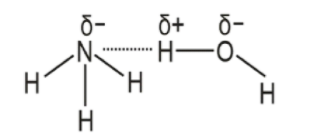
Hence, it is due to the lone pair atom that attracts hydrogen in water molecules.
Additional Information:
Solubility is the maximum amount of solute that can be dissolved in a known quantity of solvent at a certain temperature.
Note: There are two types of H bonds, called Intermolecular Hydrogen Bonding, when hydrogen bonding takes in different molecules it is called intermolecular hydrogen bonding and Intramolecular Hydrogen Bonding, when the hydrogen bonding which takes place within the same molecule itself is called intramolecular hydrogen bonding. The hydrogen bond is formed between the electronegative atom of one group with the hydrogen atoms of the other group.
Complete step by step answer:
Ammonia, also called azane, is obtained when hydrogen and nitrogen react. Its molecular formula is \[{{N}}{{{H}}_{{3}}}\]. It is lighter than air and is widely used as a fertilizer. It is also used in the manufacturing of explosives and in the production of soda ash and in the Ostwald process to get nitric acid. Ammonia is behaving as a weak base since it combines with acids to form salts. It is also showing weak acidic qualities and, is therefore, called amphoteric. The acidity of ammonia enables it to form amides with some alkali metals and alkaline earth metals.
It is highly soluble in water. The high solubility of ammonia is due to the presence of lone pairs at the nitrogen. It is attracted to hydrogen in the water molecule hydrogen bonds. The presence of hydrogen bonding between two molecules means that the molecules are polar. In case of solubility, dissolves like i.e., polar molecules will dissolve in polar solvents. This means the molecules will be soluble in a polar solvent such as water. In other words, the polarity of these molecules indicates that they dissolve in water.
Hence, it is due to the lone pair atom that attracts hydrogen in water molecules.
Additional Information:
Solubility is the maximum amount of solute that can be dissolved in a known quantity of solvent at a certain temperature.
Note: There are two types of H bonds, called Intermolecular Hydrogen Bonding, when hydrogen bonding takes in different molecules it is called intermolecular hydrogen bonding and Intramolecular Hydrogen Bonding, when the hydrogen bonding which takes place within the same molecule itself is called intramolecular hydrogen bonding. The hydrogen bond is formed between the electronegative atom of one group with the hydrogen atoms of the other group.
Recently Updated Pages
If x a + bt + ct2 where x is in meters and t is in class 11 physics CBSE

A car covers the first half distance between two places class 11 physics CBSE
The resultant of two vectors overrightarrow P and overrightarrow class 11 physics CBSE
Find the value of cos 135 class 11 maths CBSE
A mass M is held in place by an applied force F and class 11 physics CBSE
A solution of glucose in water is labelled as 10 dfracwv class 11 chemistry CBSE
Trending doubts
Find the value of the expression given below sin 30circ class 11 maths CBSE
One Metric ton is equal to kg A 10000 B 1000 C 100 class 11 physics CBSE
Draw a diagram of nephron and explain its structur class 11 biology CBSE
10 examples of friction in our daily life
Proton was discovered by A Thomson B Rutherford C Chadwick class 11 chemistry CBSE
Bond order ofO2 O2+ O2 and O22 is in order A O2 langle class 11 chemistry CBSE