




Give an account of ocean currents.
Answer
 Verified
595.2k+ views
Hint: The major movements of the water in the ocean are known as tides,ocean currents and waves. The ocean currents are large masses of surface water that goes around in regular patterns around the ocean.
Complete answer: The ocean currents are divided into two types: the cold currents and warm currents, in accordance to their temperature.The warm currents flow from the equatorial zone to the polar zones and they have a high surface temperature. These currents move around clockwise in the northern hemisphere. When in the Southern hemisphere they move around in an anti-clockwise direction. The cold currents move from polar to equatorial region and have a low surface temperature. In the northern hemisphere they flow in an anti-clockwise direction and in the southern hemisphere they flow in clockwise direction. There are several factors which affect the ocean currents:
1. The Planetary wind
2. Temperatures
3.Salinity
4. The rotation of the earth
The five major ocean currents are: North Pacific Ocean currents,South Pacific ocean currents, North Atlantic Ocean currents, South Atlantic ocean currents and the Indian ocean currents. Currents also impact the climate in many ways. The warm and cold currents affect the local climate of a particular region. Warm currents cause rain to the coastal region and the interiors whereas cold currents do not.
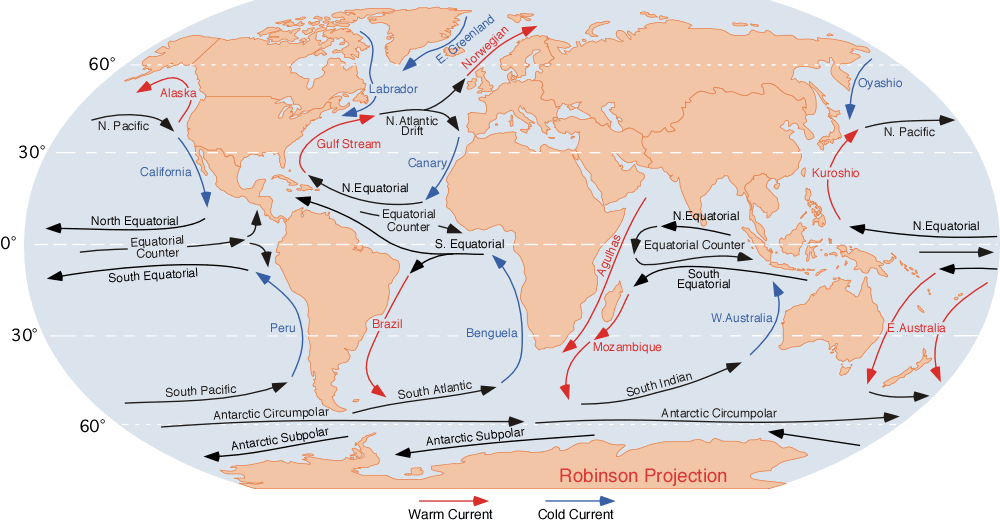
1. Pacific Ocean Currents:The Pacific Ocean currents consist of various warm and cold currents. In the Northern Pacific Ocean they move in clockwise direction and in the Southern Pcific Ocean they move in anticlockwise motion. The Pacific Currents influence the climate and the coastal region. The currents in the Pacific Ocean are:
Warm currents of the pacific Ocean:
a. North Equatorial currents flow from the western coast of Mexico to the Philippines towards the west.
b. South Equatorial currents flow from the south in the Pacific ocean and get divided into north and south near New Guinea.
c. Counter Equatorial currents: These currents flow in between north and south equatorial current in the opposite direction.
d. The Kuroshio or Japan current flows from Taiwan to the Strait of Beijing.
Cold currents of the Pacific Ocean:
a. Oyashio Current: Alaskan Current and Okhost current merges together to form the Oyashio Current.
b. California Current: This current flows along the western coast of the USA and finally it joins with the North Equatorial Current (warm) to finish the circulation.
c. West and Wind drift: Under the influence of the Westerlies, these currents flow from West to East in the zone of 400-500S.
d. Peruvian current is also known as the Humboldt current: This current flows northwards along the westen coast of South America. It is the continuation of the West wind drift.
2. Major Ocean currents of Atlantic Ocean:
Warm currents:
a. North Equatorial Current gets divided into Antilles and Caribbean currents.
b. South Equatorial Current gets separated into northern Cayenne Current and the southern brazilian Current
c. Gulf Stream originates in the Gulf of Mexico.
D. Counter Equatorial Current: This current flows from west to east in between North and South Equatorial Current.
Cold Currents:
a. Labrador Current originates in the Baffin Bay and merges with Gulf Stream off NewFoundland.
b. The Irminger Current circulates between Greenland and Iceland and joins the North Atlantic Drift.
c. Canaries Current: It is the continuation of the North Atlantic Drift. It flows along the African coast.
d. Falkland Current flows from eastern coast of South America upto Argentina.
e. South Atlantic Drift: The Brazilian current continues as the South Atlantic Drift.
f. Benguela Current: Along the western coast of South Africa, it flows northwards.
3. Currents in the Indian Ocean:
Warm Currents:
a. Indian Equatorial Current: These circulate westerwards in the South Indian Ocean and get bifurcated near Madagascar .
b. South West Monsoon Currents: These currents circulate in easterly direction along the Indian coasts.
c. North West Monsoon Currents: These currents circulate during winter along the eastern coasts.
Note: As a result of cold currents,the deserts are located in the western margins of the continents in the subtropical belts.Example: The Californian is a cold current,that creates a dry and desert type of climate around the region it flows.
Complete answer: The ocean currents are divided into two types: the cold currents and warm currents, in accordance to their temperature.The warm currents flow from the equatorial zone to the polar zones and they have a high surface temperature. These currents move around clockwise in the northern hemisphere. When in the Southern hemisphere they move around in an anti-clockwise direction. The cold currents move from polar to equatorial region and have a low surface temperature. In the northern hemisphere they flow in an anti-clockwise direction and in the southern hemisphere they flow in clockwise direction. There are several factors which affect the ocean currents:
1. The Planetary wind
2. Temperatures
3.Salinity
4. The rotation of the earth
The five major ocean currents are: North Pacific Ocean currents,South Pacific ocean currents, North Atlantic Ocean currents, South Atlantic ocean currents and the Indian ocean currents. Currents also impact the climate in many ways. The warm and cold currents affect the local climate of a particular region. Warm currents cause rain to the coastal region and the interiors whereas cold currents do not.
1. Pacific Ocean Currents:The Pacific Ocean currents consist of various warm and cold currents. In the Northern Pacific Ocean they move in clockwise direction and in the Southern Pcific Ocean they move in anticlockwise motion. The Pacific Currents influence the climate and the coastal region. The currents in the Pacific Ocean are:
Warm currents of the pacific Ocean:
a. North Equatorial currents flow from the western coast of Mexico to the Philippines towards the west.
b. South Equatorial currents flow from the south in the Pacific ocean and get divided into north and south near New Guinea.
c. Counter Equatorial currents: These currents flow in between north and south equatorial current in the opposite direction.
d. The Kuroshio or Japan current flows from Taiwan to the Strait of Beijing.
Cold currents of the Pacific Ocean:
a. Oyashio Current: Alaskan Current and Okhost current merges together to form the Oyashio Current.
b. California Current: This current flows along the western coast of the USA and finally it joins with the North Equatorial Current (warm) to finish the circulation.
c. West and Wind drift: Under the influence of the Westerlies, these currents flow from West to East in the zone of 400-500S.
d. Peruvian current is also known as the Humboldt current: This current flows northwards along the westen coast of South America. It is the continuation of the West wind drift.
2. Major Ocean currents of Atlantic Ocean:
Warm currents:
a. North Equatorial Current gets divided into Antilles and Caribbean currents.
b. South Equatorial Current gets separated into northern Cayenne Current and the southern brazilian Current
c. Gulf Stream originates in the Gulf of Mexico.
D. Counter Equatorial Current: This current flows from west to east in between North and South Equatorial Current.
Cold Currents:
a. Labrador Current originates in the Baffin Bay and merges with Gulf Stream off NewFoundland.
b. The Irminger Current circulates between Greenland and Iceland and joins the North Atlantic Drift.
c. Canaries Current: It is the continuation of the North Atlantic Drift. It flows along the African coast.
d. Falkland Current flows from eastern coast of South America upto Argentina.
e. South Atlantic Drift: The Brazilian current continues as the South Atlantic Drift.
f. Benguela Current: Along the western coast of South Africa, it flows northwards.
3. Currents in the Indian Ocean:
Warm Currents:
a. Indian Equatorial Current: These circulate westerwards in the South Indian Ocean and get bifurcated near Madagascar .
b. South West Monsoon Currents: These currents circulate in easterly direction along the Indian coasts.
c. North West Monsoon Currents: These currents circulate during winter along the eastern coasts.
Note: As a result of cold currents,the deserts are located in the western margins of the continents in the subtropical belts.Example: The Californian is a cold current,that creates a dry and desert type of climate around the region it flows.
Recently Updated Pages
Master Class 11 English: Engaging Questions & Answers for Success

Master Class 11 Social Science: Engaging Questions & Answers for Success
Master Class 11 Maths: Engaging Questions & Answers for Success
Master Class 11 Biology: Engaging Questions & Answers for Success
Master Class 11 Physics: Engaging Questions & Answers for Success
Master Class 11 Chemistry: Engaging Questions & Answers for Success
Trending doubts
One Metric ton is equal to kg A 10000 B 1000 C 100 class 11 physics CBSE
Difference Between Prokaryotic Cells and Eukaryotic Cells
1 ton equals to A 100 kg B 1000 kg C 10 kg D 10000 class 11 physics CBSE
Find the value of the expression given below sin 30circ class 11 maths CBSE
Two of the body parts which do not appear in MRI are class 11 biology CBSE
What are hard magnetic materials class 11 physics CBSE