



 Watch Video


Give a brief account of viruses with respect to their structure and nature of genetic material. Also name four common viral diseases?
Answer
 Verified
615.3k+ views
Hint: The viruses are the non- cellular organisms and a small infectious agent that are characterized by having an inert crystalline structure. The name virus was given by Pasteur. D.J. Ivanowsky in the year 1892. Either DNA or RNA is present in viruses as genetic material. Some of the common viral diseases are AIDS, mumps, smallpox, herpes, etc.
Complete answer:
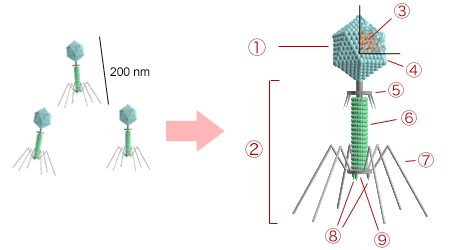
Structure of bacteriophage:
1. Head.
2. Tail.
3. Nucleic acid.
4. Capsid.
5. Collar.
6. Sheath.
7. Tail fiber.
8. Spikes.
9. Baseplate.
- Viruses are not truly 'living' if considered based on having a cell structure. The viruses are the non- cellular organisms and a small infectious agent that are characterized by having an inert crystalline structure. When they enter the living cell they take over the machinery of the host cell and start replicating themselves and killing the host.
- The meaning of the name virus is venom or poisonous. Pasteur. D.J. Ivanowsky in the year 1892 gave the name virus.
- Genetic material either DNA or RNA is present in the viruses. Both DNA or RNA can’t be present in one virus. It is a nucleoprotein and its genetic material is infectious.
The complete virus contains the following components:
> Core- it is a nucleic acid that may be either DNA or RNA, but not both together.
> Capsid- it is the outer covering of the genetic material made of certain proteins. It is made up of many identical subunits called capsomeres.
> Envelope- it is the outermost covering present on certain viruses like HIV, herpes, etc while in others it is not present.
The four common viral diseases are:
> AIDS- Acquired immunodeficiency syndrome. It is a disease caused by the human immunodeficiency virus (HIV).
> Herpes- Herpes is a viral infection resulting from the herpes simplex virus.
> Smallpox- Smallpox was an infectious disease caused by the variola virus. It was contagious, but now it has been eradicated
> Common cold- The common cold, also known as a cold. It is a viral infectious disease in which the respiratory tract mostly the nasal area and throat are affected.
Note: Viruses that infect the plant have single-stranded RNA and the viruses that infect the animal have either single or double-stranded RNA or double-stranded DNA. The viruses infecting the bacteria i.e. bacteriophage are double-stranded DNA.
Complete answer:
Structure of bacteriophage:
1. Head.
2. Tail.
3. Nucleic acid.
4. Capsid.
5. Collar.
6. Sheath.
7. Tail fiber.
8. Spikes.
9. Baseplate.
- Viruses are not truly 'living' if considered based on having a cell structure. The viruses are the non- cellular organisms and a small infectious agent that are characterized by having an inert crystalline structure. When they enter the living cell they take over the machinery of the host cell and start replicating themselves and killing the host.
- The meaning of the name virus is venom or poisonous. Pasteur. D.J. Ivanowsky in the year 1892 gave the name virus.
- Genetic material either DNA or RNA is present in the viruses. Both DNA or RNA can’t be present in one virus. It is a nucleoprotein and its genetic material is infectious.
The complete virus contains the following components:
> Core- it is a nucleic acid that may be either DNA or RNA, but not both together.
> Capsid- it is the outer covering of the genetic material made of certain proteins. It is made up of many identical subunits called capsomeres.
> Envelope- it is the outermost covering present on certain viruses like HIV, herpes, etc while in others it is not present.
The four common viral diseases are:
> AIDS- Acquired immunodeficiency syndrome. It is a disease caused by the human immunodeficiency virus (HIV).
> Herpes- Herpes is a viral infection resulting from the herpes simplex virus.
> Smallpox- Smallpox was an infectious disease caused by the variola virus. It was contagious, but now it has been eradicated
> Common cold- The common cold, also known as a cold. It is a viral infectious disease in which the respiratory tract mostly the nasal area and throat are affected.
Note: Viruses that infect the plant have single-stranded RNA and the viruses that infect the animal have either single or double-stranded RNA or double-stranded DNA. The viruses infecting the bacteria i.e. bacteriophage are double-stranded DNA.
Watch videos on
Give a brief account of viruses with respect to their structure and nature of genetic material. Also name four common viral diseases?

BIOLOGY Class 11 NCERT EXERCISE 2.11 | Biological Classification | Class 11 Chapter 1 |Kanika Sharma
Subscribe
 Share
Share likes
709 Views
2 years ago
Recently Updated Pages
Master Class 11 English: Engaging Questions & Answers for Success

Master Class 11 Social Science: Engaging Questions & Answers for Success
Master Class 11 Maths: Engaging Questions & Answers for Success
Master Class 11 Biology: Engaging Questions & Answers for Success
Master Class 11 Physics: Engaging Questions & Answers for Success
Master Class 11 Chemistry: Engaging Questions & Answers for Success
Trending doubts
One Metric ton is equal to kg A 10000 B 1000 C 100 class 11 physics CBSE
Difference Between Prokaryotic Cells and Eukaryotic Cells
Find the value of the expression given below sin 30circ class 11 maths CBSE
1 ton equals to A 100 kg B 1000 kg C 10 kg D 10000 class 11 physics CBSE
Two of the body parts which do not appear in MRI are class 11 biology CBSE
What are hard magnetic materials class 11 physics CBSE