




Girth of dicot stem increases by the activity of which of the following:
A) Apical meristem
B) Intercalary meristem
C) Lateral meristem
D) Procambium
Answer
 Verified
618.9k+ views
Hint: Meristems are the specialized regions in a plant that is responsible for the growth of the plant because of active cell division. Meristems like the apical meristem are responsible for the elongation of the plant by increasing the length of the shoot and root.
Complete answer:
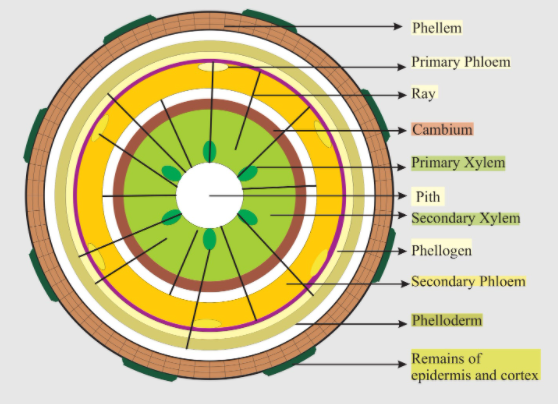
> The word meristem in Greek means division, as cell division takes place here resulting in the growth of a plant. The girth or width of the dicot stem increases by the activity of lateral meristems and this increase in the girth of a plant is known as secondary growth.
> There are two types of lateral meristems responsible for this growth known as vascular cambium and cork cambium. The vascular cambium is responsible for producing new layers of vascular tissues - xylem and phloem. Cork cambium or phellogen is formed by the cortical cells to repair damaged cortical and epidermal cells. The phellogen produces cork or phellem on the outside and secondary cortex or phelloderm on the inside. The phellogen, phellem, and phelloderm made up the periderm.
Additional information:
Let us look at the process of secondary growth in stems.
- The cells present between the primary xylem and primary phloem from the intrafascicular cambium join with the interfascicular cambium of the medullary rays to form a continuous cambium ring.
- The cambium produces new cells on both inner and outer sides. The cells produced on the inner side form secondary xylem whereas the cells produced on the outer side form secondary phloem.
- The cambium is more active on the inner side resulting in the secondary xylem being more thicker than the secondary phloem.
Hence, the correct answer is option ‘C’ i.e ‘Lateral meristem’.
Note:
- The apical meristem of the root is present at the tip of the root while the apical meristem of the shoot is present at the distant most part of the stem axis.
- Some cells are left behind from the shoot apical meristem during the growth of the stem, which forms the axillary bud. This bud is present as the axil of leaves and is capable of forming a new branch or flower.
- Plants like grasses have intercalary meristem which is responsible for regenerating parts that were eaten by grazing herbivores.
Complete answer:
> The word meristem in Greek means division, as cell division takes place here resulting in the growth of a plant. The girth or width of the dicot stem increases by the activity of lateral meristems and this increase in the girth of a plant is known as secondary growth.
> There are two types of lateral meristems responsible for this growth known as vascular cambium and cork cambium. The vascular cambium is responsible for producing new layers of vascular tissues - xylem and phloem. Cork cambium or phellogen is formed by the cortical cells to repair damaged cortical and epidermal cells. The phellogen produces cork or phellem on the outside and secondary cortex or phelloderm on the inside. The phellogen, phellem, and phelloderm made up the periderm.
Additional information:
Let us look at the process of secondary growth in stems.
- The cells present between the primary xylem and primary phloem from the intrafascicular cambium join with the interfascicular cambium of the medullary rays to form a continuous cambium ring.
- The cambium produces new cells on both inner and outer sides. The cells produced on the inner side form secondary xylem whereas the cells produced on the outer side form secondary phloem.
- The cambium is more active on the inner side resulting in the secondary xylem being more thicker than the secondary phloem.
Hence, the correct answer is option ‘C’ i.e ‘Lateral meristem’.
Note:
- The apical meristem of the root is present at the tip of the root while the apical meristem of the shoot is present at the distant most part of the stem axis.
- Some cells are left behind from the shoot apical meristem during the growth of the stem, which forms the axillary bud. This bud is present as the axil of leaves and is capable of forming a new branch or flower.
- Plants like grasses have intercalary meristem which is responsible for regenerating parts that were eaten by grazing herbivores.
Recently Updated Pages
Basicity of sulphurous acid and sulphuric acid are

Master Class 11 English: Engaging Questions & Answers for Success
Master Class 11 Physics: Engaging Questions & Answers for Success
Master Class 11 Computer Science: Engaging Questions & Answers for Success
Master Class 11 Chemistry: Engaging Questions & Answers for Success
Master Class 11 Social Science: Engaging Questions & Answers for Success
Trending doubts
Difference Between Prokaryotic Cells and Eukaryotic Cells
Two of the body parts which do not appear in MRI are class 11 biology CBSE
One Metric ton is equal to kg A 10000 B 1000 C 100 class 11 physics CBSE
10 examples of friction in our daily life
Draw a diagram of nephron and explain its structur class 11 biology CBSE
What will happen if the mucus is not secreted by the class 11 biology CBSE