




Functional unit of the kidney is
(a) Neuron
(b) Axon
(c) Glomerulus
(d) Nephron
Answer
 Verified
618.6k+ views
Hint: Each kidney is formed of one million coiled tubules, that forms the functional unit of kidneys. It is composed of a renal corpuscle and a renal tubule. The renal corpuscle consists of a tuft of capillaries known as glomerulus and an encompassing Bowman's Capsule. These structures regulate the water and other soluble substances in the blood by filtering the blood, reabsorbing the needed elements, and excreting the rest as urine.
Complete answer:
The functional unit of kidneys is nephrons. Kidneys are compound tubular glands. The inner margins of each kidney are concave, the outer margin is convex. On the concave side, there is a depression, known as hilus. From there leads down a duct, called a ureter. Terminally the ureter opens to the urinary bladder. Leading out from the bladder is a tube, called the urethra. A nephron has two portions, namely the Malpighian capsule, and urinary tubule.
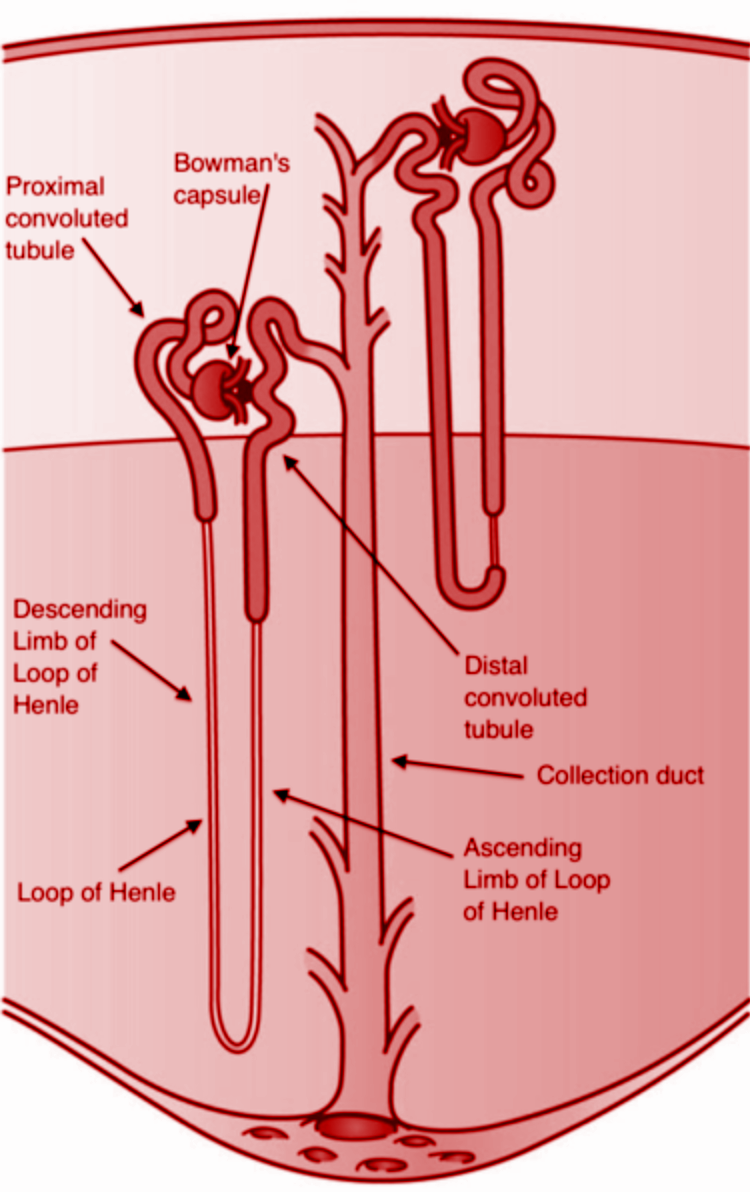
The Malpighian capsule is the basal capsular portion. The urinary tubule is the terminal tubular portion. The Malpighian tubule has two parts, namely glomerulus and Bowman’s capsule. The glomerulus is a vascular network. Bowman’s capsule is a double- walled epithelial cup that encloses the glomerulus. The glomerulus is the center of filtration. Glomerular ultrafiltration is the non-selective ultrafiltration. The fluid filtered is known as glomerular ultrafiltrate. It forms the primary urine. The urinary tubule is the long and coiled part of the neuron. It has two portions namely the proximal secretory part and distal excretory or collecting part. The secretory part in turn has three portions, proximal convoluted tubule (PCT), Henle’s loop, and distal convoluted tubule( DCT). Convoluted tubules are the highly contorted portions, lying in the cortex region. Henle’s loop is a narrow loop- like the middle portion, lying in the medulla. It has two limbs, namely a descending limb and an ascending limb.
So, the correct answer is ‘Nephron’.
Additional information:
- Terminally, the excretory portions of several tubules join to form a collecting tubule.
- Several collecting ducts join to form a discharging tubule which is also known as the duct of Bellini.
- Several discharging ducts open to the pelvis at the summits of the renal pyramid.
- From the pelvis leads out the urinary duct or ureter.
- Blood enters the glomerulus through an afferent arteriole, which is a branch of the renal artery.
- This arteriole breaks up into a capillary network. Terminally these capillaries join together to form a different arteriole., which carries blood away from the glomerulus.
Note:
- As the afferent arteriole approaches the bowman's capsule, the smooth muscle of the cell wall becomes highly modified. Their nuclei become rounded and the cytoplasm becomes highly granular. These modified cells are called juxtaglomerular cells.
- The cells of the distal convoluted tubule, adjacent to the afferent arteriole, become considerably narrower. They are called muscular densa.
- There are specialized cells between afferent and efferent arterioles. They are called granular cells.
Complete answer:
The functional unit of kidneys is nephrons. Kidneys are compound tubular glands. The inner margins of each kidney are concave, the outer margin is convex. On the concave side, there is a depression, known as hilus. From there leads down a duct, called a ureter. Terminally the ureter opens to the urinary bladder. Leading out from the bladder is a tube, called the urethra. A nephron has two portions, namely the Malpighian capsule, and urinary tubule.
The Malpighian capsule is the basal capsular portion. The urinary tubule is the terminal tubular portion. The Malpighian tubule has two parts, namely glomerulus and Bowman’s capsule. The glomerulus is a vascular network. Bowman’s capsule is a double- walled epithelial cup that encloses the glomerulus. The glomerulus is the center of filtration. Glomerular ultrafiltration is the non-selective ultrafiltration. The fluid filtered is known as glomerular ultrafiltrate. It forms the primary urine. The urinary tubule is the long and coiled part of the neuron. It has two portions namely the proximal secretory part and distal excretory or collecting part. The secretory part in turn has three portions, proximal convoluted tubule (PCT), Henle’s loop, and distal convoluted tubule( DCT). Convoluted tubules are the highly contorted portions, lying in the cortex region. Henle’s loop is a narrow loop- like the middle portion, lying in the medulla. It has two limbs, namely a descending limb and an ascending limb.
So, the correct answer is ‘Nephron’.
Additional information:
- Terminally, the excretory portions of several tubules join to form a collecting tubule.
- Several collecting ducts join to form a discharging tubule which is also known as the duct of Bellini.
- Several discharging ducts open to the pelvis at the summits of the renal pyramid.
- From the pelvis leads out the urinary duct or ureter.
- Blood enters the glomerulus through an afferent arteriole, which is a branch of the renal artery.
- This arteriole breaks up into a capillary network. Terminally these capillaries join together to form a different arteriole., which carries blood away from the glomerulus.
Note:
- As the afferent arteriole approaches the bowman's capsule, the smooth muscle of the cell wall becomes highly modified. Their nuclei become rounded and the cytoplasm becomes highly granular. These modified cells are called juxtaglomerular cells.
- The cells of the distal convoluted tubule, adjacent to the afferent arteriole, become considerably narrower. They are called muscular densa.
- There are specialized cells between afferent and efferent arterioles. They are called granular cells.
Recently Updated Pages
Master Class 11 English: Engaging Questions & Answers for Success

Master Class 11 Social Science: Engaging Questions & Answers for Success
Master Class 11 Maths: Engaging Questions & Answers for Success
Master Class 11 Biology: Engaging Questions & Answers for Success
Master Class 11 Physics: Engaging Questions & Answers for Success
Master Class 11 Chemistry: Engaging Questions & Answers for Success
Trending doubts
One Metric ton is equal to kg A 10000 B 1000 C 100 class 11 physics CBSE
Difference Between Prokaryotic Cells and Eukaryotic Cells
1 ton equals to A 100 kg B 1000 kg C 10 kg D 10000 class 11 physics CBSE
Find the value of the expression given below sin 30circ class 11 maths CBSE
Two of the body parts which do not appear in MRI are class 11 biology CBSE
What are hard magnetic materials class 11 physics CBSE