




What is the function of the tail of human sperm?
Answer
 Verified
516.3k+ views
Hint: In anisogamous forms of sexual reproduction, sperm is the male reproductive cell, or gamete (forms in which there is a larger, female reproductive cell and a smaller, male one). Animals produce spermatozoa, which are motile sperm with a flagellum tail, whereas red algae and fungi produce spermatia, which are non-motile sperm cells.
Complete answer:
The human gamete consists of three main parts: head, middle piece, and tail. The foremost operation of the tail is to provide motility to the gamete. With its whipping movement, it propels the gamete towards the egg.
The tip of the gamete head is that portion mentioned because of the process that permits the gamete to penetrate the egg. The midpiece contains the mitochondria that provide the energy the tail must move. The tail moves with whip-like movements back and forth to propel the gamete towards the egg.
The tail provides sperm movement. It whips and undulates so that the cell will travel the egg. Following gamete deposition within the female generative tract, activation of tail movement is suppressed till the gamete is carried to at intervals a relatively short distance of the egg.
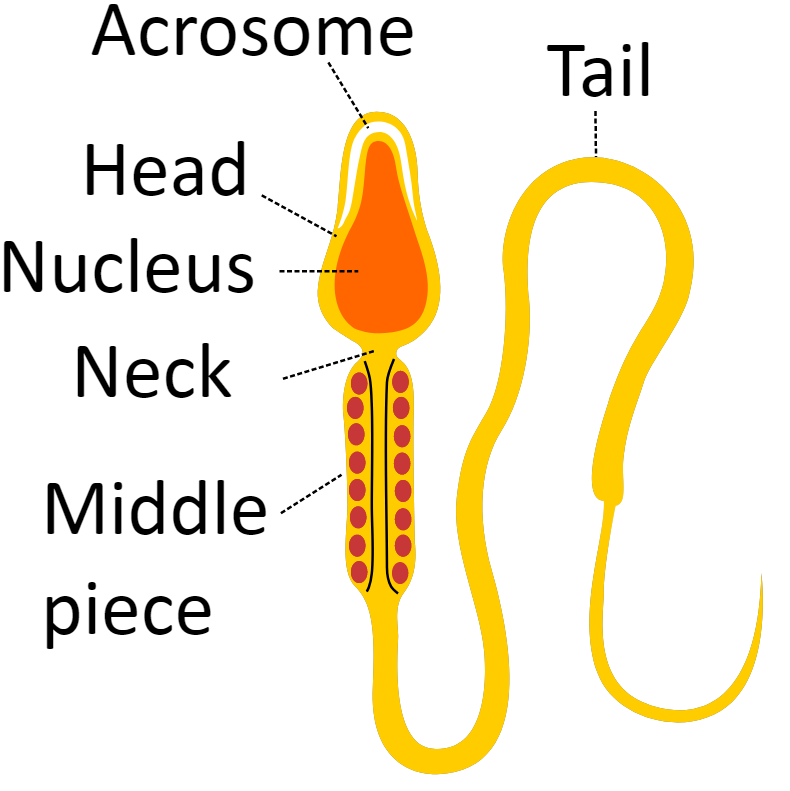
Thus, The tail's primary function is to provide sperm motility. It propels the sperm towards the egg with its whipping motion.
Note:
Sperm cells are unable to divide and have a short lifespan, but after fusing with egg cells during fertilization, a new organism emerges, beginning as a totipotent zygote. Human sperm cells are haploid, which means that their 23 chromosomes can join with the 23 chromosomes of the female egg to form a diploid cell with 46 paired chromosomes.
Complete answer:
The human gamete consists of three main parts: head, middle piece, and tail. The foremost operation of the tail is to provide motility to the gamete. With its whipping movement, it propels the gamete towards the egg.
The tip of the gamete head is that portion mentioned because of the process that permits the gamete to penetrate the egg. The midpiece contains the mitochondria that provide the energy the tail must move. The tail moves with whip-like movements back and forth to propel the gamete towards the egg.
The tail provides sperm movement. It whips and undulates so that the cell will travel the egg. Following gamete deposition within the female generative tract, activation of tail movement is suppressed till the gamete is carried to at intervals a relatively short distance of the egg.
Thus, The tail's primary function is to provide sperm motility. It propels the sperm towards the egg with its whipping motion.
Note:
Sperm cells are unable to divide and have a short lifespan, but after fusing with egg cells during fertilization, a new organism emerges, beginning as a totipotent zygote. Human sperm cells are haploid, which means that their 23 chromosomes can join with the 23 chromosomes of the female egg to form a diploid cell with 46 paired chromosomes.
Recently Updated Pages
Master Class 12 Business Studies: Engaging Questions & Answers for Success

Master Class 12 Biology: Engaging Questions & Answers for Success
Master Class 12 Chemistry: Engaging Questions & Answers for Success
Class 12 Question and Answer - Your Ultimate Solutions Guide
Master Class 11 Social Science: Engaging Questions & Answers for Success
Master Class 11 English: Engaging Questions & Answers for Success
Trending doubts
Explain the Treaty of Vienna of 1815 class 10 social science CBSE
Who Won 36 Oscar Awards? Record Holder Revealed
What is the median of the first 10 natural numbers class 10 maths CBSE
Why is it 530 pm in india when it is 1200 afternoon class 10 social science CBSE
What is the full form of POSCO class 10 social science CBSE
The highest temperature in Karnataka is recorded in class 10 social science CBSE