




What is the function of blood vessels and capillaries?
(a)They pump blood to the heart
(b)They filter impurities from the blood
(c)They carry blood to all parts of the body
(d)They carry messages from the brain to muscles
Answer
 Verified
651.3k+ views
Hint: Blood vessels are the major part of the circulatory system. Blood vessels are the passage by which blood is distributed to all the body tissue. The blood vessel generally makes two closed systems which start and end at the heart.
Complete answer:
-Blood vessels carry blood accompanied by oxygen, nutrients, water, and hormones throughout the body because they have a flexible tube.
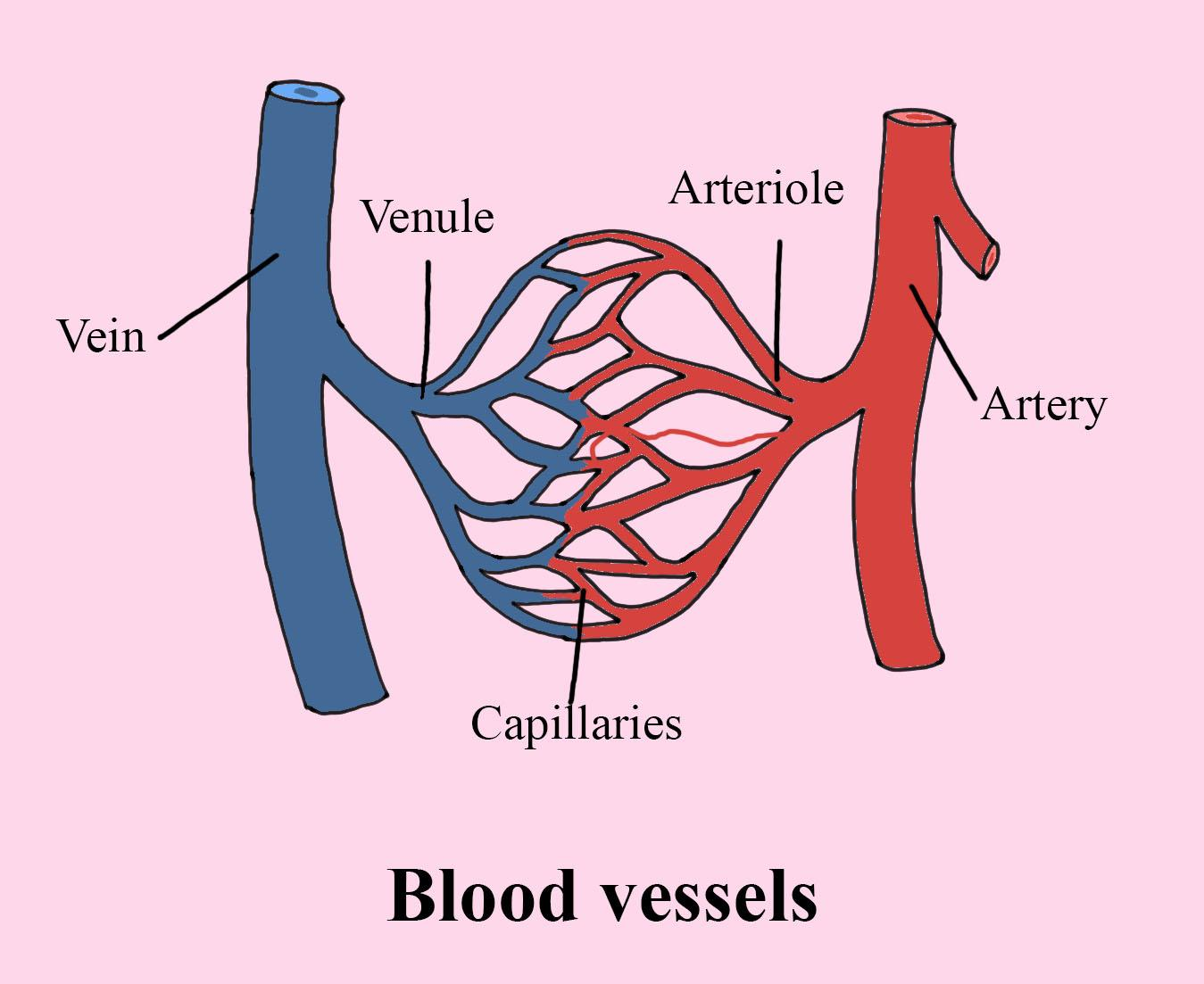
-The blood vessel comprises arteries, Arterioles, capillaries, venules, and veins.
Arteries and arterioles
Arteries are well built, they are flexible which carries blood away from the heart. It also carries high blood pressure. As the arteries are flexible, they become confined when the heart is relaxing. In this way, arteries maintain the blood pressure of the body.
-The arteries split into many smaller vessels and in the end become very small vessels called Arterioles. They both have a muscular wall; accordingly, they maintain their size(diameter) to increase or decrease the flow of blood to a particular body part.
Capillaries-
Capillaries are very thin and small vessels act as a connection between arteries(carry blood away from the heart) and veins (carry blood again back to the heart). The capillaries allow Oxygen and nutrients to pass from the blood into the tissues and carry waste products from tissues to the blood.
Additional Information: -Blood vessels are the main component of our circulatory system that helps in distributing blood to all the body parts.
The three important types of blood vessels are-
-Arteries carry blood away from the heart into arterioles to the body parts. Thus, forming the capillary network
-Now it carries the exchange of chemicals between the tissues and blood.
-Finally, capillaries combined into venules. Thus forming larger veins. Veins are important for returning the blood to the heart and anastomoses are known as junctions between blood and the heart.
So, the correct answer is, "they carry blood to all parts of the body".
Note: -So, blood vessels consist of arteries, arterioles, capillaries, venules, and veins.
-There is a single lining of endothelium and associated connective tissues in the capillaries.
-Capillaries were first discovered in 1661, after the observation of anatomical features of the brain and other organs by Marcello Malpighi.
Complete answer:
-Blood vessels carry blood accompanied by oxygen, nutrients, water, and hormones throughout the body because they have a flexible tube.
-The blood vessel comprises arteries, Arterioles, capillaries, venules, and veins.
Arteries and arterioles
Arteries are well built, they are flexible which carries blood away from the heart. It also carries high blood pressure. As the arteries are flexible, they become confined when the heart is relaxing. In this way, arteries maintain the blood pressure of the body.
-The arteries split into many smaller vessels and in the end become very small vessels called Arterioles. They both have a muscular wall; accordingly, they maintain their size(diameter) to increase or decrease the flow of blood to a particular body part.
Capillaries-
Capillaries are very thin and small vessels act as a connection between arteries(carry blood away from the heart) and veins (carry blood again back to the heart). The capillaries allow Oxygen and nutrients to pass from the blood into the tissues and carry waste products from tissues to the blood.
Additional Information: -Blood vessels are the main component of our circulatory system that helps in distributing blood to all the body parts.
The three important types of blood vessels are-
-Arteries carry blood away from the heart into arterioles to the body parts. Thus, forming the capillary network
-Now it carries the exchange of chemicals between the tissues and blood.
-Finally, capillaries combined into venules. Thus forming larger veins. Veins are important for returning the blood to the heart and anastomoses are known as junctions between blood and the heart.
So, the correct answer is, "they carry blood to all parts of the body".
Note: -So, blood vessels consist of arteries, arterioles, capillaries, venules, and veins.
-There is a single lining of endothelium and associated connective tissues in the capillaries.
-Capillaries were first discovered in 1661, after the observation of anatomical features of the brain and other organs by Marcello Malpighi.
Recently Updated Pages
Which will be the least stable resonating structure class 11 chemistry CBSE

How many 5 digit telephone numbers can be construc-class-11-maths-CBSE
How do you find the angle of the resultant vector class 11 physics CBSE
Draw labelled diagram of the following i Gram seed class 11 biology CBSE
1 Quintal is equal to a 110 kg b 10 kg c 100kg d 1000 class 11 physics CBSE
What is the need and importance of classification class 11 biology CBSE
Trending doubts
Find the value of the expression given below sin 30circ class 11 maths CBSE
One Metric ton is equal to kg A 10000 B 1000 C 100 class 11 physics CBSE
10 examples of friction in our daily life
Draw a diagram of a plant cell and label at least eight class 11 biology CBSE
Proton was discovered by A Thomson B Rutherford C Chadwick class 11 chemistry CBSE
10 examples of diffusion in everyday life