



What is the function of a three chambered heart of an amphibian?
Answer
 Verified
580.2k+ views
Hint: It is one of the categorising classes for living organisms designed by scientists to make studies easier. Individuals of those species who have capability to survive in both water and on land such as frogs, toads, etc.
Complete answer:
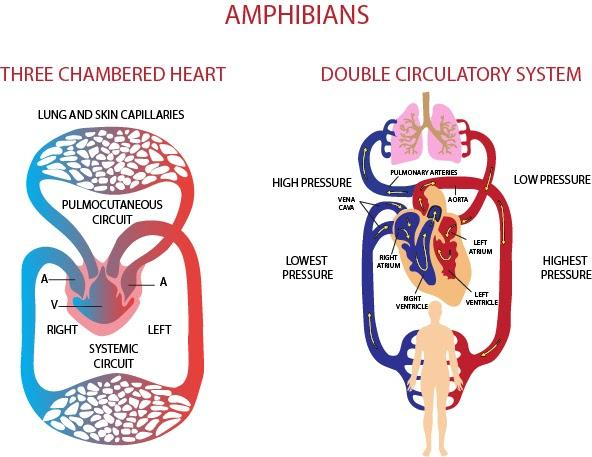
Pattern of functioning of a three chambered heart of an amphibian is discussed below:
It pumps oxygenated and deoxygenated blood throughout the body.
It has a total of two atrium chambers (carrying deoxygenated blood) and one ventricle (carrying oxygenated blood).
The process of pumping blood completes in two cycles. The first cycle involves oxygenated blood from body organs to an auricle that pours it into the ventricle. The blood in the ventricles is then transferred to the lungs where it gets oxygenated and moves to the next auricle. This auricle now pumps the blood throughout the body to transfer oxygen, thus, completing the next cycle.
Amphibians are vertebrates and cold blooded animals that are found everywhere on the planet. Their three chambered hearts imparts them a distinct blood circulating feature. They are known to exhibit double life cycles as they spent their early life in the larval stage while adulthood with common body structure. they breathe through skin while using their gills whereas breathe through their nose while using their lungs.
Note:
Amphibians can survive on both water and land because they have both aquatic gill based breathing systems to survive inside water and the lungs based breathing systems to survive on land. This imparts these organisms a capability to adjust according to their environment.
Complete answer:
Pattern of functioning of a three chambered heart of an amphibian is discussed below:
It pumps oxygenated and deoxygenated blood throughout the body.
It has a total of two atrium chambers (carrying deoxygenated blood) and one ventricle (carrying oxygenated blood).
The process of pumping blood completes in two cycles. The first cycle involves oxygenated blood from body organs to an auricle that pours it into the ventricle. The blood in the ventricles is then transferred to the lungs where it gets oxygenated and moves to the next auricle. This auricle now pumps the blood throughout the body to transfer oxygen, thus, completing the next cycle.
Amphibians are vertebrates and cold blooded animals that are found everywhere on the planet. Their three chambered hearts imparts them a distinct blood circulating feature. They are known to exhibit double life cycles as they spent their early life in the larval stage while adulthood with common body structure. they breathe through skin while using their gills whereas breathe through their nose while using their lungs.
Note:
Amphibians can survive on both water and land because they have both aquatic gill based breathing systems to survive inside water and the lungs based breathing systems to survive on land. This imparts these organisms a capability to adjust according to their environment.
Recently Updated Pages
Master Class 11 Social Science: Engaging Questions & Answers for Success

Master Class 11 English: Engaging Questions & Answers for Success
Master Class 11 Accountancy: Engaging Questions & Answers for Success
Master Class 11 Physics: Engaging Questions & Answers for Success
Master Class 11 Computer Science: Engaging Questions & Answers for Success
Master Class 11 Business Studies: Engaging Questions & Answers for Success
Trending doubts
Find the value of the expression given below sin 30circ class 11 maths CBSE
One Metric ton is equal to kg A 10000 B 1000 C 100 class 11 physics CBSE
Draw a diagram of nephron and explain its structur class 11 biology CBSE
10 examples of friction in our daily life
Proton was discovered by A Thomson B Rutherford C Chadwick class 11 chemistry CBSE
The teeth used for biting and cutting food are called class 11 biology CBSE