




Fruit of citrus is technically
(a)Hesperidium
(b)Pome
(c)Pepo
(d)Berry
Answer
 Verified
646.2k+ views
Hint: Citrus fruits have endocarp with a sub-epidermal juicy hair. They have a spongy white mesocarp and leathery epicarp, with oil glands. It is fruit inside a separable rind with sectioned pulp. For citrus fruit the example is lemon.
Complete answer:
Hesperidium is a multi-chambered, seeded fleshy fruit produced from the multidisciplinary, synchronous, and superior ovary. The epicarp is thin and smooth, leathery, and glandular e.g., lemons and oranges.
Pome is a fruit developed from the thalamus.
Pepo is a berry with an edible mesocarp, endocarp, and placenta and a hard epicarp.
Berry is a fleshy, edible fruit with a pericarp.
Additional Information: The largest citrus fruit is the pomelo, sometimes called Chinese grapefruit, thick-skinned with a rind that is popular for cooking and marmalades.
A good example of a pepo is the watermelon, a berry with a hard, thick rind. Citrullus lanatus is a "yellow watermelon" triploid and seedless. Although it is sold as "seedless," the fleshy interior contains some seeds.
Although tomato is known as a "vegetable," it is technically a botanical fruit known as a berry. The bulk of a true berry’s inner tissue is soft and fleshy.
A fleshy fruit with thin skin and a stony endocarp seed within constitutes the drupe.
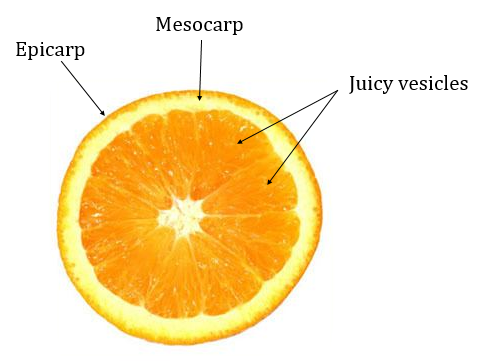
So, the correct answer is 'Hesperidium'.
Note: The name citrus derived from the Greek word for cedar, perhaps due to similar odors. Citrus fruits are known as agrumes, meaning roughly 'sour fruits." The majority of citrus fruits come from a small group of plants that are probably derived from about four species in Southeast Asia. Oranges, grapefruits, tangerines, limes, and lemons are the most common.
Complete answer:
Hesperidium is a multi-chambered, seeded fleshy fruit produced from the multidisciplinary, synchronous, and superior ovary. The epicarp is thin and smooth, leathery, and glandular e.g., lemons and oranges.
Pome is a fruit developed from the thalamus.
Pepo is a berry with an edible mesocarp, endocarp, and placenta and a hard epicarp.
Berry is a fleshy, edible fruit with a pericarp.
Additional Information: The largest citrus fruit is the pomelo, sometimes called Chinese grapefruit, thick-skinned with a rind that is popular for cooking and marmalades.
A good example of a pepo is the watermelon, a berry with a hard, thick rind. Citrullus lanatus is a "yellow watermelon" triploid and seedless. Although it is sold as "seedless," the fleshy interior contains some seeds.
Although tomato is known as a "vegetable," it is technically a botanical fruit known as a berry. The bulk of a true berry’s inner tissue is soft and fleshy.
A fleshy fruit with thin skin and a stony endocarp seed within constitutes the drupe.
So, the correct answer is 'Hesperidium'.
Note: The name citrus derived from the Greek word for cedar, perhaps due to similar odors. Citrus fruits are known as agrumes, meaning roughly 'sour fruits." The majority of citrus fruits come from a small group of plants that are probably derived from about four species in Southeast Asia. Oranges, grapefruits, tangerines, limes, and lemons are the most common.
Recently Updated Pages
Master Class 11 Social Science: Engaging Questions & Answers for Success

Master Class 11 Accountancy: Engaging Questions & Answers for Success
Master Class 11 Maths: Engaging Questions & Answers for Success
Master Class 11 Chemistry: Engaging Questions & Answers for Success
Master Class 11 English: Engaging Questions & Answers for Success
Master Class 11 Physics: Engaging Questions & Answers for Success
Trending doubts
Difference Between Prokaryotic Cells and Eukaryotic Cells
Find the value of the expression given below sin 30circ class 11 maths CBSE
One Metric ton is equal to kg A 10000 B 1000 C 100 class 11 physics CBSE
Two of the body parts which do not appear in MRI are class 11 biology CBSE
10 examples of friction in our daily life
Draw a diagram of nephron and explain its structur class 11 biology CBSE