




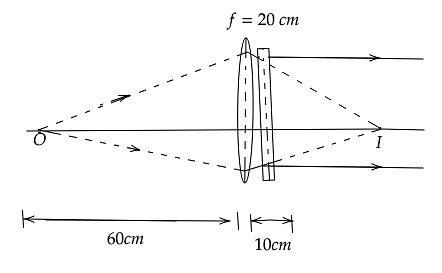
From the ray diagram show, calculate the focal length of the concave lens.
Answer
 Verified
608.1k+ views
Hint: We should understand the lens formula according to the above diagram, so we know the focal length and object distance value. a ray diagram, one helpful tool that is sometimes used to portray this concept is known. So, we use the concave lens formula to find the picture distance, and we also understand the definition of focal length to evaluate the given problem.
Useful formula:
The lens formula
$\dfrac{1}{f} = \dfrac{1}{u} + \dfrac{1}{v}$
$f = $ focal length
$u = $ object distance
$v = $image distance
Complete answer:
Given by,
$u = 60\,cm$
$f = 20\,cm$
Above diagram is represented as,
A concave lens is a lens that has at least one inward-curving surface. It is a diverging lens, which means that light rays that have been refracted into it are spread out. At its middle, a concave lens is thinner than at its edges and is used to correct short-sightedness (myopia).
According to the lens formula,
$\dfrac{1}{f} = \dfrac{1}{u} + \dfrac{1}{v}$
substituting the given value in above equation,
We get,
$\dfrac{1}{v} + \dfrac{1}{{60}} = \dfrac{1}{{20}}$
On simplifying the above equation,
Here,
$\dfrac{1}{v} = \dfrac{1}{{30}}$
Now,
the relationship between the distance of an image
$v = 30\,cm$
Hence,
Focal length of concave lens is $30 - 10 = 20cm$
Note:
Since the distance between the concave mirror pole 0 and the focus F is the concave mirror's focal length. Therefore, it is possible to approximate the focal length of a concave mirror by obtaining a real image of a distant object at its focal point. A ray diagram that traces the path taken by light for a person to view a point in an object's image.
Useful formula:
The lens formula
$\dfrac{1}{f} = \dfrac{1}{u} + \dfrac{1}{v}$
$f = $ focal length
$u = $ object distance
$v = $image distance
Complete answer:
Given by,
$u = 60\,cm$
$f = 20\,cm$
Above diagram is represented as,
A concave lens is a lens that has at least one inward-curving surface. It is a diverging lens, which means that light rays that have been refracted into it are spread out. At its middle, a concave lens is thinner than at its edges and is used to correct short-sightedness (myopia).
According to the lens formula,
$\dfrac{1}{f} = \dfrac{1}{u} + \dfrac{1}{v}$
substituting the given value in above equation,
We get,
$\dfrac{1}{v} + \dfrac{1}{{60}} = \dfrac{1}{{20}}$
On simplifying the above equation,
Here,
$\dfrac{1}{v} = \dfrac{1}{{30}}$
Now,
the relationship between the distance of an image
$v = 30\,cm$
Hence,
Focal length of concave lens is $30 - 10 = 20cm$
Note:
Since the distance between the concave mirror pole 0 and the focus F is the concave mirror's focal length. Therefore, it is possible to approximate the focal length of a concave mirror by obtaining a real image of a distant object at its focal point. A ray diagram that traces the path taken by light for a person to view a point in an object's image.
Recently Updated Pages
Master Class 5 English: Engaging Questions & Answers for Success

Master Class 5 Maths: Engaging Questions & Answers for Success
Master Class 5 Social Science: Engaging Questions & Answers for Success
Master Class 5 Science: Engaging Questions & Answers for Success
Class 5 Question and Answer - Your Ultimate Solutions Guide
Master Class 9 General Knowledge: Engaging Questions & Answers for Success
Trending doubts
Which are the Top 10 Largest Countries of the World?
The total number of vertebrae in man is a30 b31 c32 class 12 biology CBSE
Draw a labelled sketch of the human eye class 12 physics CBSE
The number of cranial nerves in a frog is A 10 pairs class 12 biology CBSE
Differentiate between homogeneous and heterogeneous class 12 chemistry CBSE
Antibodies present in colostrum which protect the new class 12 biology CBSE