




From any point $P$ on the ellipse, $PN$ is drawn perpendicular to the $x$ axis and produced to $Q$, so that $NQ$ equals $PS$, where $S$ is a focus. Prove that the locus of $Q$ is the two straight lines
\[y\pm ex+a=0\].
Answer
 Verified
625.8k+ views
Hint: First, make sure you draw the diagram of the ellipse, as this is a general problem without any values given, so it will be very convenient to get confused otherwise. Next, remember the equations of the directrices and the foci of the ellipse, and proceed to make use of the distance of point $P$ from either of the two foci and the directrices to find the eccentricity of the ellipse. This will make the question easier to tackle.
Complete step-by-step answer:
Let’s assume an ellipse \[\dfrac{{{x}^{2}}}{{{a}^{2}}}+\dfrac{{{y}^{2}}}{{{b}^{2}}}=1\]
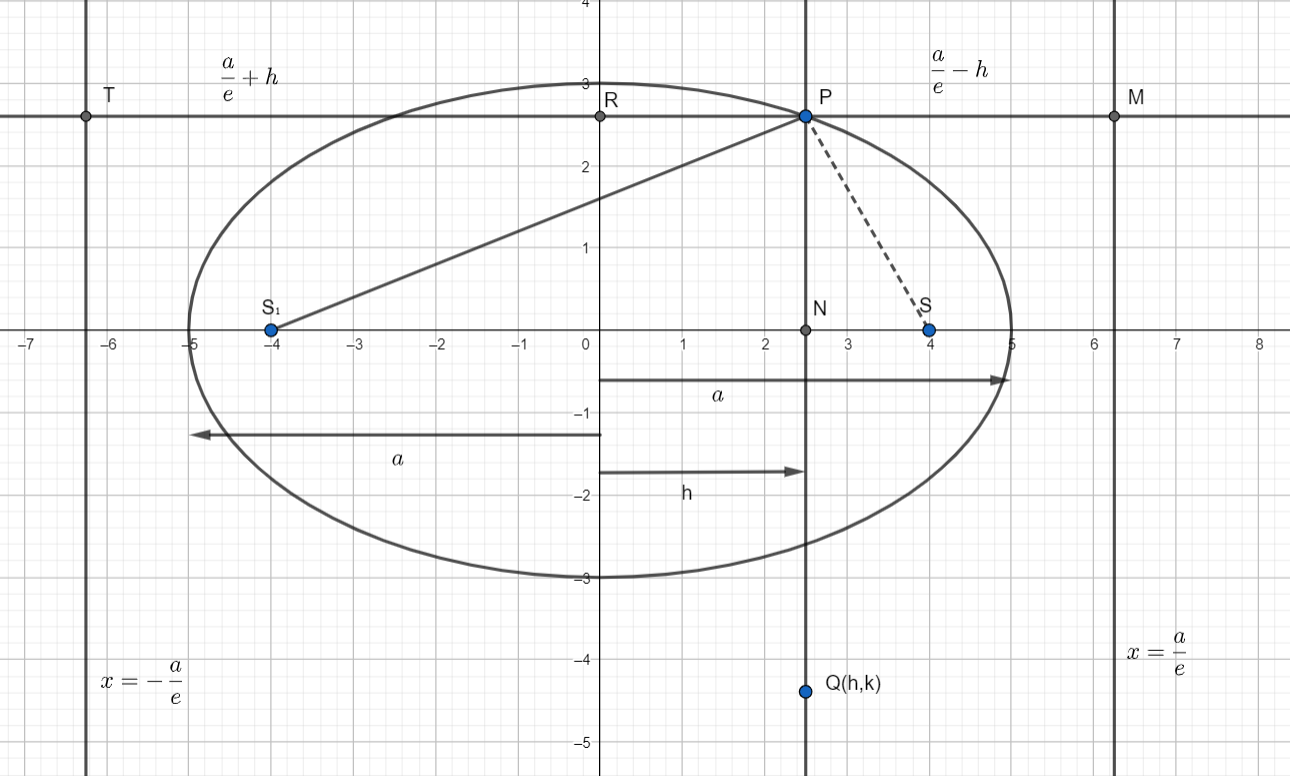
\[S\,\,and\,\,{{S}_{1}}\]are foci of the ellipse.
\[x=\dfrac{a}{e}\,\,and\,\,x=-\dfrac{a}{e}\,\] are directrix of the ellipse.
According to the question let’s assume a point $P$ on the ellipse and draw a perpendicular on the $x$axis with at $N$ and extend up to a point $Q$.
Let co-ordinates of the point\[Q\equiv (h,k)\].
From the above diagram,
The horizontal distance of point $Q$ from the $y$ axis \[=h\] (because $h$ is the $x$ coordinate of point $Q$).
\[MR=\dfrac{a}{e}\]
\[PM=MR-RP\]
\[\therefore PM=\dfrac{a}{e}-h\] ………… (A)
Similarly,
$\begin{align}
& RT=\dfrac{a}{e} \\
& PT=PR+TR \\
& \Rightarrow PT=\dfrac{a}{e}+h \\
\end{align}$
\[PT=\dfrac{a}{e}+h\] ……………. (B)
From the definition of an ellipse
Eccentricity \[e=\dfrac{PS}{PM}=\dfrac{P{{S}_{1}}}{PT}\] ………. (1)
From the expression (1)
\[\begin{align}
& PS=ePM \\
& \Rightarrow PS=e\left( \dfrac{a}{e}-h \right)=a-eh \\
\end{align}\] (From A) ………… (2)
\[\begin{align}
& P{{S}_{1}}=ePT \\
& \Rightarrow P{{S}_{1}}=e\left( \dfrac{a}{e}+h \right) \\
\end{align}\] (From B) ………… (3)
Now, given that
The absolute value of $NQ$= Absolute value of $PS$ or $P{{S}_{1}}$
Since the segment $NQ$ is below the $x$ axis.
\[NQ=PS\,\,or\,\,P{{S}_{1}}\]
\[NQ=|k|\] , Because $k$ is $y$coordinate of point $Q$.
Distance
\[\Rightarrow PS\,=a-eh\] from eq. (2)
\[\Rightarrow P{{S}_{1}}\,=a+eh\] from eq. (3)
\[\Rightarrow k\,=a\pm eh\]
\[\Rightarrow k\,\pm eh-a=0\]
Therefore; the locus of the point $Q$ with co-ordinates\[(h,k)\], can be formed by replacing\[(h,k)\to (x,y)\].
\[\therefore y\,\pm ex-a=0\].
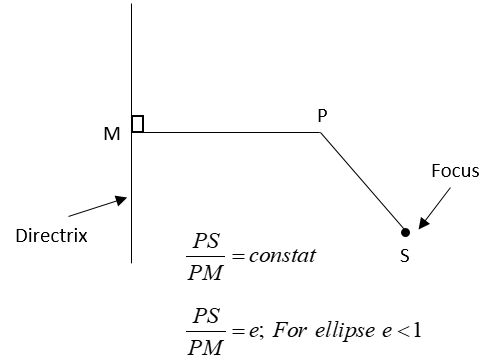
Note: Ellipse is the locus of a point which moves in a plane such that the ratio of its distance from a fixed straight line always remains constant and that constant value is known as eccentricity .
Complete step-by-step answer:
Let’s assume an ellipse \[\dfrac{{{x}^{2}}}{{{a}^{2}}}+\dfrac{{{y}^{2}}}{{{b}^{2}}}=1\]
\[S\,\,and\,\,{{S}_{1}}\]are foci of the ellipse.
\[x=\dfrac{a}{e}\,\,and\,\,x=-\dfrac{a}{e}\,\] are directrix of the ellipse.
According to the question let’s assume a point $P$ on the ellipse and draw a perpendicular on the $x$axis with at $N$ and extend up to a point $Q$.
Let co-ordinates of the point\[Q\equiv (h,k)\].
From the above diagram,
The horizontal distance of point $Q$ from the $y$ axis \[=h\] (because $h$ is the $x$ coordinate of point $Q$).
\[MR=\dfrac{a}{e}\]
\[PM=MR-RP\]
\[\therefore PM=\dfrac{a}{e}-h\] ………… (A)
Similarly,
$\begin{align}
& RT=\dfrac{a}{e} \\
& PT=PR+TR \\
& \Rightarrow PT=\dfrac{a}{e}+h \\
\end{align}$
\[PT=\dfrac{a}{e}+h\] ……………. (B)
From the definition of an ellipse
Eccentricity \[e=\dfrac{PS}{PM}=\dfrac{P{{S}_{1}}}{PT}\] ………. (1)
From the expression (1)
\[\begin{align}
& PS=ePM \\
& \Rightarrow PS=e\left( \dfrac{a}{e}-h \right)=a-eh \\
\end{align}\] (From A) ………… (2)
\[\begin{align}
& P{{S}_{1}}=ePT \\
& \Rightarrow P{{S}_{1}}=e\left( \dfrac{a}{e}+h \right) \\
\end{align}\] (From B) ………… (3)
Now, given that
The absolute value of $NQ$= Absolute value of $PS$ or $P{{S}_{1}}$
Since the segment $NQ$ is below the $x$ axis.
\[NQ=PS\,\,or\,\,P{{S}_{1}}\]
\[NQ=|k|\] , Because $k$ is $y$coordinate of point $Q$.
Distance
\[\Rightarrow PS\,=a-eh\] from eq. (2)
\[\Rightarrow P{{S}_{1}}\,=a+eh\] from eq. (3)
\[\Rightarrow k\,=a\pm eh\]
\[\Rightarrow k\,\pm eh-a=0\]
Therefore; the locus of the point $Q$ with co-ordinates\[(h,k)\], can be formed by replacing\[(h,k)\to (x,y)\].
\[\therefore y\,\pm ex-a=0\].
Note: Ellipse is the locus of a point which moves in a plane such that the ratio of its distance from a fixed straight line always remains constant and that constant value is known as eccentricity .
Recently Updated Pages
Master Class 11 Business Studies: Engaging Questions & Answers for Success

Master Class 11 Computer Science: Engaging Questions & Answers for Success
Master Class 11 Economics: Engaging Questions & Answers for Success
Master Class 11 Social Science: Engaging Questions & Answers for Success
Master Class 11 English: Engaging Questions & Answers for Success
Master Class 11 Chemistry: Engaging Questions & Answers for Success
Trending doubts
Draw a diagram of nephron and explain its structur class 11 biology CBSE
Explain zero factorial class 11 maths CBSE
Chemical formula of Bleaching powder is A Ca2OCl2 B class 11 chemistry CBSE
Name the part of the brain responsible for the precision class 11 biology CBSE
The growth of tendril in pea plants is due to AEffect class 11 biology CBSE
One Metric ton is equal to kg A 10000 B 1000 C 100 class 11 physics CBSE