




From a solid cylinder of height 4 cm and radius 3 cm, a conical cavity of height 4 cm and of base radius 3 cm is hollowed out. What is the total surface area of the remaining solid?
A. \[15\pi \] square cm
B. \[22\pi \] square cm
C. \[33\pi \] square cm
D. \[48\pi \] square cm
Answer
 Verified
631.5k+ views
Hint: First of all, find the slant height of the conical cavity. Then the remaining total surface area of the remaining solid is the sum of the curved surface areas of the conical cavity and cylinder and the area of the base of the cylinder. So, use this concept to reach the solution of the given problem.
Complete step-by-step answer:
Given,
Radius of the cylinder \[r = 3{\text{ cm}}\]
Radius of conical cavity \[r = 3{\text{ cm}}\]
Height of the cylinder \[h = 4{\text{ cm}}\]
Height of the conical cavity \[h = 4{\text{ cm}}\]
We know that the slant height of the conical cavity of radius \[r\] and height \[h\] is given by \[l = \sqrt {{r^2} + {h^2}} \] as shown in the below figure:
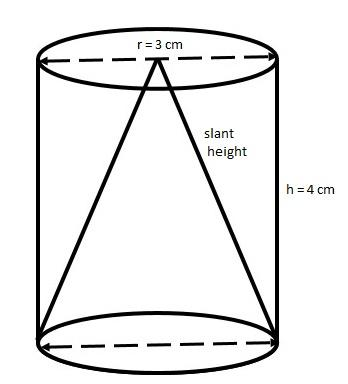
Let \[l\] be the slant of the conical cavity which is given by
\[l = \sqrt {{3^2} + {4^2}} = \sqrt {9 + 16} = \sqrt {25} = 5{\text{ cm}}\]
We know that the curved surface area of the conical cavity of radius \[r\] and slant height
\[l\] is given by\[\pi rl\]. The curved surface area of the cylinder of radius \[r\] and height
\[h\] is given by \[2\pi rh\]. And the area of the base of the cylinder of radius \[r\] is given by
\[\pi {r^2}\].
From the figure, it is clear that
Total surface area of remaining solid = curved surface area of conical cavity + curved surface area of cylinder + area of base of cylinder.
Therefore, total surface area of remaining solid is
\[
= \pi rl + 2\pi rh + \pi {r^2} \\
= \pi r\left( {l + 2h + r} \right) \\
= \pi 3\left( {5 + 2 \times 4 + 3} \right) \\
= 3\pi \left( {16} \right) \\
= 48\pi \\
\]
Hence the total surface area of remaining solid is \[48\pi \] square cm
Thus, the correct option is D. \[48\pi \] square cm
Note: The curved surface area of the conical cavity of radius \[r\] and slant height \[l\] is given by\[\pi rl\]. The curved surface area of the cylinder of radius \[r\] and height \[h\] is given by \[2\pi rh\]. And the area of the base of the cylinder of radius \[r\] is given by \[\pi {r^2}\].
Complete step-by-step answer:
Given,
Radius of the cylinder \[r = 3{\text{ cm}}\]
Radius of conical cavity \[r = 3{\text{ cm}}\]
Height of the cylinder \[h = 4{\text{ cm}}\]
Height of the conical cavity \[h = 4{\text{ cm}}\]
We know that the slant height of the conical cavity of radius \[r\] and height \[h\] is given by \[l = \sqrt {{r^2} + {h^2}} \] as shown in the below figure:
Let \[l\] be the slant of the conical cavity which is given by
\[l = \sqrt {{3^2} + {4^2}} = \sqrt {9 + 16} = \sqrt {25} = 5{\text{ cm}}\]
We know that the curved surface area of the conical cavity of radius \[r\] and slant height
\[l\] is given by\[\pi rl\]. The curved surface area of the cylinder of radius \[r\] and height
\[h\] is given by \[2\pi rh\]. And the area of the base of the cylinder of radius \[r\] is given by
\[\pi {r^2}\].
From the figure, it is clear that
Total surface area of remaining solid = curved surface area of conical cavity + curved surface area of cylinder + area of base of cylinder.
Therefore, total surface area of remaining solid is
\[
= \pi rl + 2\pi rh + \pi {r^2} \\
= \pi r\left( {l + 2h + r} \right) \\
= \pi 3\left( {5 + 2 \times 4 + 3} \right) \\
= 3\pi \left( {16} \right) \\
= 48\pi \\
\]
Hence the total surface area of remaining solid is \[48\pi \] square cm
Thus, the correct option is D. \[48\pi \] square cm
Note: The curved surface area of the conical cavity of radius \[r\] and slant height \[l\] is given by\[\pi rl\]. The curved surface area of the cylinder of radius \[r\] and height \[h\] is given by \[2\pi rh\]. And the area of the base of the cylinder of radius \[r\] is given by \[\pi {r^2}\].
Recently Updated Pages
Master Class 10 Social Science: Engaging Questions & Answers for Success

Master Class 10 Science: Engaging Questions & Answers for Success
Master Class 10 Maths: Engaging Questions & Answers for Success
Master Class 10 General Knowledge: Engaging Questions & Answers for Success
Master Class 10 Computer Science: Engaging Questions & Answers for Success
Class 10 Question and Answer - Your Ultimate Solutions Guide
Trending doubts
What is the full form of PNG A Petrol Natural Gas B class 10 chemistry CBSE
Explain the Treaty of Vienna of 1815 class 10 social science CBSE
In cricket, how many legal balls are there in a standard over?
Why is there a time difference of about 5 hours between class 10 social science CBSE
Who Won 36 Oscar Awards? Record Holder Revealed
What is the median of the first 10 natural numbers class 10 maths CBSE