




From a disc of radius R and mass M, a circular hole of diameter R, whose rim passes through the center is cut. What is the moment of inertia of the remaining part of the disc about a perpendicular axis, passing through the center?
Answer
 Verified
600.6k+ views
Hint: We need to understand the relation between the amount of substance that makes up an object – the mass – and the moment of inertia of the same object. From this we can find the moment of inertia of the disc when a portion of mass is removed.
Complete answer:
We are given a disc which has a radius of R units and mass M. It is said that a circular portion is carved out from the disc such that the rim of the sphere passes through the center of the circle with a diameter R itself.
We know that the moment of inertia of a solid disc is given as the half of the product of the mass and the square of the radius of the disc.
i.e.,
\[{{I}_{disc}}=\dfrac{M{{R}^{2}}}{2}\]
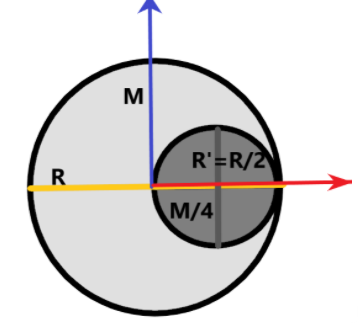
The mass removed when carving out the spherical portion is given as –
\[\begin{align}
& Mass\propto Radiu{{s}^{2}} \\
& \Rightarrow {{M}_{left}}\propto {{(\dfrac{R}{2})}^{2}} \\
& \Rightarrow {{M}_{removed}}\propto \dfrac{{{R}^{2}}}{4} \\
& \therefore {{M}_{removed}}=M\times \dfrac{1}{4} \\
\end{align}\]
Now, we can find the moment of inertia of the spherical portion that is removed using the perpendicular axes theorem as –
\[\begin{align}
& {{I}_{removed}}=\dfrac{{{M}_{removed}}R{{'}^{2}}}{2}+{{M}_{removed}}R{{'}^{2}} \\
& \Rightarrow {{I}_{removed}}=\dfrac{M}{4}\dfrac{{{(\dfrac{R}{2})}^{2}}}{2}+\dfrac{M}{4}{{(\dfrac{R}{2})}^{2}} \\
& \therefore {{I}_{removed}}=\dfrac{3M{{R}^{2}}}{32} \\
\end{align}\]
Now, we can find the moment of inertia of the remaining disc by subtracting the initial moment of inertia from the moment of inertia of the removed portion as –
\[\begin{align}
& I={{I}_{disc}}-{{I}_{removed}} \\
& \Rightarrow I=\dfrac{M{{R}^{2}}}{2}-\dfrac{3M{{R}^{2}}}{32} \\
& \therefore I=\dfrac{13M{{R}^{2}}}{32} \\
\end{align}\]
So, the moment of inertia of the remaining portion of the disc is \[\dfrac{13}{16}\] times the initial moment of inertia of the disc.
This is the required solution.
Note:
The perpendicular axes theorem says that the moment of inertia of a body along a third axis which is perpendicular to two other axes of known moment of inertia and mutually perpendicular will be the sum of the moment of inertia along these axes.
Complete answer:
We are given a disc which has a radius of R units and mass M. It is said that a circular portion is carved out from the disc such that the rim of the sphere passes through the center of the circle with a diameter R itself.
We know that the moment of inertia of a solid disc is given as the half of the product of the mass and the square of the radius of the disc.
i.e.,
\[{{I}_{disc}}=\dfrac{M{{R}^{2}}}{2}\]
The mass removed when carving out the spherical portion is given as –
\[\begin{align}
& Mass\propto Radiu{{s}^{2}} \\
& \Rightarrow {{M}_{left}}\propto {{(\dfrac{R}{2})}^{2}} \\
& \Rightarrow {{M}_{removed}}\propto \dfrac{{{R}^{2}}}{4} \\
& \therefore {{M}_{removed}}=M\times \dfrac{1}{4} \\
\end{align}\]
Now, we can find the moment of inertia of the spherical portion that is removed using the perpendicular axes theorem as –
\[\begin{align}
& {{I}_{removed}}=\dfrac{{{M}_{removed}}R{{'}^{2}}}{2}+{{M}_{removed}}R{{'}^{2}} \\
& \Rightarrow {{I}_{removed}}=\dfrac{M}{4}\dfrac{{{(\dfrac{R}{2})}^{2}}}{2}+\dfrac{M}{4}{{(\dfrac{R}{2})}^{2}} \\
& \therefore {{I}_{removed}}=\dfrac{3M{{R}^{2}}}{32} \\
\end{align}\]
Now, we can find the moment of inertia of the remaining disc by subtracting the initial moment of inertia from the moment of inertia of the removed portion as –
\[\begin{align}
& I={{I}_{disc}}-{{I}_{removed}} \\
& \Rightarrow I=\dfrac{M{{R}^{2}}}{2}-\dfrac{3M{{R}^{2}}}{32} \\
& \therefore I=\dfrac{13M{{R}^{2}}}{32} \\
\end{align}\]
So, the moment of inertia of the remaining portion of the disc is \[\dfrac{13}{16}\] times the initial moment of inertia of the disc.
This is the required solution.
Note:
The perpendicular axes theorem says that the moment of inertia of a body along a third axis which is perpendicular to two other axes of known moment of inertia and mutually perpendicular will be the sum of the moment of inertia along these axes.
Recently Updated Pages
Master Class 12 Business Studies: Engaging Questions & Answers for Success

Master Class 12 Chemistry: Engaging Questions & Answers for Success
Master Class 12 Biology: Engaging Questions & Answers for Success
Class 12 Question and Answer - Your Ultimate Solutions Guide
Master Class 11 English: Engaging Questions & Answers for Success
Master Class 11 Social Science: Engaging Questions & Answers for Success
Trending doubts
Which are the Top 10 Largest Countries of the World?
Draw a labelled sketch of the human eye class 12 physics CBSE
The end of compass needle which points towards north class 12 physics CBSE
Differentiate between homogeneous and heterogeneous class 12 chemistry CBSE
In order to find out the different types of gametes class 12 biology NEET_UG
Why is the cell called the structural and functional class 12 biology CBSE