




Friction is more on which types of surface
A. Smooth
B. Rough
C. Both A and B
D. None of the above
Answer
 Verified
655.2k+ views
Hint:We can observe in our daily life that pulling a bag on a rough surface is harder than when it is on a smoother surface. The concept of friction will help us in understanding this phenomenon. It is due to the property of interlocking surfaces during motion of an object.
Complete step-by-step answer:
First, we need to understand some forces applied on the block in the given diagrams-
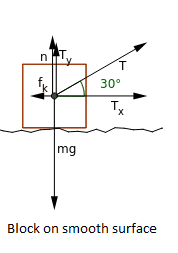
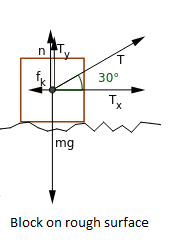
A. Friction force () - Friction is the resistance to motion of one object moving relative to another. It depends on the characteristics of the surface. If the surface is rougher. Its value will be higher. Its value is given by-
Where,
is the frictional coefficient, its value depends on the characteristics of the surface
N is the normal force exerted on the body by the surface.
B. Normal force (N) - It is a force exerted by a surface against an object. It is a reaction force which arises against gravitational force, and it is equal in strength to gravitational force.
C. Gravitational force (mg) - It is a type of conservative force with which gravity is pulling the block towards earth’s center
D. Applied force (T) - Tension T with which we are pulling the block
The left-hand side figure block is placed on a less rough surface compared to the right hand side figure.
Friction is felt more on Rough surfaces - We can observe this in our everyday life. More roughness of the surface, also attributed by , will contribute more frictional force. This happens due to the interlocking between the surfaces
Every surface is not perfectly smooth. There are peaks and valleys on the surface when it is viewed on a microscopic level. So, when two surfaces are in contact and static, these peaks and valleys are interlocked with each other. To move an object, we need to overcome these obstacles.
Thus option B. is correct, friction is more on rough surfaces.
Additional information:
On the basis of the conversation of energy, forces are divided into two types-
1. Conservative forces- In case of conservative forces, work done on a body doesn’t depend on the path. It depends on the initial and the final point. Gravitational force is a kind of conservative force. Total energy (kinetic energy + potential energy) remains conserved in these cases.
2. Non-conservative forces- In case of non-conservative forces, work done on a body depends on the path. Frictional force is a kind of non-conservative force. Total energy (kinetic energy + potential energy) doesn’t remain conserved in these cases, some part of it is lost in the type of heat or sound.
Note: Friction is a type of non-conservative force, which means work done depends on the path. Total energy (Kinetic energy + potential energy) is not conserved; in these cases some part of total energy is lost in the form of heat or sound. This lost energy, in the form of heat, can be observed in daily life.
Complete step-by-step answer:
First, we need to understand some forces applied on the block in the given diagrams-
A. Friction force () - Friction is the resistance to motion of one object moving relative to another. It depends on the characteristics of the surface. If the surface is rougher. Its value will be higher. Its value is given by-
Where,
is the frictional coefficient, its value depends on the characteristics of the surface
N is the normal force exerted on the body by the surface.
B. Normal force (N) - It is a force exerted by a surface against an object. It is a reaction force which arises against gravitational force, and it is equal in strength to gravitational force.
C. Gravitational force (mg) - It is a type of conservative force with which gravity is pulling the block towards earth’s center
D. Applied force (T) - Tension T with which we are pulling the block
The left-hand side figure block is placed on a less rough surface compared to the right hand side figure.
Friction is felt more on Rough surfaces - We can observe this in our everyday life. More roughness of the surface, also attributed by , will contribute more frictional force. This happens due to the interlocking between the surfaces
Every surface is not perfectly smooth. There are peaks and valleys on the surface when it is viewed on a microscopic level. So, when two surfaces are in contact and static, these peaks and valleys are interlocked with each other. To move an object, we need to overcome these obstacles.
Thus option B. is correct, friction is more on rough surfaces.
Additional information:
On the basis of the conversation of energy, forces are divided into two types-
1. Conservative forces- In case of conservative forces, work done on a body doesn’t depend on the path. It depends on the initial and the final point. Gravitational force is a kind of conservative force. Total energy (kinetic energy + potential energy) remains conserved in these cases.
2. Non-conservative forces- In case of non-conservative forces, work done on a body depends on the path. Frictional force is a kind of non-conservative force. Total energy (kinetic energy + potential energy) doesn’t remain conserved in these cases, some part of it is lost in the type of heat or sound.
Note: Friction is a type of non-conservative force, which means work done depends on the path. Total energy (Kinetic energy + potential energy) is not conserved; in these cases some part of total energy is lost in the form of heat or sound. This lost energy, in the form of heat, can be observed in daily life.
Recently Updated Pages
Master Class 11 Social Science: Engaging Questions & Answers for Success

Master Class 11 English: Engaging Questions & Answers for Success
Master Class 11 Accountancy: Engaging Questions & Answers for Success
Master Class 11 Physics: Engaging Questions & Answers for Success
Master Class 11 Computer Science: Engaging Questions & Answers for Success
Master Class 11 Business Studies: Engaging Questions & Answers for Success
Trending doubts
One Metric ton is equal to kg A 10000 B 1000 C 100 class 11 physics CBSE
Find the value of the expression given below sin 30circ class 11 maths CBSE
Draw a diagram of nephron and explain its structur class 11 biology CBSE
10 examples of friction in our daily life
Proton was discovered by A Thomson B Rutherford C Chadwick class 11 chemistry CBSE
The teeth used for biting and cutting food are called class 11 biology CBSE