




How is frequency different from amplitude?
Answer
 Verified
611.4k+ views
Hint: In this question, we need to comment on how the frequency is different from the amplitude. For this, we will compare the basic definition of the two terms.
The two main components of vibration or the periodic motion are the amplitude, and the frequency where amplitude determines the size of vibration and the frequency determines that after how much time the cycle is repeated.
Complete step by step answer:
When a particle is disturbed from its equilibrium position it comes into motion, and its motion is in a particular path into and for motion. Its path can be linear, circular, elliptic or the spiral.
When the particle moves in a particular path it moves to an extent from where the velocity of the particle comes to zero, and it tries to gain its equilibrium position but due to velocity in the particle while moving back to the equilibrium position the particle again moves from the equilibrium position and this process continues till the particle comes to rest.
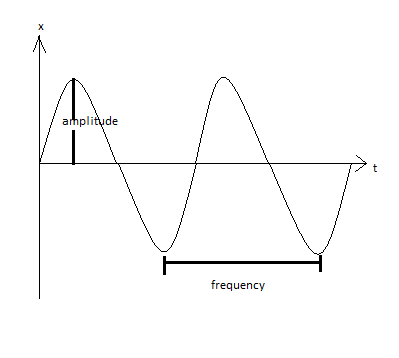
The maximum distance the particle is displaced from its equilibrium position is known as the amplitude and the number of cycles completed by the particle per second is known as frequency.
Note:
Vibration is the periodic back and forth of the particles of an elastic body resulting when a physical system is displaced from its equilibrium position. Students must note that high amplitude waves have more frequency because amplitude has more energy per second as more waves are passing by in a given period of time.
The two main components of vibration or the periodic motion are the amplitude, and the frequency where amplitude determines the size of vibration and the frequency determines that after how much time the cycle is repeated.
Complete step by step answer:
When a particle is disturbed from its equilibrium position it comes into motion, and its motion is in a particular path into and for motion. Its path can be linear, circular, elliptic or the spiral.
When the particle moves in a particular path it moves to an extent from where the velocity of the particle comes to zero, and it tries to gain its equilibrium position but due to velocity in the particle while moving back to the equilibrium position the particle again moves from the equilibrium position and this process continues till the particle comes to rest.
The maximum distance the particle is displaced from its equilibrium position is known as the amplitude and the number of cycles completed by the particle per second is known as frequency.
Note:
Vibration is the periodic back and forth of the particles of an elastic body resulting when a physical system is displaced from its equilibrium position. Students must note that high amplitude waves have more frequency because amplitude has more energy per second as more waves are passing by in a given period of time.
Recently Updated Pages
Master Class 12 Economics: Engaging Questions & Answers for Success

Master Class 12 English: Engaging Questions & Answers for Success
Master Class 12 Social Science: Engaging Questions & Answers for Success
Master Class 12 Maths: Engaging Questions & Answers for Success
Master Class 12 Physics: Engaging Questions & Answers for Success
Master Class 11 Social Science: Engaging Questions & Answers for Success
Trending doubts
One Metric ton is equal to kg A 10000 B 1000 C 100 class 11 physics CBSE
Difference Between Prokaryotic Cells and Eukaryotic Cells
Two of the body parts which do not appear in MRI are class 11 biology CBSE
1 ton equals to A 100 kg B 1000 kg C 10 kg D 10000 class 11 physics CBSE
Draw a diagram of nephron and explain its structur class 11 biology CBSE
10 examples of friction in our daily life