




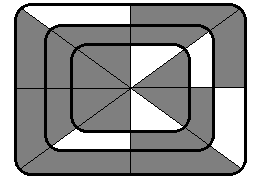
What fraction of the figure is shaded?
Answer
 Verified
637.5k+ views
Hint:A fraction is generally of the form $\dfrac{a}{b}$ .
Now coming to the question, first, we will count the total number of parts we have in the figure than the number of shaded parts, and then the number of unshaded parts. After that we will calculate the fraction of the figure that is shaded which is equal to$\dfrac{\text{number of shaded parts}}{\text{total number of parts}}$
Complete step by step answer:
Fraction: It basically represents how many parts of a whole we have. And it is generally written in the form of $\dfrac{a}{b}$ where a represents numerator and b represents the denominator of a fraction. Also, the numerator always represents the number of parts to be taken whereas the denominator represents the total number of parts we have,
Here we have,
Total number of parts in the given figure = 24
Number of shaded parts in the given figure = 18
Number of unshaded parts in the given figure = 6
$\therefore $ Fraction of the figure which is shaded $=\dfrac{\text{number of shaded parts}}{\text{total number of parts}}=\dfrac{18}{24}$
Further simplifying it to simplest form, we have
The fraction of the figure which is shaded = $\dfrac{3}{4}$
It means that, if we consider the whole figure to be 4 parts then, out of 4 parts, 3 parts are shaded and 1 part is unshaded.
Note:
Always remember a fraction of a thing is always calculated on the total of a number of things we have. Also, always remember to write the fraction into its simplest form if numerator and denominator have a common factor. And be careful while calculation, some of the common mistakes which are likely to happen, is taking a fraction of the figure that is shaded to be $\dfrac{18}{6}\text{ or }\dfrac{6}{24}$ which is absolutely wrong in this case.
Now coming to the question, first, we will count the total number of parts we have in the figure than the number of shaded parts, and then the number of unshaded parts. After that we will calculate the fraction of the figure that is shaded which is equal to$\dfrac{\text{number of shaded parts}}{\text{total number of parts}}$
Complete step by step answer:
Fraction: It basically represents how many parts of a whole we have. And it is generally written in the form of $\dfrac{a}{b}$ where a represents numerator and b represents the denominator of a fraction. Also, the numerator always represents the number of parts to be taken whereas the denominator represents the total number of parts we have,
Here we have,
Total number of parts in the given figure = 24
Number of shaded parts in the given figure = 18
Number of unshaded parts in the given figure = 6
$\therefore $ Fraction of the figure which is shaded $=\dfrac{\text{number of shaded parts}}{\text{total number of parts}}=\dfrac{18}{24}$
Further simplifying it to simplest form, we have
The fraction of the figure which is shaded = $\dfrac{3}{4}$
It means that, if we consider the whole figure to be 4 parts then, out of 4 parts, 3 parts are shaded and 1 part is unshaded.
Note:
Always remember a fraction of a thing is always calculated on the total of a number of things we have. Also, always remember to write the fraction into its simplest form if numerator and denominator have a common factor. And be careful while calculation, some of the common mistakes which are likely to happen, is taking a fraction of the figure that is shaded to be $\dfrac{18}{6}\text{ or }\dfrac{6}{24}$ which is absolutely wrong in this case.
Recently Updated Pages
Basicity of sulphurous acid and sulphuric acid are

Master Class 10 Computer Science: Engaging Questions & Answers for Success
Master Class 10 Social Science: Engaging Questions & Answers for Success
Master Class 10 Science: Engaging Questions & Answers for Success
Class 10 Question and Answer - Your Ultimate Solutions Guide
Master Class 10 Maths: Engaging Questions & Answers for Success
Trending doubts
What is the Total Duration of Football Match?
Explain the Treaty of Vienna of 1815 class 10 social science CBSE
In football, which nation is called "La Roja"?
Why is there a time difference of about 5 hours between class 10 social science CBSE
10 examples of evaporation in daily life with explanations
What is the full form of POSCO class 10 social science CBSE