




Four students perform an experiment on tracing the path of a ray of light passing through a rectangular glass slab. Their individual observations are:
Identify the incorrect observations and correct them.
A). Angle of emergence is less than the angle of refraction
B). Angle of emergence is greater than the angle of incidence
C). Emergent ray is parallel to the refracted ray
D). Emergent ray is parallel to the incident ray
Answer
 Verified
624.9k+ views
Hint: Students must remember that the incident ray and the emergent rays are always parallel to each other after refraction. When light rays go from rarer medium i.e. air to the denser medium i.e. glass the refracted rays bend towards the normal and from denser to rarer it bends away from the normal.
Complete step by step answer:
When a ray of light passes through a glass slab from denser to rarer medium it undergoes double refraction. Once when it enters the glass slab and second time when it leaves the glass slab.
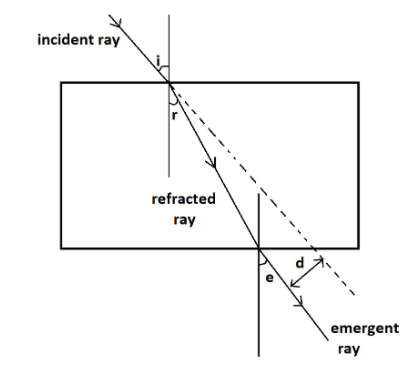
The emergent ray comes out parallel to the incident ray when it leaves the glass slab. This is due to the fact that the ray enters and leaves the two sides of a parallel glass slab. Therefore, emergent ray is parallel to the incident ray is the correct statement. Also, the angle of emergence is equal to the angle of incidence. Since refracted angle is less than the angle of incidence therefore it is also less than the angle of emergence.
The corrected statements are:
Angle of emergence is greater than the angle of refraction
Angle of emergence is equal to the angle of incidence
Emergent ray is not parallel to the refracted ray
Emergent ray is parallel to the incident ray
Note: It should be noted that the emergent ray is always parallel when it leaves the glass slab. This would not have been the case if we used a Prism instead of a glass slab as its two sides where the ray of light enter and leave are not parallel to each other.
Complete step by step answer:
When a ray of light passes through a glass slab from denser to rarer medium it undergoes double refraction. Once when it enters the glass slab and second time when it leaves the glass slab.
The emergent ray comes out parallel to the incident ray when it leaves the glass slab. This is due to the fact that the ray enters and leaves the two sides of a parallel glass slab. Therefore, emergent ray is parallel to the incident ray is the correct statement. Also, the angle of emergence is equal to the angle of incidence. Since refracted angle is less than the angle of incidence therefore it is also less than the angle of emergence.
The corrected statements are:
Angle of emergence is greater than the angle of refraction
Angle of emergence is equal to the angle of incidence
Emergent ray is not parallel to the refracted ray
Emergent ray is parallel to the incident ray
Note: It should be noted that the emergent ray is always parallel when it leaves the glass slab. This would not have been the case if we used a Prism instead of a glass slab as its two sides where the ray of light enter and leave are not parallel to each other.
Recently Updated Pages
Master Class 12 Business Studies: Engaging Questions & Answers for Success

Master Class 12 Biology: Engaging Questions & Answers for Success
Master Class 12 Chemistry: Engaging Questions & Answers for Success
Class 12 Question and Answer - Your Ultimate Solutions Guide
Master Class 11 Social Science: Engaging Questions & Answers for Success
Master Class 11 English: Engaging Questions & Answers for Success
Trending doubts
Explain the Treaty of Vienna of 1815 class 10 social science CBSE
Which Indian city is known as the "City of Victory"?
Which instrument is used to measure the Blood Pressure?
Who Won 36 Oscar Awards? Record Holder Revealed
What is the median of the first 10 natural numbers class 10 maths CBSE
Why is it 530 pm in india when it is 1200 afternoon class 10 social science CBSE