




Formula of Freon is:
A. ${\text{CC}}{{\text{l}}_{\text{2}}}{{\text{F}}_{\text{2}}}$
B. ${\text{COC}}{{\text{l}}_{\text{2}}}$
C. ${\text{S}}{{\text{O}}_{\text{2}}}{\text{C}}{{\text{l}}_{\text{2}}}$
D. None of these
Answer
 Verified
664.5k+ views
Hint: For knowing the formula of Freon we need to know the chemical name of the compound. Knowing the structure will also be an added advantage.
Step by step answer:
The chemical name of Freon is Dichlorofluoromethane. The structure of Freon is given below:
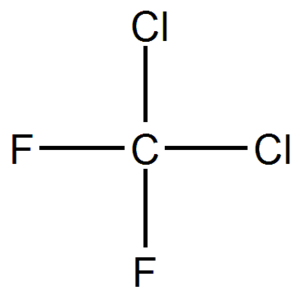
As we can see from the diagram, there are two fluorine atoms, two chlorine atoms and one carbon atom. Therefore, the formula of the compound will be ${\text{CC}}{{\text{l}}_{\text{2}}}{{\text{F}}_{\text{2}}}$.
As we can see, the formula resembles one of the options of the questions, which is option A. So the correct option is Option A.
Additional Information: Here are some properties of Freon, that we should be knowing:
Freon is slightly soluble in water at a level of approximately 0.3 grams per litre at room temperature.
Freon is tasteless, odourless (in most cases).
Because Freon is non-toxic in nature, it eliminates the danger posed by refrigerator leaks and to find the replacement for the dangerous refrigerants then in use.
Inhalation of Freon is toxic because inhalation of Freon may cause the cut down of vital oxygen to the cells and the lungs.
It has a very low melting point of $- 158 ^{\circ}C$ and boiling point of $-30^{\circ}C$.
Note: It is always advised that we should be able to know the structure of the compound, before naming it or writing the formula. Even knowing the name, would be enough, as because we can easily derive the structure following the nomenclature rules.
Step by step answer:
The chemical name of Freon is Dichlorofluoromethane. The structure of Freon is given below:
As we can see from the diagram, there are two fluorine atoms, two chlorine atoms and one carbon atom. Therefore, the formula of the compound will be ${\text{CC}}{{\text{l}}_{\text{2}}}{{\text{F}}_{\text{2}}}$.
As we can see, the formula resembles one of the options of the questions, which is option A. So the correct option is Option A.
Additional Information: Here are some properties of Freon, that we should be knowing:
Freon is slightly soluble in water at a level of approximately 0.3 grams per litre at room temperature.
Freon is tasteless, odourless (in most cases).
Because Freon is non-toxic in nature, it eliminates the danger posed by refrigerator leaks and to find the replacement for the dangerous refrigerants then in use.
Inhalation of Freon is toxic because inhalation of Freon may cause the cut down of vital oxygen to the cells and the lungs.
It has a very low melting point of $- 158 ^{\circ}C$ and boiling point of $-30^{\circ}C$.
Note: It is always advised that we should be able to know the structure of the compound, before naming it or writing the formula. Even knowing the name, would be enough, as because we can easily derive the structure following the nomenclature rules.
Recently Updated Pages
If x a + bt + ct2 where x is in meters and t is in class 11 physics CBSE

A car covers the first half distance between two places class 11 physics CBSE
The resultant of two vectors overrightarrow P and overrightarrow class 11 physics CBSE
Find the value of cos 135 class 11 maths CBSE
A mass M is held in place by an applied force F and class 11 physics CBSE
A solution of glucose in water is labelled as 10 dfracwv class 11 chemistry CBSE
Trending doubts
One Metric ton is equal to kg A 10000 B 1000 C 100 class 11 physics CBSE
Find the value of the expression given below sin 30circ class 11 maths CBSE
What do you mean by retardation What is its SI uni class 11 physics CBSE
Draw a diagram of nephron and explain its structur class 11 biology CBSE
10 examples of friction in our daily life
Difference between physical and chemical change class 11 chemistry CBSE