




What is the Force - Velocity relationship?
Answer
 Verified
497.1k+ views
Hint: Force-Velocity Relationship: As velocity rises, so does the force, and thus the power generated. Despite the fact that force increases as a result of stretching at no velocity, no power is generated. One-third of the maximum shortening velocity generates the most power.
Complete answer:
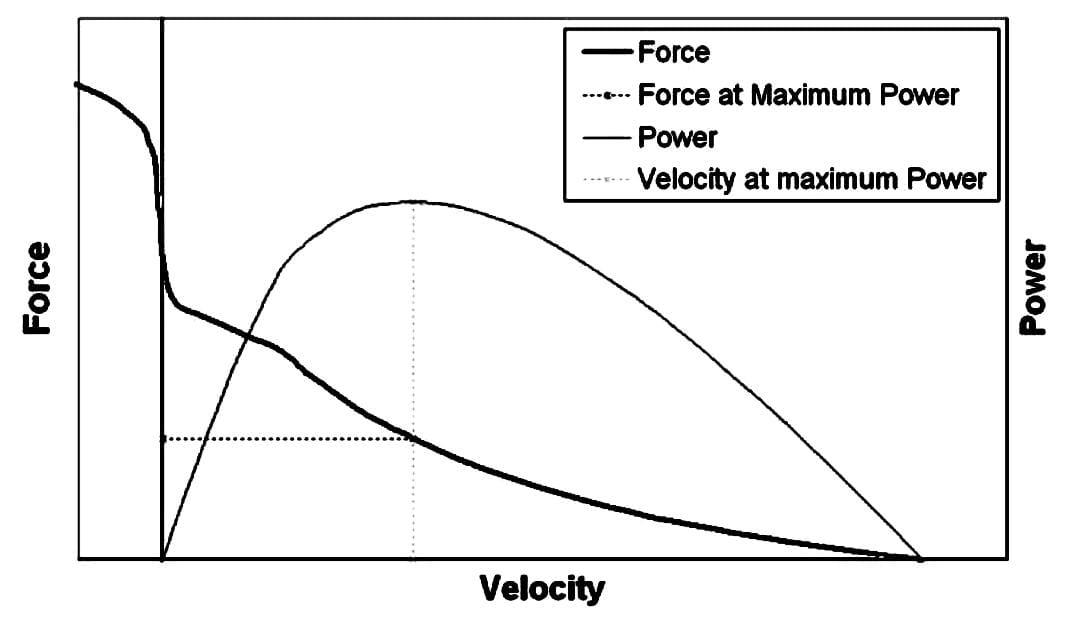
The force-velocity relationship in muscle describes the relationship between the speed at which a muscle changes length, the force of that contraction, and the power output\[\left( {force{\text{ }} \times {\text{ }}velocity = {\text{ }}power} \right)\] . The number of actin and myosin cross-bridges formed determines the amount of force generated by a muscle; more cross-bridges equals more force. Because cross-bridge formation takes time, the ability to form cross bridges and the force that results are both reduced if myofilaments slide over each other more quickly.
Because no cross-bridges can form at maximum velocity, no force is generated, resulting in zero power production (right edge of graph). When it comes to muscle stretching, the opposite is true.
The muscle's force is increased, but the contraction velocity is not, and no power is generated (left edge of graph). Maximum power is generated at about one-third of maximum shortening velocity.
Note:
It should be noted that Twitch contractions are usually only a few seconds long. They begin to rest before reaching peak force, despite having a high velocity. Long-duration tetanic contractions reach a maximum force and then plateau.
Complete answer:
The force-velocity relationship in muscle describes the relationship between the speed at which a muscle changes length, the force of that contraction, and the power output\[\left( {force{\text{ }} \times {\text{ }}velocity = {\text{ }}power} \right)\] . The number of actin and myosin cross-bridges formed determines the amount of force generated by a muscle; more cross-bridges equals more force. Because cross-bridge formation takes time, the ability to form cross bridges and the force that results are both reduced if myofilaments slide over each other more quickly.
Because no cross-bridges can form at maximum velocity, no force is generated, resulting in zero power production (right edge of graph). When it comes to muscle stretching, the opposite is true.
The muscle's force is increased, but the contraction velocity is not, and no power is generated (left edge of graph). Maximum power is generated at about one-third of maximum shortening velocity.
Note:
It should be noted that Twitch contractions are usually only a few seconds long. They begin to rest before reaching peak force, despite having a high velocity. Long-duration tetanic contractions reach a maximum force and then plateau.
Recently Updated Pages
Master Class 11 English: Engaging Questions & Answers for Success

Master Class 11 Social Science: Engaging Questions & Answers for Success
Master Class 11 Maths: Engaging Questions & Answers for Success
Master Class 11 Biology: Engaging Questions & Answers for Success
Master Class 11 Physics: Engaging Questions & Answers for Success
Master Class 11 Chemistry: Engaging Questions & Answers for Success
Trending doubts
One Metric ton is equal to kg A 10000 B 1000 C 100 class 11 physics CBSE
Difference Between Prokaryotic Cells and Eukaryotic Cells
Find the value of the expression given below sin 30circ class 11 maths CBSE
1 ton equals to A 100 kg B 1000 kg C 10 kg D 10000 class 11 physics CBSE
Two of the body parts which do not appear in MRI are class 11 biology CBSE
What are hard magnetic materials class 11 physics CBSE