




How will the forbidden energy band gap of a semiconductor vary with temperature?
(A). Increases with increase in temperature.
(B). Decrease with the increase in temperature.
(C). First increase, then decrease with increase in temperature.
(D). No variation due to increase in temperature.
Answer
 Verified
598.4k+ views
- Hint: The term gap in a general sense means there is a space which is empty between two regions. Here we are talking about the energy gap. We must have a clear idea about how temperature enables electrons from a lower energy level to get to higher energy levels.
Complete step-by-step solution -
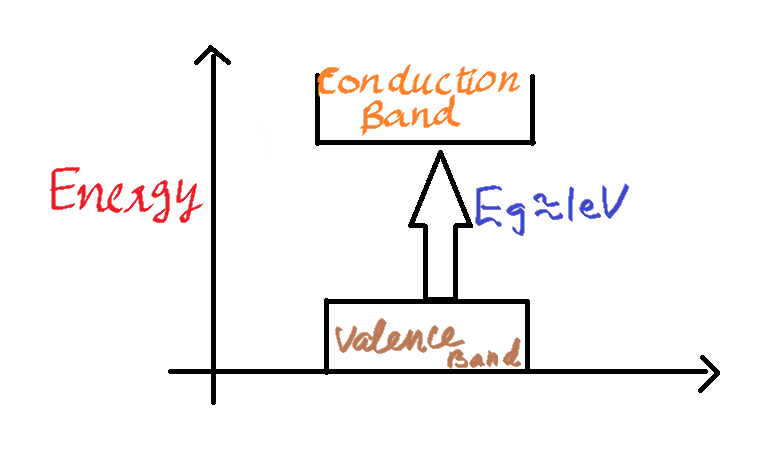
First, we need to understand what is a forbidden energy gap. The forbidden energy band gap of a semiconductor is the energy difference (in eV) between the top of the conduction band and the bottom of the valence band in any materials whether it be a metal, an insulator or a semiconductor.
For easy understanding, we can say that the gap is a region where there are no states available for an electron to occupy.
In semiconductors, the conduction band and the valence band are separated by a small energy difference of about 1 eV. This is a small energy difference and can be overcome by thermal agitation.
The energy gap of a semiconductor material is dependent on the temperature. So as the temperature increases from room temperature there is a decrease in the forbidden energy gap. The relation between the forbidden energy gap and temperature is given by the equation,
$E_{g}(T)=E_{g}(0)-\dfrac{\alpha T^{2}}{T+\beta}$
Where,
$E_{g}(T)$ is the forbidden energy gap of the semiconductor at a temperature T.
$E_{g}(0)$ is the intrinsic forbidden energy gap of the semiconductor.
$\alpha$ and $\beta$ are constants.
Hence, Option (B) is correct.
Note: In the case of metals, the conduction band and valence band overlap each other. In insulators, the conduction band and the valence band are separated by a high energy difference (greater than 10 eV).
Complete step-by-step solution -
First, we need to understand what is a forbidden energy gap. The forbidden energy band gap of a semiconductor is the energy difference (in eV) between the top of the conduction band and the bottom of the valence band in any materials whether it be a metal, an insulator or a semiconductor.
For easy understanding, we can say that the gap is a region where there are no states available for an electron to occupy.
In semiconductors, the conduction band and the valence band are separated by a small energy difference of about 1 eV. This is a small energy difference and can be overcome by thermal agitation.
The energy gap of a semiconductor material is dependent on the temperature. So as the temperature increases from room temperature there is a decrease in the forbidden energy gap. The relation between the forbidden energy gap and temperature is given by the equation,
$E_{g}(T)=E_{g}(0)-\dfrac{\alpha T^{2}}{T+\beta}$
Where,
$E_{g}(T)$ is the forbidden energy gap of the semiconductor at a temperature T.
$E_{g}(0)$ is the intrinsic forbidden energy gap of the semiconductor.
$\alpha$ and $\beta$ are constants.
Hence, Option (B) is correct.
Note: In the case of metals, the conduction band and valence band overlap each other. In insulators, the conduction band and the valence band are separated by a high energy difference (greater than 10 eV).
Recently Updated Pages
What is BLO What is the full form of BLO class 8 social science CBSE

Explain the Treaty of Vienna of 1815 class 10 social science CBSE
10 examples of friction in our daily life
Draw a diagram of nephron and explain its structur class 11 biology CBSE
Write structures of the following compounds i 2 Chloro3methylpentane class 11 chemistry CBSE
A Paragraph on Pollution in about 100-150 Words
Trending doubts
Draw a labelled sketch of the human eye class 12 physics CBSE
Which are the Top 10 Largest Countries of the World?
Differentiate between homogeneous and heterogeneous class 12 chemistry CBSE
Draw ray diagrams each showing i myopic eye and ii class 12 physics CBSE
Materials which do not allow an electric current to class 12 physics CBSE
Which is the correct genotypic ratio of mendel dihybrid class 12 biology CBSE