




For traffic control, a CCTV camera is fixed on a 8m straight pole. The camera can see a 17m distance sight line from the top. Find the area visible by the camera around the pole?
Answer
 Verified
582k+ views
Hint: First we must construct a diagram with the given information. Later we will make use of pythagoras theorem to solve the problem. The Pythagorean Theorem states that in any right triangle, the sum of the squares of the lengths of the triangle’s legs is the same as the square of the length of the triangle’s hypotenuse. This theorem is represented by the formula \[{\left( {AC} \right)^2} = {\left( {AB} \right)^2} + {\left( {BC} \right)^2}\]. Finally we have to find the area covered by the camera.
Complete step-by-step answer:
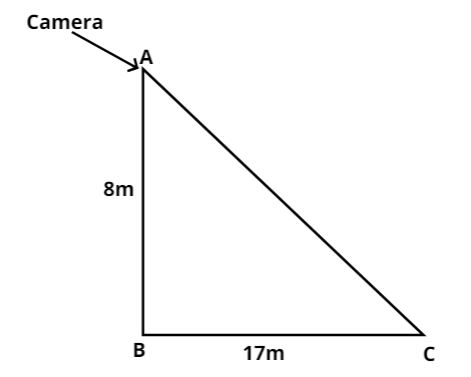
CCTV camera on pole of 8m.
Line of sight is 17m.
Therefore a right triangle is formed, with 17m Hypotenuse.
Upon calculation with the help of Pythagoras theorem to find the base.
Then ΔABC is a right-angled triangle, right angled at B.
AB = 8m and AC = 17m
Using Pythagoras theorem,
In \[\Delta ABC\]
\[{\left( {AC} \right)^2} = {\left( {AB} \right)^2} + {\left( {BC} \right)^2}\]
\[ \Rightarrow {\left( {17} \right)^2} = {\left( 8 \right)^2} + {\left( {BC} \right)^2}\]
Substitute known values for AB and AC.
\[ \Rightarrow 289 = 64 + {\left( {BC} \right)^2}\]
\[ \Rightarrow {\left( {BC} \right)^2} = 289 - 64 = 225\]
To find the value of BC, think about a number that, when multiplied by itself, equals 225. Does 10 work? How about 11? 12? 13?
\[ \Rightarrow BC = 15m\] The square root of 225 is 15.
since the camera can rotate a 360 degree.....
It forms a circle with radius as this Base which is 15m..
therefore Area of the circle that can be seen is = $\pi {r^2}$
$ = \dfrac{{22}}{7} \times 15 \times 15 = \dfrac{{4950}}{7} = 707.14{m^2}$
The area visible by the camera around the pole $707.14 m^2$.
Note: On certain occasions, all 3 sides of a right-angled triangle will be whole numbers as given in this question. This is called a Pythagorean Triad (also called a Pythagorean Triple). Pythagorean triples are relatively prime. Relatively prime means they have no common divisor other than 1, even if the numbers are not prime numbers, like 14 and 15. The number 14 has factors 1, 2, 7, and 14; the number 15 has factors 1, 3, 5, and 15. Their only common factor is 1.
Complete step-by-step answer:
CCTV camera on pole of 8m.
Line of sight is 17m.
Therefore a right triangle is formed, with 17m Hypotenuse.
Upon calculation with the help of Pythagoras theorem to find the base.
Then ΔABC is a right-angled triangle, right angled at B.
AB = 8m and AC = 17m
Using Pythagoras theorem,
In \[\Delta ABC\]
\[{\left( {AC} \right)^2} = {\left( {AB} \right)^2} + {\left( {BC} \right)^2}\]
\[ \Rightarrow {\left( {17} \right)^2} = {\left( 8 \right)^2} + {\left( {BC} \right)^2}\]
Substitute known values for AB and AC.
\[ \Rightarrow 289 = 64 + {\left( {BC} \right)^2}\]
\[ \Rightarrow {\left( {BC} \right)^2} = 289 - 64 = 225\]
To find the value of BC, think about a number that, when multiplied by itself, equals 225. Does 10 work? How about 11? 12? 13?
\[ \Rightarrow BC = 15m\] The square root of 225 is 15.
since the camera can rotate a 360 degree.....
It forms a circle with radius as this Base which is 15m..
therefore Area of the circle that can be seen is = $\pi {r^2}$
$ = \dfrac{{22}}{7} \times 15 \times 15 = \dfrac{{4950}}{7} = 707.14{m^2}$
The area visible by the camera around the pole $707.14 m^2$.
Note: On certain occasions, all 3 sides of a right-angled triangle will be whole numbers as given in this question. This is called a Pythagorean Triad (also called a Pythagorean Triple). Pythagorean triples are relatively prime. Relatively prime means they have no common divisor other than 1, even if the numbers are not prime numbers, like 14 and 15. The number 14 has factors 1, 2, 7, and 14; the number 15 has factors 1, 3, 5, and 15. Their only common factor is 1.
Recently Updated Pages
Master Class 12 Economics: Engaging Questions & Answers for Success

Master Class 12 Physics: Engaging Questions & Answers for Success
Master Class 12 English: Engaging Questions & Answers for Success
Master Class 12 Social Science: Engaging Questions & Answers for Success
Master Class 12 Maths: Engaging Questions & Answers for Success
Master Class 12 Business Studies: Engaging Questions & Answers for Success
Trending doubts
Which are the Top 10 Largest Countries of the World?
What are the major means of transport Explain each class 12 social science CBSE
Draw a labelled sketch of the human eye class 12 physics CBSE
Why cannot DNA pass through cell membranes class 12 biology CBSE
Differentiate between insitu conservation and exsitu class 12 biology CBSE
Draw a neat and well labeled diagram of TS of ovary class 12 biology CBSE