




For the velocity-time graph for a body under an uniform retardation will be,
A. retardation is the negative of slope of the graph
B. graph is a straight line inclined to the time axis with an obtuse angle.
C. graph is a straight line inclined to the time axis with an acute angle.
D. both A and B.
Answer
 Verified
620.7k+ views
Hint: The slope of the velocity-time graph shows the rate of variation in velocity with respect to time. Which means that the slope will be equal to acceleration when it is positive in sign. If it is negative then the slope is given as the retardation.
These may help you to solve this question.
Complete step-by-step answer:
Let us take an example to know the concept behind the retardation.
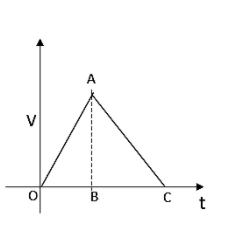
In this graph, from O to B the velocity is found to be increasing,
Therefore the slope of the graph in this region will be,
$m=\dfrac{\Delta V}{\Delta t}$
Which is the acceleration of the body and the value seems to be positive.
$m=\dfrac{\Delta V}{\Delta t}=+a$
Now when we look at the region from B to C in the time axis, we can see that the velocity has been decreasing. Therefore we can write that,
$m=\dfrac{\Delta V}{\Delta t}=-a$
This negative acceleration is known as the retardation of the object.
So as per the question, the uniform retardation will make a straight line which will be making an obtuse angle with the time axis.
Therefore the correct answer is option D.
Note: Retardation refers to the negative acceleration. The velocity of the body sometimes increases or decreases. This change in velocity is called acceleration. If the change in velocity of the body is positive, then it is in acceleration. If the change in velocity is negative, then the body is retarding.
These may help you to solve this question.
Complete step-by-step answer:
Let us take an example to know the concept behind the retardation.
In this graph, from O to B the velocity is found to be increasing,
Therefore the slope of the graph in this region will be,
$m=\dfrac{\Delta V}{\Delta t}$
Which is the acceleration of the body and the value seems to be positive.
$m=\dfrac{\Delta V}{\Delta t}=+a$
Now when we look at the region from B to C in the time axis, we can see that the velocity has been decreasing. Therefore we can write that,
$m=\dfrac{\Delta V}{\Delta t}=-a$
This negative acceleration is known as the retardation of the object.
So as per the question, the uniform retardation will make a straight line which will be making an obtuse angle with the time axis.
Therefore the correct answer is option D.
Note: Retardation refers to the negative acceleration. The velocity of the body sometimes increases or decreases. This change in velocity is called acceleration. If the change in velocity of the body is positive, then it is in acceleration. If the change in velocity is negative, then the body is retarding.
Recently Updated Pages
Master Class 12 Economics: Engaging Questions & Answers for Success

Master Class 12 English: Engaging Questions & Answers for Success
Master Class 12 Social Science: Engaging Questions & Answers for Success
Master Class 12 Maths: Engaging Questions & Answers for Success
Master Class 12 Physics: Engaging Questions & Answers for Success
Master Class 11 Social Science: Engaging Questions & Answers for Success
Trending doubts
One Metric ton is equal to kg A 10000 B 1000 C 100 class 11 physics CBSE
Difference Between Prokaryotic Cells and Eukaryotic Cells
Find the value of the expression given below sin 30circ class 11 maths CBSE
Two of the body parts which do not appear in MRI are class 11 biology CBSE
Draw a diagram of nephron and explain its structur class 11 biology CBSE
10 examples of friction in our daily life