




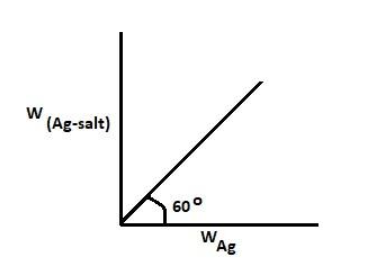
For the calculation of molecular weight of dibasic acid using silver salt method, a straight line as shown is obtained when a graph is plotted between weight of silver salt and weight of silver. Find the molecular weight of acid (Take $\sqrt 3 $ = 1.7)
A.76.6
B.8
C.153.2
D.0
Answer
 Verified
636.9k+ views
Hint: Silver salt method is used for determining the molecular masses of carboxylic acids. This method is based on the fact that they form insoluble silver salts, which upon heating decompose to leave a residue of metallic silver.
Complete Step by step answer: Silver salt method for acids: It is based on the fact that silver salt of an organic acid on heating gives residue of metallic silver.
Knowing the equivalent mass of silver salt, the equivalent mass of the acid can be obtained. The molecular mass of an acid can be determined.
Molecular mass of acid in the silver method is given by the formula: $MolecularMassofacid = \left[ {\dfrac{{Wt.of\; silver\; salt}}{{Wt.of\; silver}} \times \left( {108 - 107} \right)} \right] \times Basicity \;Of \;Acid$
So from the graph shown above we know that $\dfrac{{Wt.of\; silver\; salt}}{{Wt.ofsilver}} = \tan {60^0}$
And we are also given that: $\tan {60^0} = \sqrt 3 = 1.7$
As the question is for dibasic acid hence the basicity of acid = 2 (di means 2)
So, putting all these values in the formula for the molar mass of acid and solving $Molar\; Mass \;Of\; Acid = \left[ {1.7 \times \left( {108 - 107} \right)} \right] \times 2$$molar\;mass\;of\;acid = \left( {183.6 - 107} \right) \times 2 = 76.6 \times 2 = 153.2$
$molar\;mass\;of\;acid = 153.2gm$.
Hence the correct option is (c).
Note: From the volume of the silver salt given and the mass of the silver residue obtained, the equivalent mass of the silver salt can be calculated. Any method of quantitative analysis in which the amount of a substance is determined by measuring the volume that it occupies the volume of a second substance that combines with the first in known proportions, more correctly called titrimetric analysis is called volumetric analysis.
Complete Step by step answer: Silver salt method for acids: It is based on the fact that silver salt of an organic acid on heating gives residue of metallic silver.
Knowing the equivalent mass of silver salt, the equivalent mass of the acid can be obtained. The molecular mass of an acid can be determined.
Molecular mass of acid in the silver method is given by the formula: $MolecularMassofacid = \left[ {\dfrac{{Wt.of\; silver\; salt}}{{Wt.of\; silver}} \times \left( {108 - 107} \right)} \right] \times Basicity \;Of \;Acid$
So from the graph shown above we know that $\dfrac{{Wt.of\; silver\; salt}}{{Wt.ofsilver}} = \tan {60^0}$
And we are also given that: $\tan {60^0} = \sqrt 3 = 1.7$
As the question is for dibasic acid hence the basicity of acid = 2 (di means 2)
So, putting all these values in the formula for the molar mass of acid and solving $Molar\; Mass \;Of\; Acid = \left[ {1.7 \times \left( {108 - 107} \right)} \right] \times 2$$molar\;mass\;of\;acid = \left( {183.6 - 107} \right) \times 2 = 76.6 \times 2 = 153.2$
$molar\;mass\;of\;acid = 153.2gm$.
Hence the correct option is (c).
Note: From the volume of the silver salt given and the mass of the silver residue obtained, the equivalent mass of the silver salt can be calculated. Any method of quantitative analysis in which the amount of a substance is determined by measuring the volume that it occupies the volume of a second substance that combines with the first in known proportions, more correctly called titrimetric analysis is called volumetric analysis.
Recently Updated Pages
If x a + bt + ct2 where x is in meters and t is in class 11 physics CBSE

A car covers the first half distance between two places class 11 physics CBSE
The resultant of two vectors overrightarrow P and overrightarrow class 11 physics CBSE
Find the value of cos 135 class 11 maths CBSE
A mass M is held in place by an applied force F and class 11 physics CBSE
A solution of glucose in water is labelled as 10 dfracwv class 11 chemistry CBSE
Trending doubts
One Metric ton is equal to kg A 10000 B 1000 C 100 class 11 physics CBSE
Find the value of the expression given below sin 30circ class 11 maths CBSE
What do you mean by retardation What is its SI uni class 11 physics CBSE
Draw a diagram of nephron and explain its structur class 11 biology CBSE
10 examples of friction in our daily life
Difference between physical and chemical change class 11 chemistry CBSE