




For reflection of light from a plane surface:
A. The incident ray, reflected ray, and the normal all lie in the same plane.
B. The angle of incidence is equal to the angle of reflection.
C. Both A and B are true.
D. None of A and B is true.
Answer
 Verified
625.8k+ views
Hint: Reflection of light is a phenomenon in which the direction of wavefront changes when the wavefront hits the surface between two different mediums. The lightwave returns back to the medium from which it came.
Complete step by step answer:
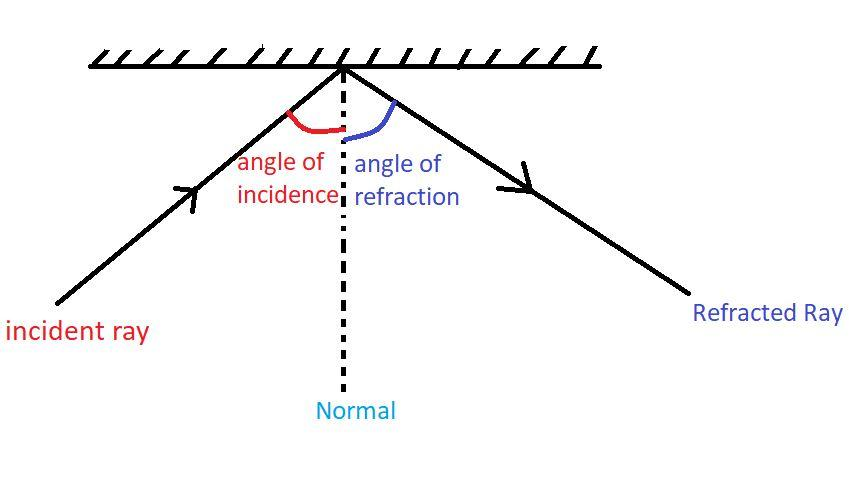
For reflection of light from a plane surface there are some laws followed by the process of reflection those are:
The angle at which the light ray is incident is always equal to the angle that the reflected ray makes with the normal.
We can mathematically represent the above statement by:
$\angle i=\angle r$.
The reflected ray, normal, and the incident ray at the point of incidence, all lie in the same plane.
These are the two main laws followed by the phenomenon known as reflection.
Thus, from the above two laws, we can say that option C, is the correct option.
Additional Information
Mirror: A mirror is a smooth, reflecting surface that is highly polished. Generally, there are two types of mirrors: plane mirror and curved mirror. Curved mirrors can be classified into two types of spherical mirrors and parabolic mirrors depending upon the curved surface of the mirror.
Note:
The characteristics followed by a plane mirror are:
The image obtained after reflection is always erect and virtual.
The size of the image and the size of the object that is forming the image are always equal.
The distance between the image obtained is just the same as the distance at which the object is kept.
Generally, the image obtained is laterally inverted.
Complete step by step answer:
For reflection of light from a plane surface there are some laws followed by the process of reflection those are:
The angle at which the light ray is incident is always equal to the angle that the reflected ray makes with the normal.
We can mathematically represent the above statement by:
$\angle i=\angle r$.
The reflected ray, normal, and the incident ray at the point of incidence, all lie in the same plane.
These are the two main laws followed by the phenomenon known as reflection.
Thus, from the above two laws, we can say that option C, is the correct option.
Additional Information
Mirror: A mirror is a smooth, reflecting surface that is highly polished. Generally, there are two types of mirrors: plane mirror and curved mirror. Curved mirrors can be classified into two types of spherical mirrors and parabolic mirrors depending upon the curved surface of the mirror.
Note:
The characteristics followed by a plane mirror are:
The image obtained after reflection is always erect and virtual.
The size of the image and the size of the object that is forming the image are always equal.
The distance between the image obtained is just the same as the distance at which the object is kept.
Generally, the image obtained is laterally inverted.
Recently Updated Pages
Master Class 12 Economics: Engaging Questions & Answers for Success

Master Class 12 English: Engaging Questions & Answers for Success
Master Class 12 Social Science: Engaging Questions & Answers for Success
Master Class 12 Maths: Engaging Questions & Answers for Success
Master Class 12 Physics: Engaging Questions & Answers for Success
Master Class 9 General Knowledge: Engaging Questions & Answers for Success
Trending doubts
Explain the Treaty of Vienna of 1815 class 10 social science CBSE
Who Won 36 Oscar Awards? Record Holder Revealed
What is the median of the first 10 natural numbers class 10 maths CBSE
Why is it 530 pm in india when it is 1200 afternoon class 10 social science CBSE
Make a sketch of the human nerve cell What function class 10 biology CBSE
What is the full form of POSCO class 10 social science CBSE