




For a right triangle ABC, how do you find the sine, cosine and tangent of angle A?
Answer
 Verified
580.8k+ views
Hint: Assume a right-angle triangle ABC with right angle at B. Consider a, b and c as the sides opposite to the angles A, B and C respectively of the right triangle ABC. Use the relations: - \[\sin A=\dfrac{P'}{H'}\], \[\cos A=\dfrac{B'}{H'}\] and \[\tan A=\dfrac{P'}{B'}\], where P’ = perpendicular, B’ = base and H’ = hypotenuse to get the relation among the angles and sides. Consider the side opposite to angle A as the perpendicular.
Complete step by step answer:
Here, we have been asked to find the sine, cosine and tangent of angle A for a right-angle triangle.
Now, let us assume a right-angle triangle ABC has a right-angle at B. Let us draw a rough diagram for the triangle.
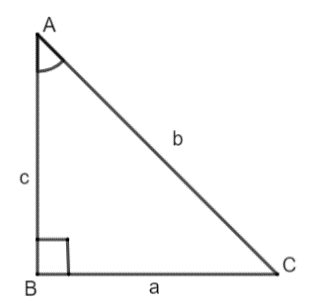
In the above figure of the right-angle triangle, according to the convention we have assumed a, b and c as the sides opposite to the angles A, B and C respectively. Now, we have to find three trigonometric ratios of angle A. So, if we will consider the angle A then according to the convention we have to assume the side ‘a’ as the perpendicular. Therefore, the side ‘i’ will be referred to as the base because side ‘b’ will always be the hypotenuse. So, considering P’ = perpendicular, B’ = base and H’ = hypotenuse, we have,
\[\Rightarrow BC=a=P',AB=c=B'\] and \[AC=b=H'\]
For a right-angle triangle ABC,
(i) \[\sin A=\dfrac{P'}{H'}\]
\[\begin{align}
& \Rightarrow \sin A=\dfrac{a}{b} \\
& \Rightarrow \sin A=\dfrac{BC}{AC} \\
\end{align}\]
(ii) \[\cos A=\dfrac{B'}{H'}\]
\[\begin{align}
& \Rightarrow \cos A=\dfrac{c}{b} \\
& \Rightarrow \cos A=\dfrac{AB}{AC} \\
\end{align}\]
(iii) \[\tan A=\dfrac{P'}{B'}\]
\[\begin{align}
& \Rightarrow \tan A=\dfrac{a}{c} \\
& \Rightarrow \tan A=\dfrac{BC}{AB} \\
\end{align}\]
Hence, the above three relations are our answers.
Note: One may note that there are three more trigonometric ratios, namely: - secant, cosecant and cotangent. We can also find them using the three relations: - \[\sec A=\dfrac{1}{\cos A}\], \[\csc A=\dfrac{1}{\sin A}\] and \[\cot A=\dfrac{1}{\tan A}\]. You must remember the naming conventions used for any triangle so that you may not get confused. Do not forget to draw a rough diagram of the right-angle triangle for these types of questions. Note that if you will consider angle A equal to 90 degrees for the above question then you will get the value of the tangent function equal to infinite because the base length will become 0.
Complete step by step answer:
Here, we have been asked to find the sine, cosine and tangent of angle A for a right-angle triangle.
Now, let us assume a right-angle triangle ABC has a right-angle at B. Let us draw a rough diagram for the triangle.
In the above figure of the right-angle triangle, according to the convention we have assumed a, b and c as the sides opposite to the angles A, B and C respectively. Now, we have to find three trigonometric ratios of angle A. So, if we will consider the angle A then according to the convention we have to assume the side ‘a’ as the perpendicular. Therefore, the side ‘i’ will be referred to as the base because side ‘b’ will always be the hypotenuse. So, considering P’ = perpendicular, B’ = base and H’ = hypotenuse, we have,
\[\Rightarrow BC=a=P',AB=c=B'\] and \[AC=b=H'\]
For a right-angle triangle ABC,
(i) \[\sin A=\dfrac{P'}{H'}\]
\[\begin{align}
& \Rightarrow \sin A=\dfrac{a}{b} \\
& \Rightarrow \sin A=\dfrac{BC}{AC} \\
\end{align}\]
(ii) \[\cos A=\dfrac{B'}{H'}\]
\[\begin{align}
& \Rightarrow \cos A=\dfrac{c}{b} \\
& \Rightarrow \cos A=\dfrac{AB}{AC} \\
\end{align}\]
(iii) \[\tan A=\dfrac{P'}{B'}\]
\[\begin{align}
& \Rightarrow \tan A=\dfrac{a}{c} \\
& \Rightarrow \tan A=\dfrac{BC}{AB} \\
\end{align}\]
Hence, the above three relations are our answers.
Note: One may note that there are three more trigonometric ratios, namely: - secant, cosecant and cotangent. We can also find them using the three relations: - \[\sec A=\dfrac{1}{\cos A}\], \[\csc A=\dfrac{1}{\sin A}\] and \[\cot A=\dfrac{1}{\tan A}\]. You must remember the naming conventions used for any triangle so that you may not get confused. Do not forget to draw a rough diagram of the right-angle triangle for these types of questions. Note that if you will consider angle A equal to 90 degrees for the above question then you will get the value of the tangent function equal to infinite because the base length will become 0.
Recently Updated Pages
Master Class 12 Business Studies: Engaging Questions & Answers for Success

Master Class 12 Biology: Engaging Questions & Answers for Success
Master Class 12 Chemistry: Engaging Questions & Answers for Success
Class 12 Question and Answer - Your Ultimate Solutions Guide
Master Class 11 Social Science: Engaging Questions & Answers for Success
Master Class 11 English: Engaging Questions & Answers for Success
Trending doubts
Explain the Treaty of Vienna of 1815 class 10 social science CBSE
Who Won 36 Oscar Awards? Record Holder Revealed
What is the median of the first 10 natural numbers class 10 maths CBSE
Why is it 530 pm in india when it is 1200 afternoon class 10 social science CBSE
The highest temperature in Karnataka is recorded in class 10 social science CBSE
Define Potential, Developed, Stock and Reserved resources