




How many food chains make up the food web?
Answer
 Verified
590.1k+ views
Hint: An ecosystem includes all the abiotic elements (water bodies, soil, etc) as well as biotic elements (animals, plants, microbes) in a particular geographic area. For the proper function of an ecosystem, all these elements need to work in a concerted manner.
Complete answer:
In ecology, the food chain refers to the sequence that transfers energy in the form of food from one organism to another. It starts from the sun and then comes the producers, consumers, and decomposers which are biotic elements in any ecosystem. Several food chains in an ecosystem collectively form a food web, and the food web is way more complex because of the interconnected food chains, while the food chain is a single straight chain.
Plants produce energy by the process of photosynthesis and they are the main source of energy producers which is consumed by the herbivores. Then herbivores are consumed by the carnivores where the flow of energy occurs from one to another. The food chain is composed of primary producers, primary consumers, secondary consumers, and decomposers. Primary consumers are the herbivores while carnivores are the secondary consumers.
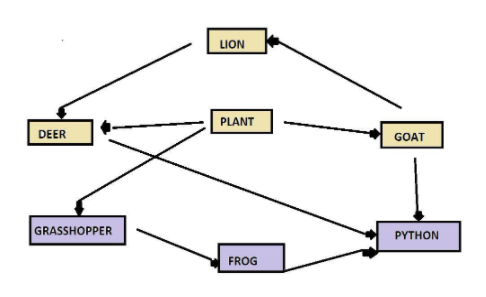
Example:- Producers like plants, phytoplankton i.e. those organisms that can produce their food are placed in the first trophic level. Primary producers take the next trophic level. Primary consumers feed on the producers i.e. grasshopper, deer. The secondary consumers like a frog, lion, python occupy the next trophic level. While tertiary consumers i.e. lion, python those who feed on the secondary consumers take the next trophic level and this shows the grazing food chain.
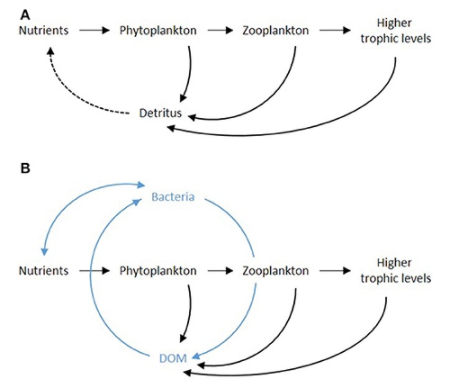
While detritus food chain flow starts from the dead organic to microorganisms and then to the organism feeding on the detritivores and their predators.
Most of the food chains are short but depending on the ecosystem the number of trophic levels varies.
Note: The terms food web and food chain refer to the group of organisms which are dependent on each other for food which is followed by the transfer of energy from one trophic level to another trophic level.
Complete answer:
In ecology, the food chain refers to the sequence that transfers energy in the form of food from one organism to another. It starts from the sun and then comes the producers, consumers, and decomposers which are biotic elements in any ecosystem. Several food chains in an ecosystem collectively form a food web, and the food web is way more complex because of the interconnected food chains, while the food chain is a single straight chain.
Plants produce energy by the process of photosynthesis and they are the main source of energy producers which is consumed by the herbivores. Then herbivores are consumed by the carnivores where the flow of energy occurs from one to another. The food chain is composed of primary producers, primary consumers, secondary consumers, and decomposers. Primary consumers are the herbivores while carnivores are the secondary consumers.
Example:- Producers like plants, phytoplankton i.e. those organisms that can produce their food are placed in the first trophic level. Primary producers take the next trophic level. Primary consumers feed on the producers i.e. grasshopper, deer. The secondary consumers like a frog, lion, python occupy the next trophic level. While tertiary consumers i.e. lion, python those who feed on the secondary consumers take the next trophic level and this shows the grazing food chain.
While detritus food chain flow starts from the dead organic to microorganisms and then to the organism feeding on the detritivores and their predators.
Most of the food chains are short but depending on the ecosystem the number of trophic levels varies.
Note: The terms food web and food chain refer to the group of organisms which are dependent on each other for food which is followed by the transfer of energy from one trophic level to another trophic level.
Recently Updated Pages
Master Class 12 Economics: Engaging Questions & Answers for Success

Master Class 12 English: Engaging Questions & Answers for Success
Master Class 12 Social Science: Engaging Questions & Answers for Success
Master Class 12 Maths: Engaging Questions & Answers for Success
Master Class 12 Physics: Engaging Questions & Answers for Success
Master Class 9 General Knowledge: Engaging Questions & Answers for Success
Trending doubts
One Metric ton is equal to kg A 10000 B 1000 C 100 class 11 physics CBSE
Difference Between Prokaryotic Cells and Eukaryotic Cells
Two of the body parts which do not appear in MRI are class 11 biology CBSE
1 ton equals to A 100 kg B 1000 kg C 10 kg D 10000 class 11 physics CBSE
Draw a diagram of nephron and explain its structur class 11 biology CBSE
10 examples of friction in our daily life