




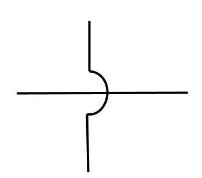
What do the following circuit symbols represent?
Answer
 Verified
574.2k+ views
Hint: Connecting lines crossed in older electrical drawings, whereas non-connecting wires “jumped” over each other with small half-circle marks. Connecting wires are joined with a dot in newer electrical diagrams, while non-connecting wires are crossed without a dot. Some people, on the other hand, continue to connect wires crossing with no dot, which might lead to confusion.
Complete answer:
The above symbol denotes that the two wires are not connected in any way. As depicted in the diagram below. When there are two or more wires in a circuit, this symbol is used.
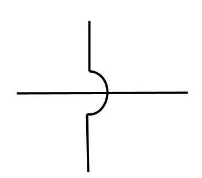
When there are two or more wires in a circuit, this symbol is used.
Additional information: The connections between leads used to be simple line crossings. The connection of two intersecting wires was depicted by a crossing of wires with a "dot" or "blob" to signify a link before the arrival of computerised drafting. Simultaneously, the crossover was simplified to be the same as before, but without the "dot."
However, if the dot was painted too small or omitted accidently, it could cause confusion between the wires that were connected and those that were not. As a result, the modern standard for showing a 4-way wire connection is to draw a straight wire and then stagger the other wires along it with "dots" as connections, resulting in two distinct T-junctions that are clearly not a crossover.
Note: For insulated crossing wires, the CAD symbol is the same as for non-insulated crossing wires, which is an older, non-CAD sign. To avoid confusion, non-CAD schematics should use the wire "jump" (semi-circle) symbol for insulated wires (rather than the CAD-style symbol for no connection), to avoid confusion with the original, earlier style symbol, which means the exact opposite. Staggering the joining wires into T-junctions is the newer, suggested approach for 4-way wire connections in both CAD and non-CAD schematics.
Complete answer:
The above symbol denotes that the two wires are not connected in any way. As depicted in the diagram below. When there are two or more wires in a circuit, this symbol is used.
When there are two or more wires in a circuit, this symbol is used.
Additional information: The connections between leads used to be simple line crossings. The connection of two intersecting wires was depicted by a crossing of wires with a "dot" or "blob" to signify a link before the arrival of computerised drafting. Simultaneously, the crossover was simplified to be the same as before, but without the "dot."
However, if the dot was painted too small or omitted accidently, it could cause confusion between the wires that were connected and those that were not. As a result, the modern standard for showing a 4-way wire connection is to draw a straight wire and then stagger the other wires along it with "dots" as connections, resulting in two distinct T-junctions that are clearly not a crossover.
Note: For insulated crossing wires, the CAD symbol is the same as for non-insulated crossing wires, which is an older, non-CAD sign. To avoid confusion, non-CAD schematics should use the wire "jump" (semi-circle) symbol for insulated wires (rather than the CAD-style symbol for no connection), to avoid confusion with the original, earlier style symbol, which means the exact opposite. Staggering the joining wires into T-junctions is the newer, suggested approach for 4-way wire connections in both CAD and non-CAD schematics.
Recently Updated Pages
A Paragraph on Pollution in about 100-150 Words

Write any three differences between metals and nonmetals class 10 social science CBSE
Amit standing on a horizontal plane finds a bird flying class 10 maths CBSE
Two circles of radii 5 cm and 3 cm intersect at two class 10 maths CBSE
Solve the following i John and Jivanti together have class 10 maths CBSE
What is the relation between orthocenter circumcentre class 10 maths CBSE
Trending doubts
Explain the Treaty of Vienna of 1815 class 10 social science CBSE
10 examples of evaporation in daily life with explanations
What is the full form of POSCO class 10 social science CBSE
Make a sketch of the human nerve cell What function class 10 biology CBSE
The uses of bleaching powder are A It is used bleaching class 10 chemistry CBSE
GST is a direct or indirect tax?