




Fluorine exhibits only -1 oxidation state while iodine exhibits oxidation states of -1, +1, +3, +5 and +7. This is due to:
(A) fluorine being a gas.
(B) available d-orbitals in iodine.
(C) non-availability of d-orbitals in iodine.
(D) none of the above.
Answer
 Verified
617.7k+ views
Hint: Fluorine and Iodine belongs to Group 17. They are commonly called as Halogens. Halogens are highly reactive nonmetals and also known as p-block elements.
Complete answer:
Oxidation state means degree of oxidation for an atom in a chemical compound. Oxidation state represented by an integer, which can be positive, negative or zero.
Fluorine and iodine are group 17 members.
There electronic configuration is
F = Atomic number = 9 = $1{s^2}2{s^2}2{p^5} = [He]2{s^2}2{p^5}$
I = Atomic number = 53 = $1{s^2}2{s^2}2{p^6}3{s^2}3{p^6}3{d^{10}}4{s^2}4{p^6}4{d^{10}}5{s^2}5{p^6}$
$ = [Kr]4{d^{10}}5{d^2}5{p^6}$
Ground state Electronic configuration of fluorine is
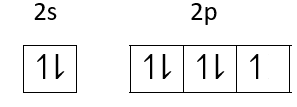
Fluorine is the most electronegative atom so it accepts electrons very easily and shows only -1 oxidation state.
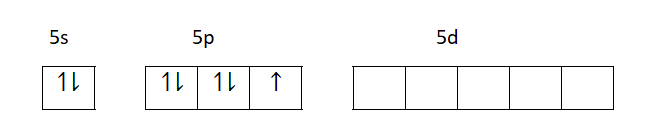
Ground state electronic configuration of iodine is shown in the diagram below.
First excited state

Second excited state

Third excited state

Therefore, iodine shows +1, +3, +5, +7 oxidation state apart from oxidation state -1 because of the presence of empty vacant d- orbitals which are not present in fluorine. So Fluorine does not show any higher oxidation state.
Note: Positive oxidation state is possible by excitation of outer s and p-orbitals into d-orbitals so that 3, 5 or 7 unpaired electrons are easily available for bonding. Elements which do not have vacant d orbitals can’t show higher oxidation state.
Complete answer:
Oxidation state means degree of oxidation for an atom in a chemical compound. Oxidation state represented by an integer, which can be positive, negative or zero.
Fluorine and iodine are group 17 members.
There electronic configuration is
F = Atomic number = 9 = $1{s^2}2{s^2}2{p^5} = [He]2{s^2}2{p^5}$
I = Atomic number = 53 = $1{s^2}2{s^2}2{p^6}3{s^2}3{p^6}3{d^{10}}4{s^2}4{p^6}4{d^{10}}5{s^2}5{p^6}$
$ = [Kr]4{d^{10}}5{d^2}5{p^6}$
Ground state Electronic configuration of fluorine is
Fluorine is the most electronegative atom so it accepts electrons very easily and shows only -1 oxidation state.
Ground state electronic configuration of iodine is shown in the diagram below.
First excited state
Second excited state
Third excited state
Therefore, iodine shows +1, +3, +5, +7 oxidation state apart from oxidation state -1 because of the presence of empty vacant d- orbitals which are not present in fluorine. So Fluorine does not show any higher oxidation state.
Note: Positive oxidation state is possible by excitation of outer s and p-orbitals into d-orbitals so that 3, 5 or 7 unpaired electrons are easily available for bonding. Elements which do not have vacant d orbitals can’t show higher oxidation state.
Recently Updated Pages
Basicity of sulphurous acid and sulphuric acid are

Master Class 12 Economics: Engaging Questions & Answers for Success
Master Class 12 Biology: Engaging Questions & Answers for Success
Master Class 11 English: Engaging Questions & Answers for Success
Master Class 11 Physics: Engaging Questions & Answers for Success
Master Class 11 Computer Science: Engaging Questions & Answers for Success
Trending doubts
Draw a labelled sketch of the human eye class 12 physics CBSE
The chemical formula of tear gas is A CO Cl 2 B C 10 class 12 chemistry CBSE
Draw ray diagrams each showing i myopic eye and ii class 12 physics CBSE
Which are the Top 10 Largest Countries of the World?
Differentiate between homogeneous and heterogeneous class 12 chemistry CBSE
Which is the correct genotypic ratio of mendel dihybrid class 12 biology CBSE