




What fluid secreted into the small intestine during digestion contains cholesterol, emulsification agents and phospholipids?
Answer
 Verified
555k+ views
Hint: Bile or gall, is a dark-green-to-yellowish-brown fluid produced by the liver of most vertebrates. It aids in the digestion of lipids in the small intestine. In humans, bile is produced continuously by the liver (liver bile) and stored and concentrated in the gallbladder. After the human eats, this stored bile is discharged into the duodenum. Per day an adult human body produces about 400 to 800 milliliters of bile.
Complete answer:
Bile acids are steroid acids found predominantly in the bile of mammals and other vertebrates. It consists mainly of bile salts, phospholipids, cholesterol, conjugated bilirubin, electrolytes, and water. Bile is basically secreted in the liver and it travels through the liver in a series of ducts, exiting through the common hepatic duct into the gallbladder. The gallbladder concentrates and stores the bile and it contracts when stimulated by the hormone cholecystokinin (CCK). On stimulation, the gallbladder pushes the bile through the cystic duct and into the common bile duct. Simultaneously, the sphincter of Oddi will relax and permit the bile to enter the duodenal lumen. Now, in the small intestine, bile acids will facilitate lipid digestion and absorption. There are two primary bile acids: cholic acid and chenodeoxycholic acid. Primary bile acids will undergo dehydroxylation by bacteria inside the small intestine and form secondary bile acids: deoxycholic acid and lithocholic acid, respectively. The liver conjugates both the primary and secondary bile acids with an amino acid (either glycine or taurine). Conjugated bile acids are called bile salts and they are amphipathic molecules despite then being soluble in water. This important property allows the bile salts to emulsify lipids and form micelles with the products of lipid digestion.
Note:
Only approximately 5% of these bile acids are eventually excreted. The majority of bile acids are efficiently reabsorbed from the ileum, secreted into the portal venous system, and returned to the liver in a process known as enterohepatic recirculation. The hormone secretin also plays an important role in the flow of bile into the small intestine. By stimulating biliary and pancreatic ductular cells to secrete bicarbonate and water in response to the presence of acid in the duodenum, secretin effectively expands the volume of bile entering the duodenum.
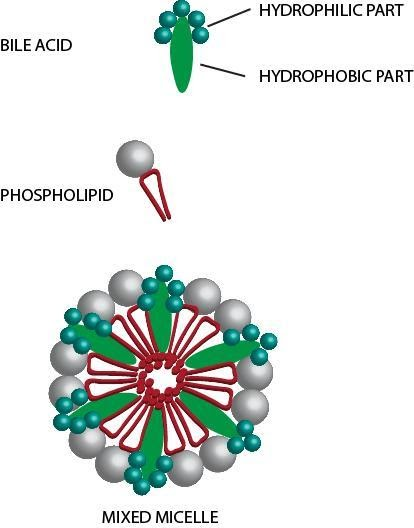
Figure 1: Micelle
Complete answer:
Bile acids are steroid acids found predominantly in the bile of mammals and other vertebrates. It consists mainly of bile salts, phospholipids, cholesterol, conjugated bilirubin, electrolytes, and water. Bile is basically secreted in the liver and it travels through the liver in a series of ducts, exiting through the common hepatic duct into the gallbladder. The gallbladder concentrates and stores the bile and it contracts when stimulated by the hormone cholecystokinin (CCK). On stimulation, the gallbladder pushes the bile through the cystic duct and into the common bile duct. Simultaneously, the sphincter of Oddi will relax and permit the bile to enter the duodenal lumen. Now, in the small intestine, bile acids will facilitate lipid digestion and absorption. There are two primary bile acids: cholic acid and chenodeoxycholic acid. Primary bile acids will undergo dehydroxylation by bacteria inside the small intestine and form secondary bile acids: deoxycholic acid and lithocholic acid, respectively. The liver conjugates both the primary and secondary bile acids with an amino acid (either glycine or taurine). Conjugated bile acids are called bile salts and they are amphipathic molecules despite then being soluble in water. This important property allows the bile salts to emulsify lipids and form micelles with the products of lipid digestion.
Note:
Only approximately 5% of these bile acids are eventually excreted. The majority of bile acids are efficiently reabsorbed from the ileum, secreted into the portal venous system, and returned to the liver in a process known as enterohepatic recirculation. The hormone secretin also plays an important role in the flow of bile into the small intestine. By stimulating biliary and pancreatic ductular cells to secrete bicarbonate and water in response to the presence of acid in the duodenum, secretin effectively expands the volume of bile entering the duodenum.
Figure 1: Micelle
Recently Updated Pages
Master Class 12 Economics: Engaging Questions & Answers for Success

Master Class 12 English: Engaging Questions & Answers for Success
Master Class 12 Social Science: Engaging Questions & Answers for Success
Master Class 12 Maths: Engaging Questions & Answers for Success
Master Class 12 Physics: Engaging Questions & Answers for Success
Master Class 11 Social Science: Engaging Questions & Answers for Success
Trending doubts
One Metric ton is equal to kg A 10000 B 1000 C 100 class 11 physics CBSE
Difference Between Prokaryotic Cells and Eukaryotic Cells
Find the value of the expression given below sin 30circ class 11 maths CBSE
Two of the body parts which do not appear in MRI are class 11 biology CBSE
Draw a diagram of nephron and explain its structur class 11 biology CBSE
10 examples of friction in our daily life