




Flow of hemolymph in Cockroach is
(a) Heart Ostia Perivisceral sinus Pericardial sinus Head Heart
(b) Heart Pericardial sinus Head Perivisceral sinus Ostia Heart
(c) Heart Head Perivisceral sinus Pericardial sinus Ostia Heart
(d) Heart Head Perivisceral sinus Ostia Pericardial sinus Heart
Answer
 Verified
617.4k+ views
Hint: The flow of haemolymph is the flow of blood in cockroaches. The direction of the flow of hemolymph is posterior to anterior.
Complete Step by Step Answer:
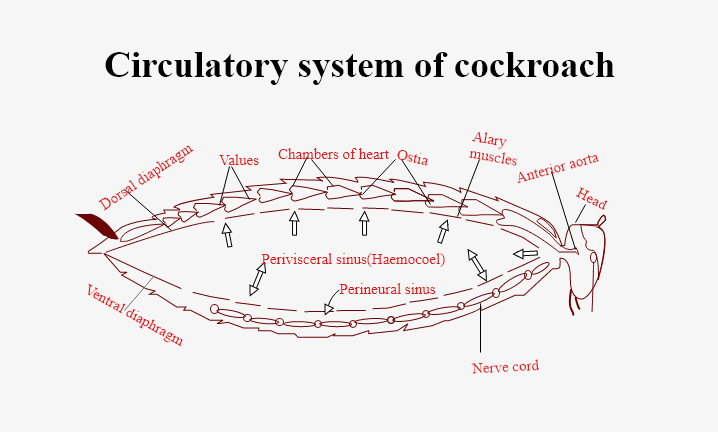
In cockroaches, the blood from the heart gets pumped into the head from where it flows into the perivisceral sinus and perineural sinus. From here the alary muscles located on the dorsal diaphragm contract causing the blood flow from the perivisceral sinus into the pericardial sinus due to the increase in the volume of the pericardial sinus. Once the blood enters the pericardial sinus, alary muscles relax causing the volume of the pericardial sinus to decrease, thus all the blood is pushed into the heart. From here the blood gets pumped again by the heart into the head and the cycle repeats.
So, the correct answer is ‘Heart Head Perivisceral sinus Pericardial sinus Ostia Heart’.
Additional information: Let us now understand the anatomy of the body of a cockroach to get a more detailed understanding. The hemocoel (body cavity where blood flows) of cockroach is divided into 3 sinuses due to the presence of a ventral and dorsal diaphragm. The pericardial sinus is present above the dorsal diaphragm. The perivisceral sinus is present in between the dorsal and ventral diaphragm. The perineural sinus is present below the ventral diaphragm. This diagram will help us understand the structure better.
Note:
- In cockroaches, the heart is dorsal and the brain is ventral. Whereas in humans it is the opposite.
- Pericardial sinus is the sinus where the heart is present. In the perivisceral sinus, all the visceral organs are present which get directly bathed in the hemolymph. The perineural sinus is where the nerve cord is present.
Complete Step by Step Answer:
In cockroaches, the blood from the heart gets pumped into the head from where it flows into the perivisceral sinus and perineural sinus. From here the alary muscles located on the dorsal diaphragm contract causing the blood flow from the perivisceral sinus into the pericardial sinus due to the increase in the volume of the pericardial sinus. Once the blood enters the pericardial sinus, alary muscles relax causing the volume of the pericardial sinus to decrease, thus all the blood is pushed into the heart. From here the blood gets pumped again by the heart into the head and the cycle repeats.
So, the correct answer is ‘Heart Head Perivisceral sinus Pericardial sinus Ostia Heart’.
Additional information: Let us now understand the anatomy of the body of a cockroach to get a more detailed understanding. The hemocoel (body cavity where blood flows) of cockroach is divided into 3 sinuses due to the presence of a ventral and dorsal diaphragm. The pericardial sinus is present above the dorsal diaphragm. The perivisceral sinus is present in between the dorsal and ventral diaphragm. The perineural sinus is present below the ventral diaphragm. This diagram will help us understand the structure better.
Note:
- In cockroaches, the heart is dorsal and the brain is ventral. Whereas in humans it is the opposite.
- Pericardial sinus is the sinus where the heart is present. In the perivisceral sinus, all the visceral organs are present which get directly bathed in the hemolymph. The perineural sinus is where the nerve cord is present.
Recently Updated Pages
Master Class 11 English: Engaging Questions & Answers for Success

Master Class 11 Social Science: Engaging Questions & Answers for Success
Master Class 11 Maths: Engaging Questions & Answers for Success
Master Class 11 Biology: Engaging Questions & Answers for Success
Master Class 11 Physics: Engaging Questions & Answers for Success
Master Class 11 Chemistry: Engaging Questions & Answers for Success
Trending doubts
One Metric ton is equal to kg A 10000 B 1000 C 100 class 11 physics CBSE
Difference Between Prokaryotic Cells and Eukaryotic Cells
1 ton equals to A 100 kg B 1000 kg C 10 kg D 10000 class 11 physics CBSE
Find the value of the expression given below sin 30circ class 11 maths CBSE
Two of the body parts which do not appear in MRI are class 11 biology CBSE
What are hard magnetic materials class 11 physics CBSE