




Flame cells are associated with -
(a)Respiration
(b)Excretion
(c)Nutrition
(d)Digestion
Answer
 Verified
612.6k+ views
Hint: The flame cells are to a flatworm are what a nephron is to a human being. They are associated with the elimination of waste from the body. They are named so because one of the parts of the cell looks like a candle flame.
Complete answer:
- Flame cells are found in freshwater invertebrates like flatworms (Platyhelminthes), rotifers (Rotifera), and ribbon worms (Nemertea).
- They function as kidneys of the organism. Bundles of flame cells are known as protonephridia.
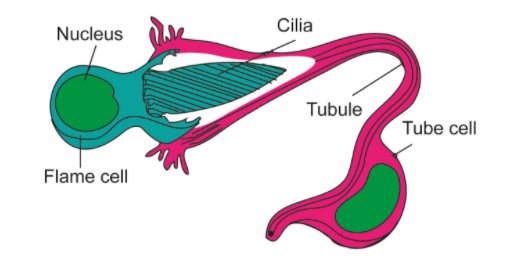
- The cell contains a nucleated cell body with a cup-shaped projection. The inner surface of the projection is covered by flagella.
- The cup is attached to a tube cell, whose inner surface is coated in cilia, which aid in liquid movement through the tube cell. This tube opens into a nephropore or an excretory bladder.
- Tube cells also contain microvilli that may help in the reabsorption of some ions.
Additional Information: - Platyhelminthes are flattened, soft-bodied, and invertebrate organisms and are either free-living or parasitic. Most of them possess a blind gut, i.e. they have a mouth but no anus.
- Flame cells also maintain the organism’s osmotic and ionic balance.
- The name is derived from the beating of the flagella, which resembles a flame.
- During excretion, molecules enter the tube cells through the gap between the flame cell and tube cell.
So, the correct answer is ‘excretion’.
Note: - Other examples of units responsible for excretion include nephrons in humans, nephridia in annelids, malpighian tubules in arthropods, and solenocytes in cephalochordates.
- Flame cells extract water and waste materials from the mesenchyme, the connective tissue in these organisms.
- Bundles of flame cells are known as protonephridia.
Complete answer:
- Flame cells are found in freshwater invertebrates like flatworms (Platyhelminthes), rotifers (Rotifera), and ribbon worms (Nemertea).
- They function as kidneys of the organism. Bundles of flame cells are known as protonephridia.
- The cell contains a nucleated cell body with a cup-shaped projection. The inner surface of the projection is covered by flagella.
- The cup is attached to a tube cell, whose inner surface is coated in cilia, which aid in liquid movement through the tube cell. This tube opens into a nephropore or an excretory bladder.
- Tube cells also contain microvilli that may help in the reabsorption of some ions.
Additional Information: - Platyhelminthes are flattened, soft-bodied, and invertebrate organisms and are either free-living or parasitic. Most of them possess a blind gut, i.e. they have a mouth but no anus.
- Flame cells also maintain the organism’s osmotic and ionic balance.
- The name is derived from the beating of the flagella, which resembles a flame.
- During excretion, molecules enter the tube cells through the gap between the flame cell and tube cell.
So, the correct answer is ‘excretion’.
Note: - Other examples of units responsible for excretion include nephrons in humans, nephridia in annelids, malpighian tubules in arthropods, and solenocytes in cephalochordates.
- Flame cells extract water and waste materials from the mesenchyme, the connective tissue in these organisms.
- Bundles of flame cells are known as protonephridia.
Recently Updated Pages
Master Class 12 Economics: Engaging Questions & Answers for Success

Master Class 12 English: Engaging Questions & Answers for Success
Master Class 12 Social Science: Engaging Questions & Answers for Success
Master Class 12 Maths: Engaging Questions & Answers for Success
Master Class 12 Physics: Engaging Questions & Answers for Success
Master Class 9 General Knowledge: Engaging Questions & Answers for Success
Trending doubts
One Metric ton is equal to kg A 10000 B 1000 C 100 class 11 physics CBSE
Difference Between Prokaryotic Cells and Eukaryotic Cells
Two of the body parts which do not appear in MRI are class 11 biology CBSE
Find the value of the expression given below sin 30circ class 11 maths CBSE
1 ton equals to A 100 kg B 1000 kg C 10 kg D 10000 class 11 physics CBSE
Draw a diagram of nephron and explain its structur class 11 biology CBSE