




Five equal forces of 10 N each applied at one point and all are lying in one plane. If the angles between them are equal, then the resultant force will be
A) zero
B) 10 N
C) 20 N
D) $10\sqrt 2 $ N
Answer
 Verified
602.7k+ views
Hint:Draw the diagram by connecting the tail of one force with another and it forms into a pentagon shape and uses the polygon law of vector addition.
Complete step by step solution:
We know from the question that the magnitude of the five forces is $F = 10\;{\rm{N}}$ and they all are acting on one point.
Let us consider a point $P$ on which all the forces are acting and the angle between the energy two forces is $\theta $.
Let us draw a figure with all five forces acting at a point
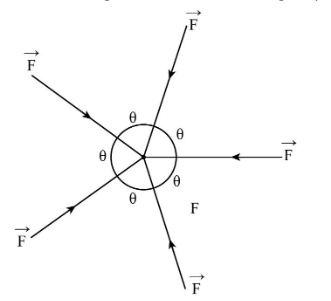
Now we arrange the forces by joining the tail of one force with the head of another force and after joining each force we get a pentagon as shown below.
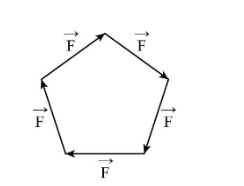
Now we apply the polygon law of vector addition, the resultant of the four forces is,
$\vec F + \vec F + \vec F + \vec F = - \vec F$
Or the above equation can be written as,
$\vec F + \vec F + \vec F + \vec F + \vec F = 0$
Hence, the resultant of 5 forces acting at a point is equal to zero and the option (A) is correct.
Additional information:polygon law of vector addition states that if the number of vectors when connected in such a way that one’s head is connected with the other's tail and so on, then the resultant vector is represented by the closing vector of the polygon taken into the opposite direction.
Note:the vector that is connected by its head with the tail of another vector and so on. If the all vectors form a closed shape, then the resultant of the vector is equal to zero.
Complete step by step solution:
We know from the question that the magnitude of the five forces is $F = 10\;{\rm{N}}$ and they all are acting on one point.
Let us consider a point $P$ on which all the forces are acting and the angle between the energy two forces is $\theta $.
Let us draw a figure with all five forces acting at a point
Now we arrange the forces by joining the tail of one force with the head of another force and after joining each force we get a pentagon as shown below.
Now we apply the polygon law of vector addition, the resultant of the four forces is,
$\vec F + \vec F + \vec F + \vec F = - \vec F$
Or the above equation can be written as,
$\vec F + \vec F + \vec F + \vec F + \vec F = 0$
Hence, the resultant of 5 forces acting at a point is equal to zero and the option (A) is correct.
Additional information:polygon law of vector addition states that if the number of vectors when connected in such a way that one’s head is connected with the other's tail and so on, then the resultant vector is represented by the closing vector of the polygon taken into the opposite direction.
Note:the vector that is connected by its head with the tail of another vector and so on. If the all vectors form a closed shape, then the resultant of the vector is equal to zero.
Recently Updated Pages
Master Class 11 Social Science: Engaging Questions & Answers for Success

Master Class 11 Chemistry: Engaging Questions & Answers for Success
Master Class 12 Business Studies: Engaging Questions & Answers for Success
Master Class 12 Chemistry: Engaging Questions & Answers for Success
Master Class 12 Biology: Engaging Questions & Answers for Success
Class 12 Question and Answer - Your Ultimate Solutions Guide
Trending doubts
One Metric ton is equal to kg A 10000 B 1000 C 100 class 11 physics CBSE
Difference Between Prokaryotic Cells and Eukaryotic Cells
How many of the following diseases can be studied with class 11 biology CBSE
Two of the body parts which do not appear in MRI are class 11 biology CBSE
Which of the following enzymes is used for carboxylation class 11 biology CBSE
Explain zero factorial class 11 maths CBSE