




How do you find the width of a rectangle with a diagonal of 12 centimeters and a length of 10 centimeters?
Answer
 Verified
599.1k+ views
Hint: In a rectangle, all the angles are right angles. Also, the diagonal and two adjacent sides of a rectangle form a right-angled triangle. Because of this, we can use the Pythagoras Theorem to calculate any one side, if two others are known. The Pythagoras theorem states that the square of the hypotenuse is equal to the sum of the squares of the two other sides.
Complete step by step answer:
We are given the length of the diagonal and width of the rectangle and have to find the width of the rectangle. We know that it is a property of a rectangle that the diagonal and two adjacent sides of a rectangle form a right-angled triangle. As it is a right-angled triangle, Pythagoras theorem can be used for this triangle which states that the square of the hypotenuse (in this case, the diagonal) is equal to the sum of the squares of the two other sides (in this case, the length and the width).
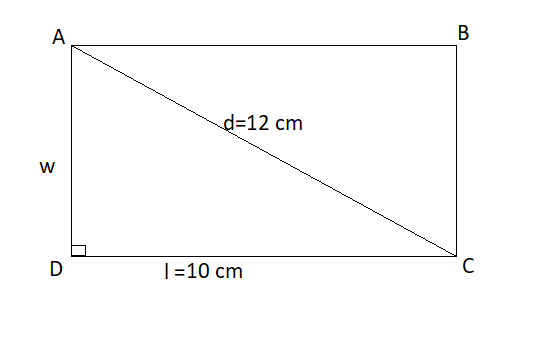
Hence, using this property in the given rectangle. We get,
\[{{d}^{2}}={{l}^{2}}+{{w}^{2}}\]
\[d,l,w\]are the diagonal, length and width of the rectangle respectively.
Substituting the values, in the above equation, we get
\[\begin{align}
& \Rightarrow {{\left( 12 \right)}^{2}}={{\left( 10 \right)}^{2}}+{{w}^{2}} \\
& \Rightarrow 144=100+{{w}^{2}} \\
\end{align}\]
Subtracting 100 from both sides of above equation, we get
\[\begin{align}
& \Rightarrow 144-100=100+{{w}^{2}}-100 \\
& \Rightarrow {{w}^{2}}=44 \\
\end{align}\]
Taking square root of both sides, we get
\[\begin{align}
& \Rightarrow w=\sqrt{44} \\
& \Rightarrow w=\sqrt{2\times 2\times 11} \\
& \Rightarrow w=2\sqrt{11} \\
\end{align}\]
Hence, width of the rectangle is \[2\sqrt{11}cm\].
Note:
The properties of different types of quadrilaterals like square, rectangle, rhombus, parallelogram, etc. should be remembered. It will be useful to solve these types of problems. Calculation mistakes should be avoided.
Complete step by step answer:
We are given the length of the diagonal and width of the rectangle and have to find the width of the rectangle. We know that it is a property of a rectangle that the diagonal and two adjacent sides of a rectangle form a right-angled triangle. As it is a right-angled triangle, Pythagoras theorem can be used for this triangle which states that the square of the hypotenuse (in this case, the diagonal) is equal to the sum of the squares of the two other sides (in this case, the length and the width).
Hence, using this property in the given rectangle. We get,
\[{{d}^{2}}={{l}^{2}}+{{w}^{2}}\]
\[d,l,w\]are the diagonal, length and width of the rectangle respectively.
Substituting the values, in the above equation, we get
\[\begin{align}
& \Rightarrow {{\left( 12 \right)}^{2}}={{\left( 10 \right)}^{2}}+{{w}^{2}} \\
& \Rightarrow 144=100+{{w}^{2}} \\
\end{align}\]
Subtracting 100 from both sides of above equation, we get
\[\begin{align}
& \Rightarrow 144-100=100+{{w}^{2}}-100 \\
& \Rightarrow {{w}^{2}}=44 \\
\end{align}\]
Taking square root of both sides, we get
\[\begin{align}
& \Rightarrow w=\sqrt{44} \\
& \Rightarrow w=\sqrt{2\times 2\times 11} \\
& \Rightarrow w=2\sqrt{11} \\
\end{align}\]
Hence, width of the rectangle is \[2\sqrt{11}cm\].
Note:
The properties of different types of quadrilaterals like square, rectangle, rhombus, parallelogram, etc. should be remembered. It will be useful to solve these types of problems. Calculation mistakes should be avoided.
Recently Updated Pages
Master Class 11 English: Engaging Questions & Answers for Success

Master Class 11 Social Science: Engaging Questions & Answers for Success
Master Class 11 Maths: Engaging Questions & Answers for Success
Master Class 11 Biology: Engaging Questions & Answers for Success
Master Class 11 Physics: Engaging Questions & Answers for Success
Master Class 11 Chemistry: Engaging Questions & Answers for Success
Trending doubts
Explain the Treaty of Vienna of 1815 class 10 social science CBSE
What is the full form of POSCO class 10 social science CBSE
Define Potential, Developed, Stock and Reserved resources
The diagonals of a rhombus are 10cm and 24cm Find the class 10 maths CBSE
Fill the blanks with proper collective nouns 1 A of class 10 english CBSE
What planets have no moons Which one has only one moon class 10 physics CBSE