




How do you find the vertex and intercepts for $y = 4{x^2} + 8x + 7$ ?
Answer
 Verified
562.8k+ views
Hint: The equation here represents a parabola. To find the intercepts i.e. the points on the coordinate axes where the curve intersects the coordinate axes, we can assume one of the variables as $\;0$ , and find the value of the other variable. To find the vertex of a parabola, we convert the equation into standard form $y = a{(x - h)^2} + k$ , where $(h,k)$ is the vertex of the parabola.
Complete step-by-step answer:
The equation given here represents a parabola that does not pass through the origin.
The standard form of an equation of a parabola is $y = a{x^2} + bx + c$ .
Comparing the standard equation with the given equation, we get the values
$\Rightarrow$ $a = 4$ , $b = 8$ , $c = 7$
Here $a > 0$ , which means the parabola opens upwards.
Now, to find the intercepts on coordinate axes, we have to assume one of the variables as $\;0$ and find the value of the other variable for it.
Hence, for the Y-intercept, we have to assume $x = 0$
Substituting $x = 0$ in the equation of the parabola given here,
$ \Rightarrow y = 4{(0)^2} + 8(0) + 7$
$ \Rightarrow y = 0 + 0 + 7$
Hence, the final value of the variable $y$ is,
$ \Rightarrow y = 7$
Thus, the Y-intercept of the parabola is $y = 7$or in the Cartesian coordinates $(0,7)$ .
For the X-intercept, we have to assume $y = 0$
Substituting $y = 0$ in the equation of the parabola given here,
$ \Rightarrow 0 = 4{x^2} + 8x + 7$
To make the equation a perfect square, we need to find the last term by the formula
$\Rightarrow$L. T. = $\dfrac{{{b^2}}}{{4a}}$
Substituting the values, we get
$\Rightarrow$L. T. = $\dfrac{{{{(8)}^2}}}{{4(4)}} = \dfrac{{64}}{{16}} = 4$
Hence, adding and subtracting $\;4$ in the equation,
$ \Rightarrow 0 = 4{x^2} + 8x + 7 + 4 - 4$
Rearranging the terms,
$ \Rightarrow 0 = 4{x^2} + 8x + 4 + 7 - 4$
Taking $\;4$ out as a common factor from the first three terms,
$ \Rightarrow 0 = 4({x^2} + 2x + 1) + 3$
$ \Rightarrow 0 = 4{(x + 1)^2} + 3$
Subtracting $\;3$ on both sides of the equation
$ \Rightarrow - 3 = 4{(x + 1)^2}$
But, we know that the value of a perfect square is always positive
Hence, the parabola does not have an X-intercept
Now, for the vertex of the parabola, convert the equation into the vertex form $y = a{(x - h)^2} + k$
$ \Rightarrow y = 4{(x + 1)^2} + 3$ , where $a = 4$ , $h = - 1$ , $k = 3$
Now, we know that the vertex of a parabola is given as $(h,k)$
Hence, the vertex of the parabola is $( - 1,3)$ .
If we plot the parabola, we get the graph as shown
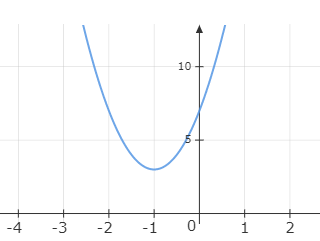
Note:
Here, to find the vertex, we can also use the standard form of the equation $y = a{x^2} + bx + c$ , where the axis of symmetry or the x coordinate is given as $x = \dfrac{{ - b}}{{2a}}$ and then find the value of $y$ from the equation of the parabola.
Complete step-by-step answer:
The equation given here represents a parabola that does not pass through the origin.
The standard form of an equation of a parabola is $y = a{x^2} + bx + c$ .
Comparing the standard equation with the given equation, we get the values
$\Rightarrow$ $a = 4$ , $b = 8$ , $c = 7$
Here $a > 0$ , which means the parabola opens upwards.
Now, to find the intercepts on coordinate axes, we have to assume one of the variables as $\;0$ and find the value of the other variable for it.
Hence, for the Y-intercept, we have to assume $x = 0$
Substituting $x = 0$ in the equation of the parabola given here,
$ \Rightarrow y = 4{(0)^2} + 8(0) + 7$
$ \Rightarrow y = 0 + 0 + 7$
Hence, the final value of the variable $y$ is,
$ \Rightarrow y = 7$
Thus, the Y-intercept of the parabola is $y = 7$or in the Cartesian coordinates $(0,7)$ .
For the X-intercept, we have to assume $y = 0$
Substituting $y = 0$ in the equation of the parabola given here,
$ \Rightarrow 0 = 4{x^2} + 8x + 7$
To make the equation a perfect square, we need to find the last term by the formula
$\Rightarrow$L. T. = $\dfrac{{{b^2}}}{{4a}}$
Substituting the values, we get
$\Rightarrow$L. T. = $\dfrac{{{{(8)}^2}}}{{4(4)}} = \dfrac{{64}}{{16}} = 4$
Hence, adding and subtracting $\;4$ in the equation,
$ \Rightarrow 0 = 4{x^2} + 8x + 7 + 4 - 4$
Rearranging the terms,
$ \Rightarrow 0 = 4{x^2} + 8x + 4 + 7 - 4$
Taking $\;4$ out as a common factor from the first three terms,
$ \Rightarrow 0 = 4({x^2} + 2x + 1) + 3$
$ \Rightarrow 0 = 4{(x + 1)^2} + 3$
Subtracting $\;3$ on both sides of the equation
$ \Rightarrow - 3 = 4{(x + 1)^2}$
But, we know that the value of a perfect square is always positive
Hence, the parabola does not have an X-intercept
Now, for the vertex of the parabola, convert the equation into the vertex form $y = a{(x - h)^2} + k$
$ \Rightarrow y = 4{(x + 1)^2} + 3$ , where $a = 4$ , $h = - 1$ , $k = 3$
Now, we know that the vertex of a parabola is given as $(h,k)$
Hence, the vertex of the parabola is $( - 1,3)$ .
If we plot the parabola, we get the graph as shown
Note:
Here, to find the vertex, we can also use the standard form of the equation $y = a{x^2} + bx + c$ , where the axis of symmetry or the x coordinate is given as $x = \dfrac{{ - b}}{{2a}}$ and then find the value of $y$ from the equation of the parabola.
Recently Updated Pages
Master Class 10 Computer Science: Engaging Questions & Answers for Success

Master Class 10 English: Engaging Questions & Answers for Success
Master Class 10 Social Science: Engaging Questions & Answers for Success
Master Class 10 General Knowledge: Engaging Questions & Answers for Success
Master Class 10 Maths: Engaging Questions & Answers for Success
Master Class 10 Science: Engaging Questions & Answers for Success
Trending doubts
Why is there a time difference of about 5 hours between class 10 social science CBSE
Who Won 36 Oscar Awards? Record Holder Revealed
What is the median of the first 10 natural numbers class 10 maths CBSE
Who was Subhash Chandra Bose Why was he called Net class 10 english CBSE
Write a letter to the principal requesting him to grant class 10 english CBSE
Who is the executive head of the government APresident class 10 social science CBSE