




Find the vector equation of the plane determined by the points $A\left( 3,-1,2 \right)$, $B\left( 5,2,4 \right)$ and $C\left( -1,-1,6 \right)$. Also find the distance of point $P\left( 6,5,9 \right)$ from this plane.
Answer
 Verified
651k+ views
Hint: We start solving the problem by checking whether the given three-point are non-collinear or not. If the points are not collinear, we find the equation of the plane using these three points. Once we find the equation of the plane, we find the distance of the point from the plane.
Complete step-by-step solution:
Given that we have three points $A\left( 3,-1,2 \right)$, $B\left( 5,2,4 \right)$ and $C\left( -1,-1,6 \right)$. We need to find the vector equation of the plane and the distance of the point $P\left( 6,5,9 \right)$ from this plane.
Let us draw all the given information to get a better view.
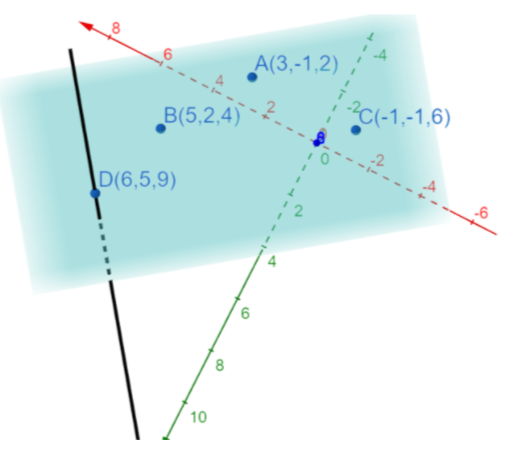
To find the equation of the plane containing three points, we first need to make sure that the three points are not collinear.
We know if three points $\left( {{x}_{1}},{{y}_{1}},{{z}_{1}} \right)$, $\left( {{x}_{2}},{{y}_{2}},{{z}_{2}} \right)$ and $\left( {{x}_{3}},{{y}_{3}},{{z}_{3}} \right)$ are said to be collinear, then the condition to be satisfied is \[\left| \begin{matrix}
{{x}_{1}} & {{y}_{1}} & {{z}_{1}} \\
{{x}_{2}} & {{y}_{2}} & {{z}_{2}} \\
{{x}_{3}} & {{y}_{3}} & {{z}_{3}} \\
\end{matrix} \right|=0\].
Let us find the value of the determinant \[\left| \begin{matrix}
3 & -1 & 2 \\
5 & 2 & 4 \\
-1 & -1 & 6 \\
\end{matrix} \right|\].
We know that the determinant of a $3\times 3$ matrix is defined as $\left| \begin{matrix}
a & b & c \\
d & e & f \\
g & h & i \\
\end{matrix} \right|=a\times \left| \begin{matrix}
e & f \\
h & i \\
\end{matrix} \right|-b\times \left| \begin{matrix}
d & f \\
g & i \\
\end{matrix} \right|+c\times \left| \begin{matrix}
d & e \\
g & h \\
\end{matrix} \right|$.
$\Rightarrow \left| \begin{matrix}
3 & -1 & 2 \\
5 & 2 & 4 \\
-1 & -1 & 6 \\
\end{matrix} \right|=3\times \left| \begin{matrix}
2 & 4 \\
-1 & 6 \\
\end{matrix} \right|-\left( -1 \right)\times \left| \begin{matrix}
5 & 4 \\
-1 & 6 \\
\end{matrix} \right|+2\times \left| \begin{matrix}
5 & 2 \\
-1 & -1 \\
\end{matrix} \right|$.
We know that determinant of $2\times 2$ matrix is defined as $\left| \begin{matrix}
p & q \\
r & s \\
\end{matrix} \right|=\left( p\times s \right)-\left( q\times r \right)$.
$\Rightarrow \left| \begin{matrix}
3 & -1 & 2 \\
5 & 2 & 4 \\
-1 & -1 & 6 \\
\end{matrix} \right|=3\times \left( \left( 2\times 6 \right)-\left( -1\times 4 \right) \right)-\left( -1 \right)\times \left( \left( 5\times 6 \right)-\left( -1\times 4 \right) \right)+2\times \left( \left( 5\times -1 \right)-\left( -1\times 2 \right) \right)$.
$\Rightarrow \left| \begin{matrix}
3 & -1 & 2 \\
5 & 2 & 4 \\
-1 & -1 & 6 \\
\end{matrix} \right|=3\times \left( \left( 12 \right)-\left( -4 \right) \right)-\left( -1 \right)\times \left( \left( 30 \right)-\left( -4 \right) \right)+2\times \left( \left( -5 \right)-\left( -2 \right) \right)$.
$\Rightarrow \left| \begin{matrix}
3 & -1 & 2 \\
5 & 2 & 4 \\
-1 & -1 & 6 \\
\end{matrix} \right|=3\times \left( 12+4 \right)-\left( -1 \right)\times \left( 30+4 \right)+2\times \left( -5+2 \right)$.
$\Rightarrow \left| \begin{matrix}
3 & -1 & 2 \\
5 & 2 & 4 \\
-1 & -1 & 6 \\
\end{matrix} \right|=3\times \left( 16 \right)+1\times \left( 34 \right)+2\times \left( -3 \right)$.
$\Rightarrow \left| \begin{matrix}
3 & -1 & 2 \\
5 & 2 & 4 \\
-1 & -1 & 6 \\
\end{matrix} \right|=48+34-6$.
$\Rightarrow \left| \begin{matrix}
3 & -1 & 2 \\
5 & 2 & 4 \\
-1 & -1 & 6 \\
\end{matrix} \right|=76$.
So, the points $A\left( 3,-1,2 \right)$, $B\left( 5,2,4 \right)$ and $C\left( -1,-1,6 \right)$ are not collinear.
We know that the equation of the plane containing three non- collinear points $\left( {{x}_{1}},{{y}_{1}},{{z}_{1}} \right)$, $\left( {{x}_{2}},{{y}_{2}},{{z}_{2}} \right)$ and $\left( {{x}_{3}},{{y}_{3}},{{z}_{3}} \right)$ is \[\left| \begin{matrix}
x-{{x}_{1}} & y-{{y}_{1}} & z-{{z}_{1}} \\
{{x}_{2}}-{{x}_{1}} & {{y}_{2}}-{{y}_{1}} & {{z}_{2}}-{{z}_{1}} \\
{{x}_{3}}-{{x}_{1}} & {{y}_{3}}-{{y}_{1}} & {{z}_{3}}-{{z}_{1}} \\
\end{matrix} \right|=0\].
Now, we find the equation of the plane containing the points $A\left( 3,-1,2 \right)$, $B\left( 5,2,4 \right)$ and $C\left( -1,-1,6 \right)$.
The equation of the required plane is \[\left| \begin{matrix}
x-3 & y-\left( -1 \right) & z-2 \\
5-3 & 2-\left( -1 \right) & 4-2 \\
-1-3 & -1-\left( -1 \right) & 6-2 \\
\end{matrix} \right|=0\].
\[\Rightarrow \left| \begin{matrix}
x-3 & y+1 & z-2 \\
2 & 2+1 & 2 \\
-4 & -1+1 & 4 \\
\end{matrix} \right|=0\].
\[\Rightarrow \left| \begin{matrix}
x-3 & y+1 & z-2 \\
2 & 3 & 2 \\
-4 & 0 & 4 \\
\end{matrix} \right|=0\]
\[\Rightarrow \left( x-3 \right)\times \left| \begin{matrix}
3 & 2 \\
0 & 4 \\
\end{matrix} \right|-\left( y+1 \right)\times \left| \begin{matrix}
2 & 2 \\
-4 & 4 \\
\end{matrix} \right|+\left( z-2 \right)\times \left| \begin{matrix}
2 & 3 \\
-4 & 0 \\
\end{matrix} \right|=0\].
\[\Rightarrow \left( x-3 \right)\times \left( \left( 3\times 4 \right)-\left( 0\times 2 \right) \right)-\left( y+1 \right)\times \left( \left( 2\times 4 \right)-\left( 2\times -4 \right) \right)+\left( z-2 \right)\times \left( \left( 2\times 0 \right)-\left( -4\times 3 \right) \right)=0\].
\[\Rightarrow \left( x-3 \right)\times \left( \left( 12 \right)-\left( 0 \right) \right)-\left( y+1 \right)\times \left( \left( 8 \right)-\left( -8 \right) \right)+\left( z-2 \right)\times \left( \left( 0 \right)-\left( -12 \right) \right)=0\].
\[\Rightarrow \left( x-3 \right)\times \left( 12-0 \right)-\left( y+1 \right)\times \left( 8+8 \right)+\left( z-2 \right)\times \left( 0+12 \right)=0\].
\[\Rightarrow \left( x-3 \right)\times \left( 12 \right)-\left( y+1 \right)\times \left( 16 \right)+\left( z-2 \right)\times \left( 12 \right)=0\].
\[\Rightarrow 12x-36-16y-16+12z-24=0\].
\[\Rightarrow 12x-16y+12z-76=0\].
\[\Rightarrow 3x-4y+3z-19=0\] ---(1).
Let us assume the vector in plane \[\vec{r}=x\hat{i}+y\hat{j}+z\hat{k}\].
We know that dot product of two vectors $\left( a\hat{i}+b\hat{j}+c\hat{k} \right)$ and $\left( d\hat{i}+e\hat{j}+f\hat{k} \right)$ is given as $\left( a\hat{i}+b\hat{j}+c\hat{k} \right)\bullet \left( d\hat{i}+e\hat{j}+f\hat{k} \right)=ad+be+cf$.
So, we get \[3x-4y+3z\] as a dot product of two vectors $\left( 3\hat{i}-4\hat{j}+3\hat{k} \right)$ and \[\left( x\hat{i}+y\hat{j}+z\hat{k} \right)\].
So, \[3x-4y+3z=\vec{r}\bullet \left( 3\hat{i}-4\hat{j}+3\hat{k} \right)\].
So, we get the vector equation of the plane \[3x-4y+3z-19=0\] is given as \[\vec{r}\bullet \left( 3\hat{i}-4\hat{j}+3\hat{k} \right)-19=0\].
We know that the perpendicular distance of the point \[\left( {{x}_{1}},{{y}_{1}},{{z}_{1}} \right)\] to the plane $ax+by+cz+d=0$ is $\dfrac{\left| a{{x}_{1}}+b{{y}_{1}}+c{{z}_{1}}+d \right|}{\sqrt{{{a}^{2}}+{{b}^{2}}+{{c}^{2}}}}$.
We need to find the distance from point $P\left( 6,5,9 \right)$ to the plane \[3x-4y+3z-19=0\]. Let the perpendicular distance be ‘d’.
$\Rightarrow d=\dfrac{\left| 3\left( 6 \right)-4\left( 5 \right)+3\left( 9 \right)-19 \right|}{\sqrt{{{3}^{2}}+{{\left( -4 \right)}^{2}}+{{3}^{2}}}}$.
$\Rightarrow d=\dfrac{\left| 18-20+27-19 \right|}{\sqrt{9+16+9}}$.
$\Rightarrow d=\dfrac{\left| 6 \right|}{\sqrt{34}}$.
$\Rightarrow d=\dfrac{6}{\sqrt{34}}$.
∴ We got the distance of the plane \[3x-4y+3z-19=0\] from point $P\left( 6,5,9 \right)$ is $\dfrac{6}{\sqrt{34}}$.
The equation of the plane is \[3x-4y+3z-19=0\] and the distance of plane \[3x-4y+3z-19=0\] from point $P\left( 6,5,9 \right)$ is $\dfrac{6}{\sqrt{34}}$.
Note: We should not just start finding the equation of the plane without checking whether the given points are not collinear. To convert the cartesian form to vector form we always take the form of a general vector present in a plane \[\vec{r}=x\hat{i}+y\hat{j}+z\hat{k}\]. If we get the perpendicular distance zero then the point lies in the plane.
Complete step-by-step solution:
Given that we have three points $A\left( 3,-1,2 \right)$, $B\left( 5,2,4 \right)$ and $C\left( -1,-1,6 \right)$. We need to find the vector equation of the plane and the distance of the point $P\left( 6,5,9 \right)$ from this plane.
Let us draw all the given information to get a better view.
To find the equation of the plane containing three points, we first need to make sure that the three points are not collinear.
We know if three points $\left( {{x}_{1}},{{y}_{1}},{{z}_{1}} \right)$, $\left( {{x}_{2}},{{y}_{2}},{{z}_{2}} \right)$ and $\left( {{x}_{3}},{{y}_{3}},{{z}_{3}} \right)$ are said to be collinear, then the condition to be satisfied is \[\left| \begin{matrix}
{{x}_{1}} & {{y}_{1}} & {{z}_{1}} \\
{{x}_{2}} & {{y}_{2}} & {{z}_{2}} \\
{{x}_{3}} & {{y}_{3}} & {{z}_{3}} \\
\end{matrix} \right|=0\].
Let us find the value of the determinant \[\left| \begin{matrix}
3 & -1 & 2 \\
5 & 2 & 4 \\
-1 & -1 & 6 \\
\end{matrix} \right|\].
We know that the determinant of a $3\times 3$ matrix is defined as $\left| \begin{matrix}
a & b & c \\
d & e & f \\
g & h & i \\
\end{matrix} \right|=a\times \left| \begin{matrix}
e & f \\
h & i \\
\end{matrix} \right|-b\times \left| \begin{matrix}
d & f \\
g & i \\
\end{matrix} \right|+c\times \left| \begin{matrix}
d & e \\
g & h \\
\end{matrix} \right|$.
$\Rightarrow \left| \begin{matrix}
3 & -1 & 2 \\
5 & 2 & 4 \\
-1 & -1 & 6 \\
\end{matrix} \right|=3\times \left| \begin{matrix}
2 & 4 \\
-1 & 6 \\
\end{matrix} \right|-\left( -1 \right)\times \left| \begin{matrix}
5 & 4 \\
-1 & 6 \\
\end{matrix} \right|+2\times \left| \begin{matrix}
5 & 2 \\
-1 & -1 \\
\end{matrix} \right|$.
We know that determinant of $2\times 2$ matrix is defined as $\left| \begin{matrix}
p & q \\
r & s \\
\end{matrix} \right|=\left( p\times s \right)-\left( q\times r \right)$.
$\Rightarrow \left| \begin{matrix}
3 & -1 & 2 \\
5 & 2 & 4 \\
-1 & -1 & 6 \\
\end{matrix} \right|=3\times \left( \left( 2\times 6 \right)-\left( -1\times 4 \right) \right)-\left( -1 \right)\times \left( \left( 5\times 6 \right)-\left( -1\times 4 \right) \right)+2\times \left( \left( 5\times -1 \right)-\left( -1\times 2 \right) \right)$.
$\Rightarrow \left| \begin{matrix}
3 & -1 & 2 \\
5 & 2 & 4 \\
-1 & -1 & 6 \\
\end{matrix} \right|=3\times \left( \left( 12 \right)-\left( -4 \right) \right)-\left( -1 \right)\times \left( \left( 30 \right)-\left( -4 \right) \right)+2\times \left( \left( -5 \right)-\left( -2 \right) \right)$.
$\Rightarrow \left| \begin{matrix}
3 & -1 & 2 \\
5 & 2 & 4 \\
-1 & -1 & 6 \\
\end{matrix} \right|=3\times \left( 12+4 \right)-\left( -1 \right)\times \left( 30+4 \right)+2\times \left( -5+2 \right)$.
$\Rightarrow \left| \begin{matrix}
3 & -1 & 2 \\
5 & 2 & 4 \\
-1 & -1 & 6 \\
\end{matrix} \right|=3\times \left( 16 \right)+1\times \left( 34 \right)+2\times \left( -3 \right)$.
$\Rightarrow \left| \begin{matrix}
3 & -1 & 2 \\
5 & 2 & 4 \\
-1 & -1 & 6 \\
\end{matrix} \right|=48+34-6$.
$\Rightarrow \left| \begin{matrix}
3 & -1 & 2 \\
5 & 2 & 4 \\
-1 & -1 & 6 \\
\end{matrix} \right|=76$.
So, the points $A\left( 3,-1,2 \right)$, $B\left( 5,2,4 \right)$ and $C\left( -1,-1,6 \right)$ are not collinear.
We know that the equation of the plane containing three non- collinear points $\left( {{x}_{1}},{{y}_{1}},{{z}_{1}} \right)$, $\left( {{x}_{2}},{{y}_{2}},{{z}_{2}} \right)$ and $\left( {{x}_{3}},{{y}_{3}},{{z}_{3}} \right)$ is \[\left| \begin{matrix}
x-{{x}_{1}} & y-{{y}_{1}} & z-{{z}_{1}} \\
{{x}_{2}}-{{x}_{1}} & {{y}_{2}}-{{y}_{1}} & {{z}_{2}}-{{z}_{1}} \\
{{x}_{3}}-{{x}_{1}} & {{y}_{3}}-{{y}_{1}} & {{z}_{3}}-{{z}_{1}} \\
\end{matrix} \right|=0\].
Now, we find the equation of the plane containing the points $A\left( 3,-1,2 \right)$, $B\left( 5,2,4 \right)$ and $C\left( -1,-1,6 \right)$.
The equation of the required plane is \[\left| \begin{matrix}
x-3 & y-\left( -1 \right) & z-2 \\
5-3 & 2-\left( -1 \right) & 4-2 \\
-1-3 & -1-\left( -1 \right) & 6-2 \\
\end{matrix} \right|=0\].
\[\Rightarrow \left| \begin{matrix}
x-3 & y+1 & z-2 \\
2 & 2+1 & 2 \\
-4 & -1+1 & 4 \\
\end{matrix} \right|=0\].
\[\Rightarrow \left| \begin{matrix}
x-3 & y+1 & z-2 \\
2 & 3 & 2 \\
-4 & 0 & 4 \\
\end{matrix} \right|=0\]
\[\Rightarrow \left( x-3 \right)\times \left| \begin{matrix}
3 & 2 \\
0 & 4 \\
\end{matrix} \right|-\left( y+1 \right)\times \left| \begin{matrix}
2 & 2 \\
-4 & 4 \\
\end{matrix} \right|+\left( z-2 \right)\times \left| \begin{matrix}
2 & 3 \\
-4 & 0 \\
\end{matrix} \right|=0\].
\[\Rightarrow \left( x-3 \right)\times \left( \left( 3\times 4 \right)-\left( 0\times 2 \right) \right)-\left( y+1 \right)\times \left( \left( 2\times 4 \right)-\left( 2\times -4 \right) \right)+\left( z-2 \right)\times \left( \left( 2\times 0 \right)-\left( -4\times 3 \right) \right)=0\].
\[\Rightarrow \left( x-3 \right)\times \left( \left( 12 \right)-\left( 0 \right) \right)-\left( y+1 \right)\times \left( \left( 8 \right)-\left( -8 \right) \right)+\left( z-2 \right)\times \left( \left( 0 \right)-\left( -12 \right) \right)=0\].
\[\Rightarrow \left( x-3 \right)\times \left( 12-0 \right)-\left( y+1 \right)\times \left( 8+8 \right)+\left( z-2 \right)\times \left( 0+12 \right)=0\].
\[\Rightarrow \left( x-3 \right)\times \left( 12 \right)-\left( y+1 \right)\times \left( 16 \right)+\left( z-2 \right)\times \left( 12 \right)=0\].
\[\Rightarrow 12x-36-16y-16+12z-24=0\].
\[\Rightarrow 12x-16y+12z-76=0\].
\[\Rightarrow 3x-4y+3z-19=0\] ---(1).
Let us assume the vector in plane \[\vec{r}=x\hat{i}+y\hat{j}+z\hat{k}\].
We know that dot product of two vectors $\left( a\hat{i}+b\hat{j}+c\hat{k} \right)$ and $\left( d\hat{i}+e\hat{j}+f\hat{k} \right)$ is given as $\left( a\hat{i}+b\hat{j}+c\hat{k} \right)\bullet \left( d\hat{i}+e\hat{j}+f\hat{k} \right)=ad+be+cf$.
So, we get \[3x-4y+3z\] as a dot product of two vectors $\left( 3\hat{i}-4\hat{j}+3\hat{k} \right)$ and \[\left( x\hat{i}+y\hat{j}+z\hat{k} \right)\].
So, \[3x-4y+3z=\vec{r}\bullet \left( 3\hat{i}-4\hat{j}+3\hat{k} \right)\].
So, we get the vector equation of the plane \[3x-4y+3z-19=0\] is given as \[\vec{r}\bullet \left( 3\hat{i}-4\hat{j}+3\hat{k} \right)-19=0\].
We know that the perpendicular distance of the point \[\left( {{x}_{1}},{{y}_{1}},{{z}_{1}} \right)\] to the plane $ax+by+cz+d=0$ is $\dfrac{\left| a{{x}_{1}}+b{{y}_{1}}+c{{z}_{1}}+d \right|}{\sqrt{{{a}^{2}}+{{b}^{2}}+{{c}^{2}}}}$.
We need to find the distance from point $P\left( 6,5,9 \right)$ to the plane \[3x-4y+3z-19=0\]. Let the perpendicular distance be ‘d’.
$\Rightarrow d=\dfrac{\left| 3\left( 6 \right)-4\left( 5 \right)+3\left( 9 \right)-19 \right|}{\sqrt{{{3}^{2}}+{{\left( -4 \right)}^{2}}+{{3}^{2}}}}$.
$\Rightarrow d=\dfrac{\left| 18-20+27-19 \right|}{\sqrt{9+16+9}}$.
$\Rightarrow d=\dfrac{\left| 6 \right|}{\sqrt{34}}$.
$\Rightarrow d=\dfrac{6}{\sqrt{34}}$.
∴ We got the distance of the plane \[3x-4y+3z-19=0\] from point $P\left( 6,5,9 \right)$ is $\dfrac{6}{\sqrt{34}}$.
The equation of the plane is \[3x-4y+3z-19=0\] and the distance of plane \[3x-4y+3z-19=0\] from point $P\left( 6,5,9 \right)$ is $\dfrac{6}{\sqrt{34}}$.
Note: We should not just start finding the equation of the plane without checking whether the given points are not collinear. To convert the cartesian form to vector form we always take the form of a general vector present in a plane \[\vec{r}=x\hat{i}+y\hat{j}+z\hat{k}\]. If we get the perpendicular distance zero then the point lies in the plane.
Recently Updated Pages
Explain the structure of megasporangium class 12 biology CBSE

Why is chloroform kept in dark coloured bottles class 12 chemistry CBSE
Derive the balancing condition of a Wheatstone bri class 12 physics CBSE
Draw VI characteristics of a pn junction diode Explain class 12 physics CBSE
Is it possible to carry pride in ones language too class 12 english CBSE
In a population at Hardy Weinberg equilibrium the allele class 12 biology CBSE
Trending doubts
Draw a labelled sketch of the human eye class 12 physics CBSE
Which are the Top 10 Largest Countries of the World?
Draw ray diagrams each showing i myopic eye and ii class 12 physics CBSE
Which is the correct genotypic ratio of mendel dihybrid class 12 biology CBSE
Differentiate between homogeneous and heterogeneous class 12 chemistry CBSE
Which animal never drinks water in its entire life class 12 biology CBSE