




Find the vector equation of the coordinate planes.
Answer
 Verified
615.6k+ views
Hint: We know that for a XY plane z coordinate is 0, for an YZ plane x coordinate is 0 and for a ZX plane y coordinate is 0.
Complete step-by-step answer:
Observe the figure given below.
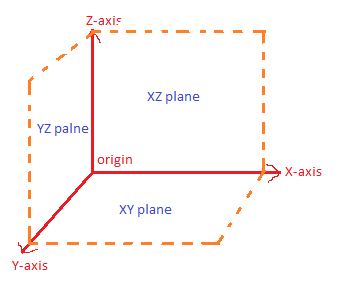
From the figure above we observe that the Z-axis is perpendicular to the XY plane, Y-axis is perpendicular to the XZ plane and X-axis is perpendicular to YZ plane.
Let \[\vec r = a\mathop i\limits^ \wedge + b\mathop j\limits^ \wedge + c\mathop k\limits^ \wedge \] is a position vector in the plane.
Let \[\mathop i\limits^ \wedge \] be the unit vector parallel to the X-axis, \[\mathop j\limits^ \wedge \] be the unit vector parallel to the Y-axis and \[\mathop k\limits^ \wedge \] be the unit vector parallel to Z-axis respectively.
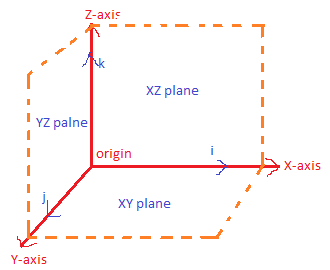
For an XY plane:
Unit vector parallel to the z axis is normal to the plane. That is their dot product with XY plane is equal to zero. So the equation of the plane is \[\vec r.\mathop k\limits^ \wedge = 0\] or we know that a point lying on this plane has z coordinate is 0. So the equation can also be written as \[\vec r = a\mathop i\limits^ \wedge + b\mathop j\limits^ \wedge \].
Similarly for the other two planes we can write.
For an YZ plane:
Unit vector parallel to the x axis is normal to the plane. That is, their dot product with the YZ plane is equal to zero. So the equation of the plane is \[\vec r.\mathop i\limits^ \wedge = 0\] or we know that a point lying on this plane has x coordinate is 0. So the equation can also be written as \[\vec r = b\mathop j\limits^ \wedge + c\mathop k\limits^ \wedge \].
For an XZ plane:
Unit vector parallel to the z axis is normal to the plane. That is their dot product with XY plane is equal to zero. So the equation of the plane is \[\vec r.\mathop j\limits^ \wedge = 0\] or we know that a point lying on this plane has z coordinate is 0. So the equation can also be written as \[\vec r = a\mathop i\limits^ \wedge + c\mathop k\limits^ \wedge \].
Note: Note that a dot product of a position vector with unit vector parallel to the plane is taken zero here because there is an angle of \[{90^ \circ }\] in between them. Unit vector is having value 1.
Complete step-by-step answer:
Observe the figure given below.
From the figure above we observe that the Z-axis is perpendicular to the XY plane, Y-axis is perpendicular to the XZ plane and X-axis is perpendicular to YZ plane.
Let \[\vec r = a\mathop i\limits^ \wedge + b\mathop j\limits^ \wedge + c\mathop k\limits^ \wedge \] is a position vector in the plane.
Let \[\mathop i\limits^ \wedge \] be the unit vector parallel to the X-axis, \[\mathop j\limits^ \wedge \] be the unit vector parallel to the Y-axis and \[\mathop k\limits^ \wedge \] be the unit vector parallel to Z-axis respectively.
For an XY plane:
Unit vector parallel to the z axis is normal to the plane. That is their dot product with XY plane is equal to zero. So the equation of the plane is \[\vec r.\mathop k\limits^ \wedge = 0\] or we know that a point lying on this plane has z coordinate is 0. So the equation can also be written as \[\vec r = a\mathop i\limits^ \wedge + b\mathop j\limits^ \wedge \].
Similarly for the other two planes we can write.
For an YZ plane:
Unit vector parallel to the x axis is normal to the plane. That is, their dot product with the YZ plane is equal to zero. So the equation of the plane is \[\vec r.\mathop i\limits^ \wedge = 0\] or we know that a point lying on this plane has x coordinate is 0. So the equation can also be written as \[\vec r = b\mathop j\limits^ \wedge + c\mathop k\limits^ \wedge \].
For an XZ plane:
Unit vector parallel to the z axis is normal to the plane. That is their dot product with XY plane is equal to zero. So the equation of the plane is \[\vec r.\mathop j\limits^ \wedge = 0\] or we know that a point lying on this plane has z coordinate is 0. So the equation can also be written as \[\vec r = a\mathop i\limits^ \wedge + c\mathop k\limits^ \wedge \].
Note: Note that a dot product of a position vector with unit vector parallel to the plane is taken zero here because there is an angle of \[{90^ \circ }\] in between them. Unit vector is having value 1.
Recently Updated Pages
Master Class 11 English: Engaging Questions & Answers for Success

Master Class 11 Social Science: Engaging Questions & Answers for Success
Master Class 11 Maths: Engaging Questions & Answers for Success
Master Class 11 Biology: Engaging Questions & Answers for Success
Master Class 11 Physics: Engaging Questions & Answers for Success
Master Class 11 Chemistry: Engaging Questions & Answers for Success
Trending doubts
One Metric ton is equal to kg A 10000 B 1000 C 100 class 11 physics CBSE
Difference Between Prokaryotic Cells and Eukaryotic Cells
Find the value of the expression given below sin 30circ class 11 maths CBSE
Two of the body parts which do not appear in MRI are class 11 biology CBSE
Draw a diagram of a plant cell and label at least eight class 11 biology CBSE
10 examples of friction in our daily life