




Find the value of x and y using cross multiplication method:
\[2x+y=13\] and \[x+y=8\].
A. (5, 3)
B. (5, -3)
C. (-5, -3)
D. (-5, 3)
Answer
 Verified
624.3k+ views
Hint:Consider two linear equations applying the cross product where the coefficient of x, y and constant terms in the equation are interrelated. Take this relation into formula.
Complete step-by-step answer:
We have been given two equations \[2x+y=13.....(1)\]
\[x+y=8....(2)\]
Now let us look into the formula for cross multiplication and its use in solving two simultaneous equations can be presented as,
\[\begin{align}
& {{a}_{1}}x+{{b}_{1}}y+{{c}_{1}}=0......(3) \\
& {{a}_{2}}x+{{b}_{2}}y+{{c}_{2}}=0.....(4) \\
\end{align}\]
Thus we can draw it as,
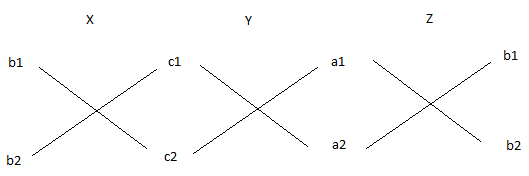
Here z=1
Thus from this we can write as,
\[\dfrac{x}{{{b}_{1}}{{c}_{2}}-{{b}_{2}}{{c}_{1}}}=\dfrac{y}{{{c}_{1}}{{a}_{2}}-{{c}_{2}}{{a}_{1}}}=\dfrac{1}{{{a}_{1}}{{b}_{2}}-{{a}_{2}}{{b}_{1}}}\]
From this we can write,
\[\begin{align}
& \dfrac{x}{{{b}_{1}}{{c}_{2}}-{{b}_{2}}{{c}_{1}}}=\dfrac{1}{{{a}_{1}}{{b}_{2}}-{{a}_{2}}{{b}_{1}}} \\
& \Rightarrow x=\dfrac{{{b}_{1}}{{c}_{2}}-{{b}_{2}}{{c}_{1}}}{{{a}_{1}}{{b}_{2}}-{{a}_{2}}{{b}_{1}}}.....(5) \\
\end{align}\]
\[\begin{align}
& \dfrac{y}{{{c}_{1}}{{a}_{2}}-{{c}_{2}}{{a}_{1}}}=\dfrac{1}{{{a}_{1}}{{b}_{2}}-{{a}_{2}}{{b}_{1}}} \\
& \therefore y=\dfrac{{{c}_{1}}{{a}_{2}}-{{c}_{2}}{{a}_{1}}}{{{a}_{1}}{{b}_{2}}-{{a}_{2}}{{b}_{1}}}....(6) \\
\end{align}\]
Thus from equation (1) , \[2x+y-13=0\], compare it with equation (3).
\[{{a}_{1}}=2,{{b}_{1}}=1,{{c}_{1}}=-13\]
Now from equation (2), \[x+y=8\], compare it with equation (4).
\[{{a}_{2}}=1,{{b}_{2}}=1,{{c}_{2}}=-8\]
Now apply these values in equation (5) and (6).
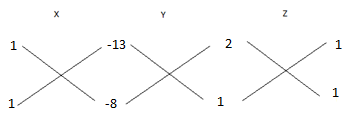
Here z=1
\[\begin{align}
& x=\dfrac{{{b}_{1}}{{c}_{2}}-{{b}_{2}}{{c}_{1}}}{{{a}_{1}}{{b}_{2}}-{{a}_{2}}{{b}_{1}}}=\dfrac{1\times (-8)-1\times (-13)}{2\times 1-1\times 1}=\dfrac{-8+13}{2-1}=\dfrac{5}{1}=5 \\
& y=\dfrac{{{c}_{1}}{{a}_{2}}-{{c}_{2}}{{a}_{1}}}{{{a}_{1}}{{b}_{2}}-{{a}_{2}}{{b}_{1}}}=\dfrac{(-13\times 1)-(-8\times 2)}{(2\times 1)-(1\times 1)}=\dfrac{-13+16}{2-1}=3 \\
\end{align}\]
Thus we got x = 5 and y = 3, i.e. the value we got by cross multiplication is (5, 3).
Option A is the correct answer.
Note: If the value of x or y is zero, that is \[\left( {{b}_{1}}{{c}_{2}}-{{b}_{2}}{{c}_{1}} \right)=0\] or \[\left( {{c}_{1}}{{a}_{2}}-{{c}_{2}}{{a}_{1}} \right)=0\], it is not proper way to express in the formula for cross multiplication, because the denominator of a fraction can never be zero. For two simultaneous equations, cross multiplication is an important concept.
Complete step-by-step answer:
We have been given two equations \[2x+y=13.....(1)\]
\[x+y=8....(2)\]
Now let us look into the formula for cross multiplication and its use in solving two simultaneous equations can be presented as,
\[\begin{align}
& {{a}_{1}}x+{{b}_{1}}y+{{c}_{1}}=0......(3) \\
& {{a}_{2}}x+{{b}_{2}}y+{{c}_{2}}=0.....(4) \\
\end{align}\]
Thus we can draw it as,
Here z=1
Thus from this we can write as,
\[\dfrac{x}{{{b}_{1}}{{c}_{2}}-{{b}_{2}}{{c}_{1}}}=\dfrac{y}{{{c}_{1}}{{a}_{2}}-{{c}_{2}}{{a}_{1}}}=\dfrac{1}{{{a}_{1}}{{b}_{2}}-{{a}_{2}}{{b}_{1}}}\]
From this we can write,
\[\begin{align}
& \dfrac{x}{{{b}_{1}}{{c}_{2}}-{{b}_{2}}{{c}_{1}}}=\dfrac{1}{{{a}_{1}}{{b}_{2}}-{{a}_{2}}{{b}_{1}}} \\
& \Rightarrow x=\dfrac{{{b}_{1}}{{c}_{2}}-{{b}_{2}}{{c}_{1}}}{{{a}_{1}}{{b}_{2}}-{{a}_{2}}{{b}_{1}}}.....(5) \\
\end{align}\]
\[\begin{align}
& \dfrac{y}{{{c}_{1}}{{a}_{2}}-{{c}_{2}}{{a}_{1}}}=\dfrac{1}{{{a}_{1}}{{b}_{2}}-{{a}_{2}}{{b}_{1}}} \\
& \therefore y=\dfrac{{{c}_{1}}{{a}_{2}}-{{c}_{2}}{{a}_{1}}}{{{a}_{1}}{{b}_{2}}-{{a}_{2}}{{b}_{1}}}....(6) \\
\end{align}\]
Thus from equation (1) , \[2x+y-13=0\], compare it with equation (3).
\[{{a}_{1}}=2,{{b}_{1}}=1,{{c}_{1}}=-13\]
Now from equation (2), \[x+y=8\], compare it with equation (4).
\[{{a}_{2}}=1,{{b}_{2}}=1,{{c}_{2}}=-8\]
Now apply these values in equation (5) and (6).
Here z=1
\[\begin{align}
& x=\dfrac{{{b}_{1}}{{c}_{2}}-{{b}_{2}}{{c}_{1}}}{{{a}_{1}}{{b}_{2}}-{{a}_{2}}{{b}_{1}}}=\dfrac{1\times (-8)-1\times (-13)}{2\times 1-1\times 1}=\dfrac{-8+13}{2-1}=\dfrac{5}{1}=5 \\
& y=\dfrac{{{c}_{1}}{{a}_{2}}-{{c}_{2}}{{a}_{1}}}{{{a}_{1}}{{b}_{2}}-{{a}_{2}}{{b}_{1}}}=\dfrac{(-13\times 1)-(-8\times 2)}{(2\times 1)-(1\times 1)}=\dfrac{-13+16}{2-1}=3 \\
\end{align}\]
Thus we got x = 5 and y = 3, i.e. the value we got by cross multiplication is (5, 3).
Option A is the correct answer.
Note: If the value of x or y is zero, that is \[\left( {{b}_{1}}{{c}_{2}}-{{b}_{2}}{{c}_{1}} \right)=0\] or \[\left( {{c}_{1}}{{a}_{2}}-{{c}_{2}}{{a}_{1}} \right)=0\], it is not proper way to express in the formula for cross multiplication, because the denominator of a fraction can never be zero. For two simultaneous equations, cross multiplication is an important concept.
Recently Updated Pages
Three beakers labelled as A B and C each containing 25 mL of water were taken A small amount of NaOH anhydrous CuSO4 and NaCl were added to the beakers A B and C respectively It was observed that there was an increase in the temperature of the solutions contained in beakers A and B whereas in case of beaker C the temperature of the solution falls Which one of the following statements isarecorrect i In beakers A and B exothermic process has occurred ii In beakers A and B endothermic process has occurred iii In beaker C exothermic process has occurred iv In beaker C endothermic process has occurred

Master Class 10 Social Science: Engaging Questions & Answers for Success
Master Class 10 Science: Engaging Questions & Answers for Success
Master Class 10 Maths: Engaging Questions & Answers for Success
Master Class 10 General Knowledge: Engaging Questions & Answers for Success
Master Class 10 Computer Science: Engaging Questions & Answers for Success
Three beakers labelled as A B and C each containing 25 mL of water were taken A small amount of NaOH anhydrous CuSO4 and NaCl were added to the beakers A B and C respectively It was observed that there was an increase in the temperature of the solutions contained in beakers A and B whereas in case of beaker C the temperature of the solution falls Which one of the following statements isarecorrect i In beakers A and B exothermic process has occurred ii In beakers A and B endothermic process has occurred iii In beaker C exothermic process has occurred iv In beaker C endothermic process has occurred
Master Class 10 Social Science: Engaging Questions & Answers for Success
Master Class 10 Science: Engaging Questions & Answers for Success
Trending doubts
Explain the Treaty of Vienna of 1815 class 10 social science CBSE
In cricket, what is the term for a bowler taking five wickets in an innings?
Who Won 36 Oscar Awards? Record Holder Revealed
What is the name of Japan Parliament?
What is the median of the first 10 natural numbers class 10 maths CBSE
Why is it 530 pm in india when it is 1200 afternoon class 10 social science CBSE