



Find the value of $\tan \left( 90{}^\circ -\theta \right)$
[a] $\sin \theta $
[b] $\cos \theta $
[c] $\sin \theta +\cos \theta $
[d] $\cot \theta $
Answer
 Verified
628.5k+ views
Hint: In a right triangle, ABC is right-angled at A if $\angle C=\theta $ then $\angle B=90{}^\circ -\theta $. Use the fact that \[\sin \theta =\dfrac{\text{Perpendicular}}{\text{Hypotenuse}}\] and \[\cos \theta =\dfrac{\text{Base}}{\text{Hypotenuse}}\] and $\tan \theta =\dfrac{\text{Perpendicular}}{\text{Base}}$
Complete step-by-step answer:
Trigonometric ratios:
There are six trigonometric ratios defined on an angle of a right-angled triangle, viz sine, cosine, tangent, cotangent, secant and cosecant.
The sine of an angle is defined as the ratio of the opposite side to the hypotenuse.
The cosine of an angle is defined as the ratio of the adjacent side to the hypotenuse.
The tangent of an angle is defined as the ratio of the opposite side to the adjacent side.
The cotangent of an angle is defined as the ratio of the adjacent side to the opposite side.
The secant of an angle is defined as the ratio of the hypotenuse to the adjacent side.
The cosecant of an angle is defined as the ratio of the hypotenuse to the adjacent side.
Observe that sine and cosecant are multiplicative inverses of each other, cosine and secant are multiplicative inverses of each other, and tangent and cotangent are multiplicative inverses of each other.
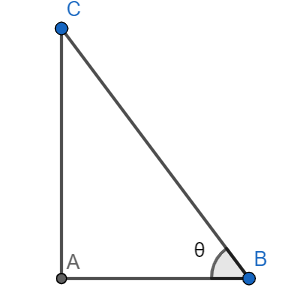
In the given figure ABC is a right-angled triangle right-angled at A
$\angle B=\theta $
Now we know that, from the property of a triangle, Sum of the angles of a triangle is
$\angle A+\angle B+\angle C=180$
Substituting the value of $\angle A$ and $\angle B$ we get
\[\begin{align}
& 90{}^\circ +\theta +\angle C=180{}^\circ \\
& \Rightarrow \angle C=180{}^\circ -90{}^\circ -\theta \\
& \Rightarrow \angle C=90{}^\circ -\theta \\
\end{align}\]
Now $\tan C=\dfrac{AB}{AC}$ and $\tan B=\dfrac{AC}{AB}$
Hence $\tan C\tan B=\dfrac{AB}{AC}\times \dfrac{AC}{AB}=1$
Hence $\tan C=\dfrac{1}{\tan B}=\cot B$
Put the value of C and B, we get
$\tan \left( 90{}^\circ -\theta \right)=\cot \theta $
Hence option [d] is correct.
Note:
[1] sin(90-x) = cosx
[2] cos(90-x) = sinx
[3] tan(90-x) = cotx
[4] cot(90-x) = tanx
[5] sec(90-x) = cosecx
[6] cosec(90-x) = secx
Complete step-by-step answer:
Trigonometric ratios:
There are six trigonometric ratios defined on an angle of a right-angled triangle, viz sine, cosine, tangent, cotangent, secant and cosecant.
The sine of an angle is defined as the ratio of the opposite side to the hypotenuse.
The cosine of an angle is defined as the ratio of the adjacent side to the hypotenuse.
The tangent of an angle is defined as the ratio of the opposite side to the adjacent side.
The cotangent of an angle is defined as the ratio of the adjacent side to the opposite side.
The secant of an angle is defined as the ratio of the hypotenuse to the adjacent side.
The cosecant of an angle is defined as the ratio of the hypotenuse to the adjacent side.
Observe that sine and cosecant are multiplicative inverses of each other, cosine and secant are multiplicative inverses of each other, and tangent and cotangent are multiplicative inverses of each other.
In the given figure ABC is a right-angled triangle right-angled at A
$\angle B=\theta $
Now we know that, from the property of a triangle, Sum of the angles of a triangle is
$\angle A+\angle B+\angle C=180$
Substituting the value of $\angle A$ and $\angle B$ we get
\[\begin{align}
& 90{}^\circ +\theta +\angle C=180{}^\circ \\
& \Rightarrow \angle C=180{}^\circ -90{}^\circ -\theta \\
& \Rightarrow \angle C=90{}^\circ -\theta \\
\end{align}\]
Now $\tan C=\dfrac{AB}{AC}$ and $\tan B=\dfrac{AC}{AB}$
Hence $\tan C\tan B=\dfrac{AB}{AC}\times \dfrac{AC}{AB}=1$
Hence $\tan C=\dfrac{1}{\tan B}=\cot B$
Put the value of C and B, we get
$\tan \left( 90{}^\circ -\theta \right)=\cot \theta $
Hence option [d] is correct.
Note:
[1] sin(90-x) = cosx
[2] cos(90-x) = sinx
[3] tan(90-x) = cotx
[4] cot(90-x) = tanx
[5] sec(90-x) = cosecx
[6] cosec(90-x) = secx

Recently Updated Pages
Basicity of sulphurous acid and sulphuric acid are

Master Class 7 Social Science: Engaging Questions & Answers for Success
Master Class 7 Science: Engaging Questions & Answers for Success
Master Class 7 Maths: Engaging Questions & Answers for Success
Class 7 Question and Answer - Your Ultimate Solutions Guide
Master Class 11 Business Studies: Engaging Questions & Answers for Success
Trending doubts
Convert 200 Million dollars in rupees class 7 maths CBSE
What were the major teachings of Baba Guru Nanak class 7 social science CBSE
What are the main characteristics of mineral resou class 7 social science CBSE
Aeroplanes fly in which of the following layers of class 7 social science CBSE
Write a letter to the editor of the national daily class 7 english CBSE
What are the controls affecting the climate of Ind class 7 social science CBSE