




Find the value of $\tan {{60}^{\circ }}$ geometrically.
A). $\sqrt{5}$
B). $\sqrt{3}$
C). $-\sqrt{3}$
D). $\sqrt{2}$
Answer
 Verified
615k+ views
Hint: In this question, we have to find the tangent of ${{60}^{\circ }}$. Therefore, we should try to construct an appropriate figure from which we can find out the tangent of ${{60}^{\circ }}$from its definition.
Complete step-by-step solution
Let the figure below represent an equilateral triangle CBD with each side equal to 1cm and let CA represent the perpendicular from C to BD. As the triangle is equilateral, $\angle CBD=\angle CDB=\angle BCD={{60}^{\circ }}$……………..(1.1)
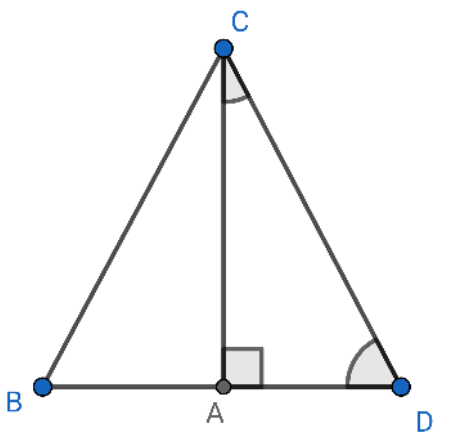
We should note that by RHS criterion, two right angled triangles are said to be congruent ($\cong $) if the length of the hypotenuse and one side is equal in both the triangles…………………………….. (1.2)
In $\Delta CBA$ and $\Delta CDA$, we find that
$\angle CAD=\angle CAB={{90}^{\circ }}$
$\angle CBA=\angle CDA={{60}^{\circ }}$
$CB=CD\text{ (as }\Delta \text{CBD is equilateral)}$
Therefore, by the RHS criterion stated in equation (1.2), $\Delta CBA\cong \Delta CDA........................(1.3)$
Now, the corresponding sides in congruent triangles are equal. Therefore, from equation (1.3), as the triangles are congruent
$BA=AD.....................(1.4)$
Therefore, as $\Delta CBD$ is equilateral of side length 1cm and from equation (1.4), we get
$\begin{align}
& BD=BA+AD=2BA=1cm \\
& \Rightarrow BA=AD=\dfrac{1}{2}cm........................(1.5) \\
\end{align}$
Also, as $\Delta CAD$ is an equilateral triangle, by Pythagoras theorem,
\[\begin{align}
& \text{hypotenuse}{{\text{e}}^{2}}\text{=Sum of square of sides} \\
& \Rightarrow \text{C}{{\text{D}}^{2}}=\text{C}{{\text{A}}^{2}}+A{{\text{D}}^{2}} \\
& \Rightarrow CA=\sqrt{C{{D}^{2}}-A{{D}^{2}}}=\sqrt{1-{{\left( \dfrac{1}{2} \right)}^{2}}}=\sqrt{\dfrac{3}{4}}..................(1.6) \\
\end{align}\]
Now, tangent of an angle in a right-angled triangle is given by
$\tan \left( \theta \right)=\dfrac{\text{length of the side facing angle }\theta }{\text{length of the side adjacent to angle }\theta }.....................(1.7)$
Therefore, using equation (1.5) in $\Delta CAD$, as $\angle CDA={{60}^{\circ }}$ from equation (1.1), (1.6) and (1.7), we get
$\tan (\theta )=\dfrac{CA}{AD}=\dfrac{\sqrt{\dfrac{3}{4}}}{\dfrac{1}{2}}=2\times \dfrac{\sqrt{3}}{2}=\sqrt{3}$
Thus, the value of $\tan ({{60}^{\circ }})$ is found geometrically to be $\sqrt{3}$. Thus, option (b) is the correct answer.
Note: In the above problem, we have shown the value of $\tan {{60}^{\circ }}$ as $\sqrt{3}$ geometrically but as you can see that it is a multiple-choice question so if you remember the value of $\tan {{60}^{\circ }}$ then you don’t have to solve it geometrically. The point to be noted that you should know the sine, cosine, tangent of the following angles: ${{0}^{\circ }},{{30}^{\circ }},{{45}^{\circ }},{{60}^{\circ }},{{90}^{\circ }}$. It will help you in solving various trigonometric questions.
In this problem also, if you would have known that $\tan {{60}^{\circ }}$ is equal to $\sqrt{3}$ then in the final answer when you are solving it geometrically if you are not getting $\sqrt{3}$ then you know that you have made a mistake.
Complete step-by-step solution
Let the figure below represent an equilateral triangle CBD with each side equal to 1cm and let CA represent the perpendicular from C to BD. As the triangle is equilateral, $\angle CBD=\angle CDB=\angle BCD={{60}^{\circ }}$……………..(1.1)
We should note that by RHS criterion, two right angled triangles are said to be congruent ($\cong $) if the length of the hypotenuse and one side is equal in both the triangles…………………………….. (1.2)
In $\Delta CBA$ and $\Delta CDA$, we find that
$\angle CAD=\angle CAB={{90}^{\circ }}$
$\angle CBA=\angle CDA={{60}^{\circ }}$
$CB=CD\text{ (as }\Delta \text{CBD is equilateral)}$
Therefore, by the RHS criterion stated in equation (1.2), $\Delta CBA\cong \Delta CDA........................(1.3)$
Now, the corresponding sides in congruent triangles are equal. Therefore, from equation (1.3), as the triangles are congruent
$BA=AD.....................(1.4)$
Therefore, as $\Delta CBD$ is equilateral of side length 1cm and from equation (1.4), we get
$\begin{align}
& BD=BA+AD=2BA=1cm \\
& \Rightarrow BA=AD=\dfrac{1}{2}cm........................(1.5) \\
\end{align}$
Also, as $\Delta CAD$ is an equilateral triangle, by Pythagoras theorem,
\[\begin{align}
& \text{hypotenuse}{{\text{e}}^{2}}\text{=Sum of square of sides} \\
& \Rightarrow \text{C}{{\text{D}}^{2}}=\text{C}{{\text{A}}^{2}}+A{{\text{D}}^{2}} \\
& \Rightarrow CA=\sqrt{C{{D}^{2}}-A{{D}^{2}}}=\sqrt{1-{{\left( \dfrac{1}{2} \right)}^{2}}}=\sqrt{\dfrac{3}{4}}..................(1.6) \\
\end{align}\]
Now, tangent of an angle in a right-angled triangle is given by
$\tan \left( \theta \right)=\dfrac{\text{length of the side facing angle }\theta }{\text{length of the side adjacent to angle }\theta }.....................(1.7)$
Therefore, using equation (1.5) in $\Delta CAD$, as $\angle CDA={{60}^{\circ }}$ from equation (1.1), (1.6) and (1.7), we get
$\tan (\theta )=\dfrac{CA}{AD}=\dfrac{\sqrt{\dfrac{3}{4}}}{\dfrac{1}{2}}=2\times \dfrac{\sqrt{3}}{2}=\sqrt{3}$
Thus, the value of $\tan ({{60}^{\circ }})$ is found geometrically to be $\sqrt{3}$. Thus, option (b) is the correct answer.
Note: In the above problem, we have shown the value of $\tan {{60}^{\circ }}$ as $\sqrt{3}$ geometrically but as you can see that it is a multiple-choice question so if you remember the value of $\tan {{60}^{\circ }}$ then you don’t have to solve it geometrically. The point to be noted that you should know the sine, cosine, tangent of the following angles: ${{0}^{\circ }},{{30}^{\circ }},{{45}^{\circ }},{{60}^{\circ }},{{90}^{\circ }}$. It will help you in solving various trigonometric questions.
In this problem also, if you would have known that $\tan {{60}^{\circ }}$ is equal to $\sqrt{3}$ then in the final answer when you are solving it geometrically if you are not getting $\sqrt{3}$ then you know that you have made a mistake.
Recently Updated Pages
Master Class 11 English: Engaging Questions & Answers for Success

Master Class 11 Social Science: Engaging Questions & Answers for Success
Master Class 11 Maths: Engaging Questions & Answers for Success
Master Class 11 Biology: Engaging Questions & Answers for Success
Master Class 11 Physics: Engaging Questions & Answers for Success
Master Class 11 Chemistry: Engaging Questions & Answers for Success
Trending doubts
Explain the Treaty of Vienna of 1815 class 10 social science CBSE
What is the full form of CNG A Complete Natural Gas class 10 social science CBSE
In cricket, what is a "Yorker" designed to do?
What is the full form of POSCO class 10 social science CBSE
Define Potential, Developed, Stock and Reserved resources
What were the majoritarian measures taken in Sri Lanka class 10 social science CBSE