




Find the value of $\sqrt7$ up to six decimal places.
Answer
 Verified
630.9k+ views
Hint: To determine the square root of a number we can either use the long division method or the prime factorisation method. As here in the question we are asked to find the root of 7 to six decimal places, long division method would be a wise choice.
Complete step-by-step answer:
For numbers like $7$ where it is difficult to find the factors, we use the division method for finding the root. First, we make a pair of digits starting from the unit place. Then we need to find the largest perfect square smaller than the number formed by the pair of digits appearing first from the right.
$2\overset{2}{\overline{\left){\begin{align}
& 7 \\
& \underline{\text{4 }} \\
& 3 \\
\end{align}}\right.}}$
Now double the quotient you got in the first step and make it the tenth place of a number, now find a unit place to the number such that the number into its unit place is equal to or closest to the number you obtained as the remainder of the previous steps. Also, make the unit digit of the number, the unit digit of the quotient as well. Repeat the steps till you get the remainder zero. However, if you introduce a decimal point to the quotient, unlike normal division instead of one zero, pair of zeroes are introduced at the end of the remainder of the previous step.
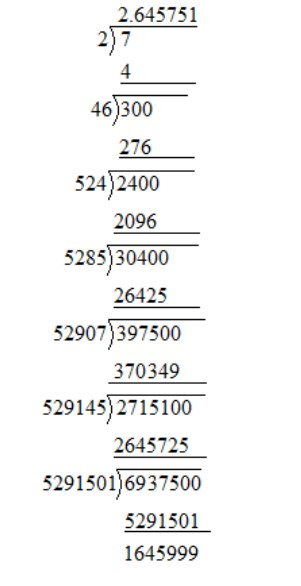
Therefore, the root of 7 is 2.645751, correct up to six decimal places.
Note: While calculating square roots and cube roots, prime factorization is the easiest method. But it takes time and difficult to use for the questions where the square roots are not integers. Hence, other methods should also be learnt, so that they can be used while solving problems in cases where time plays an important role.
Complete step-by-step answer:
For numbers like $7$ where it is difficult to find the factors, we use the division method for finding the root. First, we make a pair of digits starting from the unit place. Then we need to find the largest perfect square smaller than the number formed by the pair of digits appearing first from the right.
$2\overset{2}{\overline{\left){\begin{align}
& 7 \\
& \underline{\text{4 }} \\
& 3 \\
\end{align}}\right.}}$
Now double the quotient you got in the first step and make it the tenth place of a number, now find a unit place to the number such that the number into its unit place is equal to or closest to the number you obtained as the remainder of the previous steps. Also, make the unit digit of the number, the unit digit of the quotient as well. Repeat the steps till you get the remainder zero. However, if you introduce a decimal point to the quotient, unlike normal division instead of one zero, pair of zeroes are introduced at the end of the remainder of the previous step.
Therefore, the root of 7 is 2.645751, correct up to six decimal places.
Note: While calculating square roots and cube roots, prime factorization is the easiest method. But it takes time and difficult to use for the questions where the square roots are not integers. Hence, other methods should also be learnt, so that they can be used while solving problems in cases where time plays an important role.
Recently Updated Pages
Master Class 11 English: Engaging Questions & Answers for Success

Master Class 11 Maths: Engaging Questions & Answers for Success
Class 11 Question and Answer - Your Ultimate Solutions Guide
Master Class 11 Biology: Engaging Questions & Answers for Success
Master Class 11 Physics: Engaging Questions & Answers for Success
Master Class 11 Accountancy: Engaging Questions & Answers for Success
Trending doubts
Explain the Treaty of Vienna of 1815 class 10 social science CBSE
Who Won 36 Oscar Awards? Record Holder Revealed
What is the median of the first 10 natural numbers class 10 maths CBSE
Why is it 530 pm in india when it is 1200 afternoon class 10 social science CBSE
Why is there a time difference of about 5 hours between class 10 social science CBSE
What is the full form of POSCO class 10 social science CBSE