




Find the value of $\sin \left( \dfrac{x}{2} \right)$ , $\cos \left( \dfrac{x}{2} \right)$ and $\tan \left( \dfrac{x}{2} \right)$ if $\tan \left( x \right)=\dfrac{-4}{3}$ And x is in the second quadrant.
Answer
 Verified
633k+ views
Hint: In this question, we are given the value of tangent of x of the angle and the quadrant in which the angle x lies. Therefore, using the definition of $\tan \left( \dfrac{x}{2} \right)$ , and other trigonometric formulas, we can obtain the values of $\sin \left( \dfrac{x}{2} \right)$ , $\cos \left( \dfrac{x}{2} \right)$ and $\tan \left( \dfrac{x}{2} \right)$ by solving the corresponding trigonometric equations.
Complete step-by-step solution -
In this given question, we are asked to find the value of $\sin \left( \dfrac{x}{2} \right)$ , $\cos \left( \dfrac{x}{2} \right)$ and $\tan \left( \dfrac{x}{2} \right)$ if
$\tan \left( x \right)=\dfrac{-4}{3}$ And x is in the second quadrant.
We know that the formula for finding the tangent of twice an angle is given by
$\tan \left( 2a \right)=\dfrac{2\tan a}{1-{{\tan }^{2}}a}................................(1.1)$
Now, x can be written as $2\times \dfrac{x}{2}$ .
So, putting $2\times \dfrac{x}{2}$ in place of a in equation 1.1, we get,
$\begin{align}
& \tan \left( 2\times \dfrac{x}{2} \right)=\dfrac{2\tan \left( \dfrac{x}{2} \right)}{1-{{\tan }^{2}}\left( \dfrac{x}{2} \right)} \\
& \Rightarrow \tan \left( x \right)=\dfrac{2\tan \left( \dfrac{x}{2} \right)}{1-{{\tan }^{2}}\left( \dfrac{x}{2} \right)}..........(1.2) \\
\end{align}$
Now, putting $\tan \left( x \right)=\dfrac{-4}{3}$ in equation 1.2, we get,
\[\begin{align}
& \tan \left( x \right)=\dfrac{2\tan \left( \dfrac{x}{2} \right)}{1-{{\tan }^{2}}\left( \dfrac{x}{2} \right)} \\
& \Rightarrow \dfrac{-4}{3}=\dfrac{2\tan \left( \dfrac{x}{2} \right)}{1-{{\tan }^{2}}\left( \dfrac{x}{2} \right)} \\
& \Rightarrow \dfrac{-4}{3}\left[ 1-{{\tan }^{2}}\left( \dfrac{x}{2} \right) \right]=2\tan \left( \dfrac{x}{2} \right) \\
& \Rightarrow \dfrac{-4}{3}+\dfrac{4}{3}{{\tan }^{2}}\left( \dfrac{x}{2} \right)-2\tan \left( \dfrac{x}{2} \right)=0 \\
& \Rightarrow \dfrac{4}{3}{{\tan }^{2}}\left( \dfrac{x}{2} \right)-2\tan \left( \dfrac{x}{2} \right)-\dfrac{4}{3}=0...........(1.3) \\
\end{align}\]
Multiplying both sides by 3 and then simplifying for $\tan \left( \dfrac{x}{2} \right)$ , we get,
$\begin{align}
& \left( \dfrac{4}{3}{{\tan }^{2}}\left( \dfrac{x}{2} \right)-2\tan \left( \dfrac{x}{2} \right)-\dfrac{4}{3} \right)\times 3=0\times 3 \\
& \Rightarrow 4{{\tan }^{2}}\left( \dfrac{x}{2} \right)-6\tan \left( \dfrac{x}{2} \right)-4=0 \\
& \Rightarrow \left( \tan \left( \dfrac{x}{2} \right)+\dfrac{1}{2} \right)\times \left( \tan \left( \dfrac{x}{2} \right)-2 \right)=0 \\
& \Rightarrow \tan \left( \dfrac{x}{2} \right)=-\dfrac{1}{2}\text{ or }2..........(1.4) \\
\end{align}$
As x is in the second quadrant, tan x should be negative as shown in the figure below. So, the value of \[tan\left( x \right)\] is $-\dfrac{1}{2}$ .
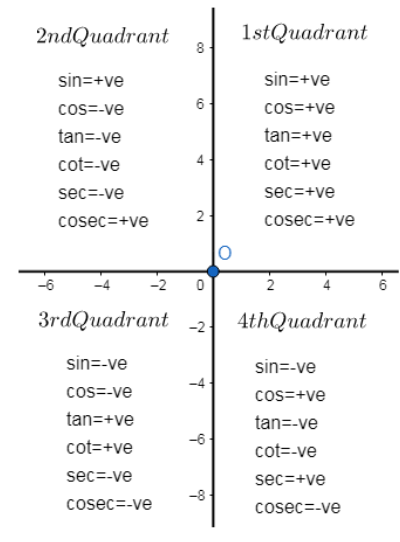
Now, we know that ${{\sec }^{2}}x=1+{{\tan }^{2}}x$ , so using this, we get,
${{\sec }^{2}}\left( \dfrac{x}{2} \right)=1+{{\tan }^{2}}\left( \dfrac{x}{2} \right)...........(1.5)$
Putting the value obtained in 1.4 in 1.5, and taking square roots of both the sides we get,
$\begin{align}
& {{\sec }^{2}}\left( \dfrac{x}{2} \right)=\dfrac{5}{4} \\
& \Rightarrow \text{sec}\left( \dfrac{x}{2} \right)=\pm \dfrac{\sqrt{5}}{2}............\text{(1}\text{.6)} \\
\end{align}$
As, x is in second quadrant, \[sec\left( x \right)\] is negative so \[sec\left( x \right)\] is equal to $-\dfrac{\sqrt{5}}{2}$
Now, \[\begin{align}
& \sec \left( \dfrac{x}{2} \right)=\dfrac{1}{\cos \left( \dfrac{x}{2} \right)} \\
& \Rightarrow \cos \left( \dfrac{x}{2} \right)=\dfrac{1}{\sec \left( \dfrac{x}{2} \right)} \\
\end{align}\]
So, we get the values of \[\cos \left( \dfrac{x}{2} \right)\] as \[-\dfrac{2}{\sqrt{5}}\] .
Now, \[\begin{align}
& \tan \left( \dfrac{x}{2} \right)=\dfrac{\sin \left( \dfrac{x}{2} \right)}{\cos \left( \dfrac{x}{2} \right)} \\
& \Rightarrow \sin \left( \dfrac{x}{2} \right)=\tan \left( \dfrac{x}{2} \right)\times \cos \left( \dfrac{x}{2} \right) \\
& \Rightarrow \sin \left( \dfrac{x}{2} \right)=\left( -\dfrac{1}{2} \right)\times \left( -\dfrac{2}{\sqrt{5}} \right) \\
& \Rightarrow \sin \left( \dfrac{x}{2} \right)=\dfrac{1}{\sqrt{5}}............(1.7) \\
\end{align}\]
Using equation 1.7, we get the value of $\sin \left( \dfrac{x}{2} \right)$ as $\dfrac{1}{\sqrt{5}}$ .
Hence, we have got all our answer as the values of$\sin \left( \dfrac{x}{2} \right)$ , $\cos \left( \dfrac{x}{2} \right)$ and $\tan \left( \dfrac{x}{2} \right)$ as $\dfrac{1}{\sqrt{5}}$, \[-\dfrac{2}{\sqrt{5}}\] and $-\dfrac{1}{2}$.
Note: We could also have found \[tan\left( x \right)\] by using $\tan (x)=\dfrac{1}{\cot (x)}$ and then \[sec\left( x \right)\] from \[tan\left( x \right)\]by using the identity ${{\sec }^{2}}\left( x \right)=1+{{\tan }^{2}}\left( x \right)$ and from there we could have found \[sin\left( x \right)\] and\[cos\left( x \right)\] . However, the answer would have remained the same as found out in the solution above.
Complete step-by-step solution -
In this given question, we are asked to find the value of $\sin \left( \dfrac{x}{2} \right)$ , $\cos \left( \dfrac{x}{2} \right)$ and $\tan \left( \dfrac{x}{2} \right)$ if
$\tan \left( x \right)=\dfrac{-4}{3}$ And x is in the second quadrant.
We know that the formula for finding the tangent of twice an angle is given by
$\tan \left( 2a \right)=\dfrac{2\tan a}{1-{{\tan }^{2}}a}................................(1.1)$
Now, x can be written as $2\times \dfrac{x}{2}$ .
So, putting $2\times \dfrac{x}{2}$ in place of a in equation 1.1, we get,
$\begin{align}
& \tan \left( 2\times \dfrac{x}{2} \right)=\dfrac{2\tan \left( \dfrac{x}{2} \right)}{1-{{\tan }^{2}}\left( \dfrac{x}{2} \right)} \\
& \Rightarrow \tan \left( x \right)=\dfrac{2\tan \left( \dfrac{x}{2} \right)}{1-{{\tan }^{2}}\left( \dfrac{x}{2} \right)}..........(1.2) \\
\end{align}$
Now, putting $\tan \left( x \right)=\dfrac{-4}{3}$ in equation 1.2, we get,
\[\begin{align}
& \tan \left( x \right)=\dfrac{2\tan \left( \dfrac{x}{2} \right)}{1-{{\tan }^{2}}\left( \dfrac{x}{2} \right)} \\
& \Rightarrow \dfrac{-4}{3}=\dfrac{2\tan \left( \dfrac{x}{2} \right)}{1-{{\tan }^{2}}\left( \dfrac{x}{2} \right)} \\
& \Rightarrow \dfrac{-4}{3}\left[ 1-{{\tan }^{2}}\left( \dfrac{x}{2} \right) \right]=2\tan \left( \dfrac{x}{2} \right) \\
& \Rightarrow \dfrac{-4}{3}+\dfrac{4}{3}{{\tan }^{2}}\left( \dfrac{x}{2} \right)-2\tan \left( \dfrac{x}{2} \right)=0 \\
& \Rightarrow \dfrac{4}{3}{{\tan }^{2}}\left( \dfrac{x}{2} \right)-2\tan \left( \dfrac{x}{2} \right)-\dfrac{4}{3}=0...........(1.3) \\
\end{align}\]
Multiplying both sides by 3 and then simplifying for $\tan \left( \dfrac{x}{2} \right)$ , we get,
$\begin{align}
& \left( \dfrac{4}{3}{{\tan }^{2}}\left( \dfrac{x}{2} \right)-2\tan \left( \dfrac{x}{2} \right)-\dfrac{4}{3} \right)\times 3=0\times 3 \\
& \Rightarrow 4{{\tan }^{2}}\left( \dfrac{x}{2} \right)-6\tan \left( \dfrac{x}{2} \right)-4=0 \\
& \Rightarrow \left( \tan \left( \dfrac{x}{2} \right)+\dfrac{1}{2} \right)\times \left( \tan \left( \dfrac{x}{2} \right)-2 \right)=0 \\
& \Rightarrow \tan \left( \dfrac{x}{2} \right)=-\dfrac{1}{2}\text{ or }2..........(1.4) \\
\end{align}$
As x is in the second quadrant, tan x should be negative as shown in the figure below. So, the value of \[tan\left( x \right)\] is $-\dfrac{1}{2}$ .
Now, we know that ${{\sec }^{2}}x=1+{{\tan }^{2}}x$ , so using this, we get,
${{\sec }^{2}}\left( \dfrac{x}{2} \right)=1+{{\tan }^{2}}\left( \dfrac{x}{2} \right)...........(1.5)$
Putting the value obtained in 1.4 in 1.5, and taking square roots of both the sides we get,
$\begin{align}
& {{\sec }^{2}}\left( \dfrac{x}{2} \right)=\dfrac{5}{4} \\
& \Rightarrow \text{sec}\left( \dfrac{x}{2} \right)=\pm \dfrac{\sqrt{5}}{2}............\text{(1}\text{.6)} \\
\end{align}$
As, x is in second quadrant, \[sec\left( x \right)\] is negative so \[sec\left( x \right)\] is equal to $-\dfrac{\sqrt{5}}{2}$
Now, \[\begin{align}
& \sec \left( \dfrac{x}{2} \right)=\dfrac{1}{\cos \left( \dfrac{x}{2} \right)} \\
& \Rightarrow \cos \left( \dfrac{x}{2} \right)=\dfrac{1}{\sec \left( \dfrac{x}{2} \right)} \\
\end{align}\]
So, we get the values of \[\cos \left( \dfrac{x}{2} \right)\] as \[-\dfrac{2}{\sqrt{5}}\] .
Now, \[\begin{align}
& \tan \left( \dfrac{x}{2} \right)=\dfrac{\sin \left( \dfrac{x}{2} \right)}{\cos \left( \dfrac{x}{2} \right)} \\
& \Rightarrow \sin \left( \dfrac{x}{2} \right)=\tan \left( \dfrac{x}{2} \right)\times \cos \left( \dfrac{x}{2} \right) \\
& \Rightarrow \sin \left( \dfrac{x}{2} \right)=\left( -\dfrac{1}{2} \right)\times \left( -\dfrac{2}{\sqrt{5}} \right) \\
& \Rightarrow \sin \left( \dfrac{x}{2} \right)=\dfrac{1}{\sqrt{5}}............(1.7) \\
\end{align}\]
Using equation 1.7, we get the value of $\sin \left( \dfrac{x}{2} \right)$ as $\dfrac{1}{\sqrt{5}}$ .
Hence, we have got all our answer as the values of$\sin \left( \dfrac{x}{2} \right)$ , $\cos \left( \dfrac{x}{2} \right)$ and $\tan \left( \dfrac{x}{2} \right)$ as $\dfrac{1}{\sqrt{5}}$, \[-\dfrac{2}{\sqrt{5}}\] and $-\dfrac{1}{2}$.
Note: We could also have found \[tan\left( x \right)\] by using $\tan (x)=\dfrac{1}{\cot (x)}$ and then \[sec\left( x \right)\] from \[tan\left( x \right)\]by using the identity ${{\sec }^{2}}\left( x \right)=1+{{\tan }^{2}}\left( x \right)$ and from there we could have found \[sin\left( x \right)\] and\[cos\left( x \right)\] . However, the answer would have remained the same as found out in the solution above.
Recently Updated Pages
Master Class 12 Economics: Engaging Questions & Answers for Success

Master Class 12 English: Engaging Questions & Answers for Success
Master Class 12 Social Science: Engaging Questions & Answers for Success
Master Class 12 Maths: Engaging Questions & Answers for Success
Master Class 12 Physics: Engaging Questions & Answers for Success
Master Class 9 General Knowledge: Engaging Questions & Answers for Success
Trending doubts
Explain the Treaty of Vienna of 1815 class 10 social science CBSE
Why is it 530 pm in india when it is 1200 afternoon class 10 social science CBSE
What is the full form of POSCO class 10 social science CBSE
Define Potential, Developed, Stock and Reserved resources
Which Country Has the Largest Border with India?
Complete the sentence with the most appropriate word class 10 english CBSE