




Find the value of p(0), p(1) and p(2) where p(t) is given by
$p\left( t \right)=2+t+2{{t}^{2}}-{{t}^{3}}$
Answer
 Verified
644.1k+ views
Hint: p(a) can be calculated by substituting x = a in the expression of p(x). Hence substitute t = 0, 1, 2 successively in the expression of p(t) to get the value of p(0), p(1) and p(2) respectively.
Complete step-by-step answer:
Alternatively, use synthetic division to get the value of p(0), p(1) and p(2).
Calculating p(0):
We have $p\left( t \right)=2+t+2{{t}^{2}}-{{t}^{3}}$
Substituting t= 0 in the expression of p(t), we get
$p\left( 0 \right)=2+0+2{{\left( 0 \right)}^{2}}-{{0}^{3}}=2+0+0-0=2$
Hence, we have p(0) = 2.
Calculating p(1):
We have $p\left( t \right)=2+t+2{{t}^{2}}-{{t}^{3}}$
Substituting t= 1 in the expression of p(t), we get
$p\left( 1 \right)=2+1+2{{\left( 1 \right)}^{2}}-{{1}^{3}}=2+1+2-1=4$
Hence, we have p(1) = 4.
Calculating p(2):
We have $p\left( t \right)=2+t+2{{t}^{2}}-{{t}^{3}}$
Substituting t= 2 in the expression of p(t), we get
$p\left( 2 \right)=2+2+2{{\left( 2 \right)}^{2}}-{{2}^{3}}=2+2+8-8=4$
Hence, we have p(2) = 4.
Note: Alternative method: Synthetic division: Best method.
In this method, we start by writing coefficients of the polynomial in order from the highest degree to the constant term. If in between some degree terms are missing we set their coefficient as 0.
Hence $p\left( t \right)=2+t+2{{t}^{2}}-{{t}^{3}}=-{{t}^{3}}+2{{t}^{2}}+t+2$ will be written as
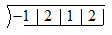
Now each the point which has to be substituted(say x= 0) is written as follows
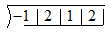
0 is placed below the first term
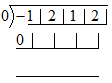
Now the terms under the same column are added. The sum is then multiplied with the root, and the product is written under the coefficient of the next term.
Hence, we have
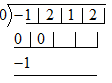
Continuing in this way we have the following
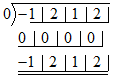
Since the last sum is 2, we have $p\left( 0 \right)=2$. This method also tells you what the quotient will be when p(t) is divided by t-0. Here it will be $-1\left( {{t}^{2}} \right)+2\left( t \right)+1=-{{t}^{2}}+2t+1$
Similarly creating tables for t = 1 and t = 2, we get
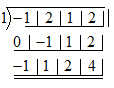
Since the last sum is 4, we have $p\left( 1 \right)=4$
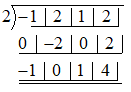
Since the last sum is 4, we have $p\left( 2 \right)=4$
Complete step-by-step answer:
Alternatively, use synthetic division to get the value of p(0), p(1) and p(2).
Calculating p(0):
We have $p\left( t \right)=2+t+2{{t}^{2}}-{{t}^{3}}$
Substituting t= 0 in the expression of p(t), we get
$p\left( 0 \right)=2+0+2{{\left( 0 \right)}^{2}}-{{0}^{3}}=2+0+0-0=2$
Hence, we have p(0) = 2.
Calculating p(1):
We have $p\left( t \right)=2+t+2{{t}^{2}}-{{t}^{3}}$
Substituting t= 1 in the expression of p(t), we get
$p\left( 1 \right)=2+1+2{{\left( 1 \right)}^{2}}-{{1}^{3}}=2+1+2-1=4$
Hence, we have p(1) = 4.
Calculating p(2):
We have $p\left( t \right)=2+t+2{{t}^{2}}-{{t}^{3}}$
Substituting t= 2 in the expression of p(t), we get
$p\left( 2 \right)=2+2+2{{\left( 2 \right)}^{2}}-{{2}^{3}}=2+2+8-8=4$
Hence, we have p(2) = 4.
Note: Alternative method: Synthetic division: Best method.
In this method, we start by writing coefficients of the polynomial in order from the highest degree to the constant term. If in between some degree terms are missing we set their coefficient as 0.
Hence $p\left( t \right)=2+t+2{{t}^{2}}-{{t}^{3}}=-{{t}^{3}}+2{{t}^{2}}+t+2$ will be written as
Now each the point which has to be substituted(say x= 0) is written as follows
0 is placed below the first term
Now the terms under the same column are added. The sum is then multiplied with the root, and the product is written under the coefficient of the next term.
Hence, we have
Continuing in this way we have the following
Since the last sum is 2, we have $p\left( 0 \right)=2$. This method also tells you what the quotient will be when p(t) is divided by t-0. Here it will be $-1\left( {{t}^{2}} \right)+2\left( t \right)+1=-{{t}^{2}}+2t+1$
Similarly creating tables for t = 1 and t = 2, we get
Since the last sum is 4, we have $p\left( 1 \right)=4$
Since the last sum is 4, we have $p\left( 2 \right)=4$
Recently Updated Pages
Master Class 11 English: Engaging Questions & Answers for Success

Master Class 11 Social Science: Engaging Questions & Answers for Success
Master Class 11 Maths: Engaging Questions & Answers for Success
Master Class 11 Biology: Engaging Questions & Answers for Success
Master Class 11 Physics: Engaging Questions & Answers for Success
Master Class 11 Chemistry: Engaging Questions & Answers for Success
Trending doubts
In which year voting age was reduced from 21 to 18?
What planets have no moons Which one has only one moon class 10 physics CBSE
In football, what is a hat-trick?
In football, which nation is called "La Roja"?
Draw a labelled diagram of the excretory system of class 10 biology CBSE
Identify the feminine form of the word Duke a Dukes class 10 english CBSE